• HOME
  • NEWS
  • EXPLORE
    • CAREER
      • Companies
      • Jobs
    • EVENTS
    • iGEM
      • News
      • Team
    • PHOTOS
    • VIDEO
    • WIKI
  • BLOG
  • COMMUNITY
    • FACEBOOK
    • INSTAGRAM
    • TWITTER
Monday, October 26, 2026
BIOENGINEER.ORG
No Result
View All Result
  • Login
  • HOME
  • NEWS
  • EXPLORE
    • CAREER
      • Companies
      • Jobs
        • Lecturer
        • PhD Studentship
        • Postdoc
        • Research Assistant
    • EVENTS
    • iGEM
      • News
      • Team
    • PHOTOS
    • VIDEO
    • WIKI
  • BLOG
  • COMMUNITY
    • FACEBOOK
    • INSTAGRAM
    • TWITTER
No Result
View All Result
Bioengineer.org
No Result
View All Result
Home NEWS Science News Technology

Kinematic Model Tests Ductile-Hinge Layouts for Curved Bridge Launching

by
October 26, 2026
in Technology
Reading Time: 2 mins read
0
Kinematic Model Tests Ductile-Hinge Layouts for Curved Bridge Launching

Kinematic Model Tests Ductile-Hinge Layouts for Curved Bridge Launching

Share on FacebookShare on TwitterShare on LinkedinShare on RedditShare on Telegram

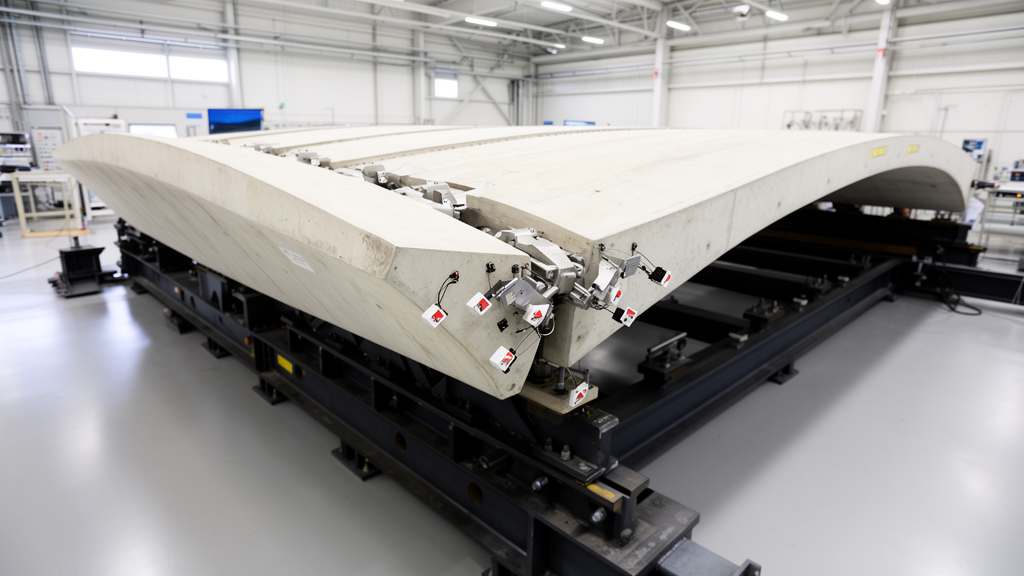
A geometric-kinematic modeling study combined with a dual-strategy heuristic screening method to evaluate ductile-hinge layouts for multi-body coordinated incremental launching of spatially curved bridges. The work focused on a 1,991-metre steel box-girder viaduct weighing 36,000 tonnes, a construction arrangement intended for bridge projects where site constraints limit conventional launching conditions.

The framework represents bridge segments as composite rigid bodies and updates their positions through chainage-based boundary lookup. Spatial posture is calculated with a safeguarded endpoint-based Rodrigues transformation, allowing the model to track how the coordinated system changes as the launching sequence proceeds. The study presents the approach as a quantitative pre-construction tool rather than as a field demonstration.

To screen potential hinge arrangements, the researchers combined a proximity rule for detecting lateral-deviation exceedances with a global assessment of candidates associated with height-difference exceedances. The heuristic was designed to identify feasible layouts with fewer ductile hinges. In the reported case, one simulation containing 772 states took approximately 14 seconds, illustrating the computational efficiency sought by the model.

For the example viaduct, adding five hinges reduced the maximum lateral deviation from 2.997 metres to 0.911 metres. The maximum height difference fell from 1.727 metres to 0.586 metres. Internal geometric checks and convergence checks supported the numerical consistency of the simulations, while the fixed-layout test found that the selected arrangement remained within the stated 1.0-metre lateral-deviation and 0.8-metre height-difference constraints across 100 simulations with independent 10-millimetre coordinate perturbations.

These results show how a kinematic simulation can be linked to hinge-layout screening in an incremental-launching process for bridges with spatially variable curvature. The study does not establish performance in completed bridge projects, and the reported evidence is limited to modeling, numerical checks and perturbation simulations. Its contribution is a computational method for comparing layouts and quantifying changes in geometric deviations before construction, with the authors describing the approach as a design tool for multi-body coordinated incremental launching of spatially curved bridges.

Subject of Research: Computational screening of ductile-hinge layouts for spatially curved bridge launching

Article Title: Kinematic modeling and dual-strategy heuristic screening of ductile hinge layout for multi-body coordinated incremental launching of spatial curve bridges

Article References: Zhang, X., Xiao, L., Li, M., Chen, L., Wang, M., Zheng, H., & Zhu, H. (2026). Kinematic modeling and dual-strategy heuristic screening of ductile hinge layout for multi-body coordinated incremental launching of spatial curve bridges. Scientific Reports. https://doi.org/10.1038/s41598-026-76812-2

Image Credits: AI Generated

DOI: 10.1038/s41598-026-76812-2

Keywords: bridge engineering, incremental launching, ductile hinges, kinematic modeling, curved bridges, composite rigid bodies, geometric deviation, construction design, steel box girders, Kinematic, modeling, dual-strategy

News Source: Denise Maddox. (October 26, 2026). Kinematic Model Tests Ductile-Hinge Layouts for Curved Bridge Launching. Scienmag.


Tags: bridge engineeringcomposite rigid bodiesconstruction designcurved bridgesdual-strategyductile hingesgeometric deviationincremental launchingkinematickinematic modelingModelingsteel box girders
Share12Tweet7Share2ShareShareShare1

Related Posts

Statistical Model Reveals Patterns in Restroom Site Choices

Statistical Model Reveals Patterns in Restroom Site Choices

October 26, 2026
Physics-informed AI reduces operational CO₂ in façade design study

Physics-informed AI reduces operational CO₂ in façade design study

October 26, 2026

New framework prioritizes power expansion projects under disruption

October 26, 2026

Sentinel-node gastrectomy linked to better five-year pancreatic volume preservation

October 26, 2026

POPULAR NEWS

  • Electric field shifts the bottleneck in oxide-interface superconductivity

    Electric field shifts the bottleneck in oxide-interface superconductivity

    29 shares
    Share 12 Tweet 7
  • Review finds ZIF-67 supports synergistic flame-retardant polymer strategies

    29 shares
    Share 12 Tweet 7
  • Juno reveals Jupiter’s layered plasma-wave defense against solar wind

    29 shares
    Share 12 Tweet 7
  • Statistical Model Reveals Patterns in Restroom Site Choices

    29 shares
    Share 12 Tweet 7

About

We bring you the latest biotechnology news from best research centers and universities around the world. Check our website.

Follow us

Recent News

Electric field shifts the bottleneck in oxide-interface superconductivity

Review finds ZIF-67 supports synergistic flame-retardant polymer strategies

Juno reveals Jupiter’s layered plasma-wave defense against solar wind

Subscribe to Blog via Email

Enter your email address to subscribe to this blog and receive notifications of new posts by email.

Join 85 other subscribers
  • Contact Us

Bioengineer.org © Copyright 2023 All Rights Reserved.

Welcome Back!

Login to your account below

Forgotten Password?

Retrieve your password

Please enter your username or email address to reset your password.

Log In
No Result
View All Result
  • Homepages
    • Home Page 1
    • Home Page 2
  • News
  • National
  • Business
  • Health
  • Lifestyle
  • Science

Bioengineer.org © Copyright 2023 All Rights Reserved.