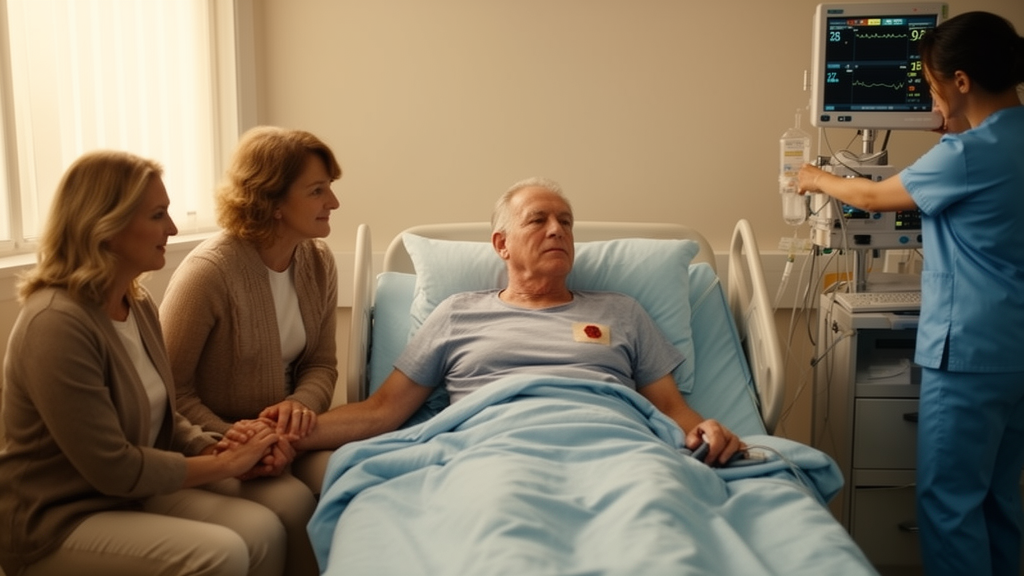
Older adults who received a structured, family-centered education program after implantation of a cardiac device reported better health status, greater functional independence, and fewer pain and depressive symptoms than similar patients receiving routine care alone, according to a quasi-experimental study published in BMC Geriatrics. The intervention, based on the Family-Centered Empowerment Model (FCEM), was delivered jointly to patients and their primary family caregivers over three months following implantation of cardiac implantable electronic devices (CIEDs).
The research team recruited 80 patients aged 60 years or older with newly implanted CIEDs, along with their primary family caregivers, from two teaching hospitals in Tehran, Iran. Because the study was not randomized at the individual level, the hospitals themselves were allocated by coin toss: one hospital delivered the FCEM program alongside routine care to 40 patient-caregiver dyads, while the other provided routine care alone to 40 dyads. This design means the intervention cannot be separated from the treating center, a limitation the authors emphasize throughout their reporting.
The FCEM intervention followed a four-step structure and was delivered through six biweekly contacts over three months for each patient-caregiver dyad. The program engaged both patients and the family members who support them daily, rather than treating the patient in isolation. In this study, the program targeted recovery after device implantation, a period in which implantation may be followed by clinical complications and psychological symptoms that impair health status and functional independence.
The researchers measured three domains after implantation and again at three months: health status using the EQ-5D-3L questionnaire, functional independence using the Barthel Index, and clinical complications and psychological symptoms using a researcher-developed checklist. At the three-month follow-up, the intervention group scored higher on the EQ-5D-3L index, averaging 0.75 (standard deviation 0.23) compared with 0.52 (standard deviation 0.22) in the routine-care group. After statistical adjustment, the difference was 0.23 points (95% confidence interval: 0.13 to 0.33; p < 0.001).
Functional independence showed a parallel pattern. The intervention group’s mean Barthel Index score was 87.00 (standard deviation 14.62) versus 74.38 (standard deviation 17.13) in the comparison group, an adjusted difference of 12.72 points (95% confidence interval: 5.77 to 19.51; p < 0.001). The gap corresponds to a measurable difference in day-to-day functional capacity between the two groups at three months.
The clinical checklist results were more selective. Patients in the intervention group reported pain less often, with an adjusted relative risk of 0.58 (95% confidence interval: 0.37 to 0.89; p = 0.014), and self-reported depressive or grief symptoms were also less frequent, with a relative risk of 0.50 (95% confidence interval: 0.33 to 0.77; p = 0.002). However, two other outcome categories did not differ significantly between the groups: rhythm disturbance and palpitations showed a relative risk of 1.81 (95% confidence interval: 0.96 to 3.41; p = 0.069), and dyspnea or pulmonary problems showed a relative risk of 0.60 (95% confidence interval: 0.30 to 1.18; p = 0.140). The authors therefore frame the benefits as concentrated in perceived health status, independence, pain, and mood rather than in all device-related complications.
The study’s methodological constraints are substantial and are stated plainly by the investigators. As a non-randomized, quasi-experimental evaluation with one hospital per arm, the design cannot rule out that differences between the two centers, rather than the empowerment program itself, produced the observed gaps. Patients and caregivers at the two hospitals may have differed in ways the statistical adjustment did not capture, and the treating institution’s routine care practices may themselves have varied. The authors describe their findings as preliminary and call for confirmation in multicenter randomized trials before the model is adopted more widely.
Registration and transparency issues also deserve note. The study was not prospectively registered; it was registered retrospectively on ClinicalTrials.gov under number NCT07857915 on September 29, 2026. The researchers explain that prospective registration could not be obtained through the Iranian Registry of Clinical Trials, and that an investigator-developed protocol specifying procedures, intervention, outcomes, and the planned analysis was prepared before the study began and retained by the team. Any substantive departures from that protocol were identified explicitly in the paper’s Methods section as protocol deviations. The study was conducted as part of a master’s thesis project and received institutional ethical approval from Shahid Beheshti University of Medical Sciences.
Within those limits, the results suggest that involving family caregivers in structured post-implantation education may be associated with how older CIED recipients feel and function in the months after surgery. Because the measured benefits span quality of life, daily independence, pain, and mood, while arrhythmia-related and respiratory symptoms showed no significant difference, the findings point mainly to patient-reported and functional outcomes. Whether a nurse-led, family-centered empowerment model can reproduce these associations when tested under randomized, multicenter conditions remains the key open question raised by this study.
Subject of Research: Effect of a family-centered empowerment model on health outcomes in older adults with cardiac implantable electronic devices
Article Title: Effect of the family-centered empowerment model on health status, functional independence, and post-implantation complications in older adults with cardiac implantable electronic devices: a quasi-experimental study
Article References: Ahani Moghaddam, R., Boozari Pour, M., Javaheri Tehrani, F., Akbarzadeh, M. A., Sarmadi, S., Zare-Kaseb, A., & Shariatpanahi, S. (2026). Effect of the family-centered empowerment model on health status, functional independence, and post-implantation complications in older adults with cardiac implantable electronic devices: a quasi-experimental study. BMC Geriatrics. https://doi.org/10.1186/s12877-026-08536-x
Image Credits: AI Generated
DOI: 10.1186/s12877-026-08536-x
Keywords: cardiac implantable electronic devices, family-centered empowerment model, older adults, quasi-experimental study, health status, functional independence, Barthel Index, EQ-5D-3L, post-implantation complications, depressive symptoms, nurse-led intervention, Iran
News Source: Ophelia Keating. (October 26, 2026). Family empowerment program linked to better recovery after heart device implantation. Scienmag.