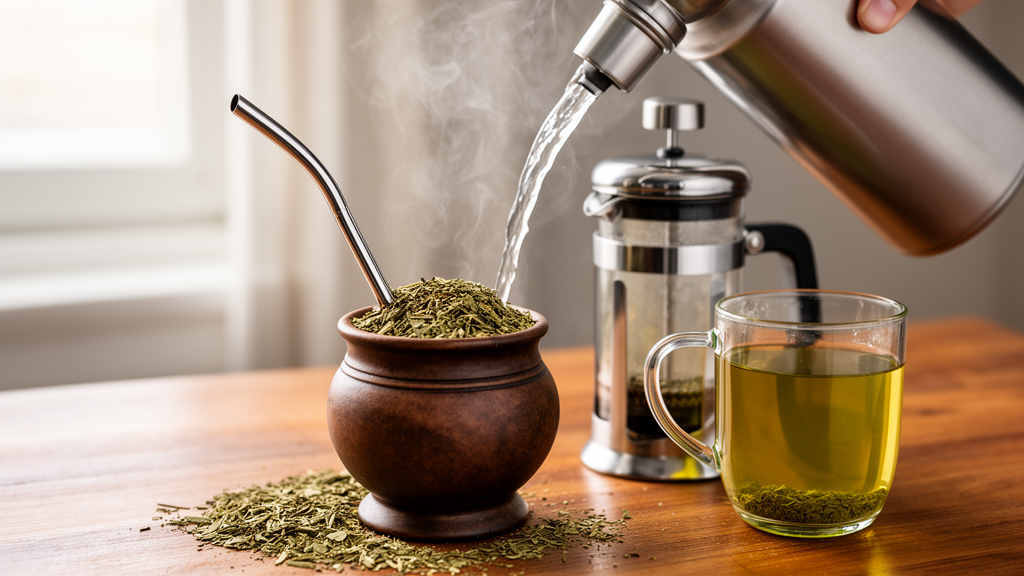
Yerba mate, the caffeinated infusion beloved across southern Brazil, Argentina, and Uruguay and increasingly sold worldwide as tea bags, capsules, and ready-to-drink beverages, may deliver very different amounts of its bioactive compounds to the body depending on how it is prepared. A new open-access study published in Food Science and Biotechnology compared three consumption formats—static infusion, simulated chimarrão, and pressurized capsule extraction—and found that the preparation method significantly affected the release, digestive stability, and bioaccessibility of the drink’s polyphenols, methylxanthines, and saponins under laboratory-simulated gastrointestinal conditions.
The research team, led by Sandra Maria Schenatto Palavicini and colleagues including Rogério Luis Cansian, worked with the Cambona 4 cultivar of Ilex paraguariensis, a variety developed by the Brazilian agricultural research corporation Embrapa and grown in Machadinho, in the state of Rio Grande do Sul. To make the three preparations directly comparable, the researchers standardized everything that could otherwise confound the comparison: each extraction used the same mass of plant material, 2.6 grams, and the same final extract volume, 55 milliliters, all at a water temperature of 72 degrees Celsius, a temperature typical of traditional mate consumption, where water below the boiling point is used to avoid degrading heat-sensitive compounds.
The control infusion was the most exhaustive method. Dried, finely ground leaves were steeped for a full ten minutes, yielding the highest recovery of water-soluble solids at 19.67 percent of the starting mass. The simulated chimarrão, which used industrially processed leaves subjected to the traditional sapeco fire-drying step and high-temperature drying, was infused for only 120 seconds, mimicking the brief contact time of real chimarrão consumption, and yielded an intermediate 16.46 percent. The capsule mate tea, extracted in a Nespresso-style machine at 19 bar of pressure, pushed water through the grounds in roughly 15 seconds and produced the lowest yield, 11.43 percent. The researchers attribute this to the extremely short solvent–matrix contact time, which limits the diffusion of compounds bound within plant tissue even when pressure initially drives water in quickly.
Chemical analysis confirmed that contact time and processing history left clear fingerprints on the extracts. The static infusion contained the highest levels of every constituent measured, including total phenolics, flavonoids, tannins, rutin, chlorogenic acid, caffeine, theobromine, and saponins. Chlorogenic acid, a signature polyphenol of mate, fell from 7.85 milligrams per liter in the control to 3.54 in the simulated chimarrão and just 1.20 in the capsule extract. Rutin, a glycosylated flavonoid, dropped even more steeply, from 4.33 to 1.53 and then 0.55 milligrams per liter across the same sequence. The team notes that industrial processing such as sapeco and drying at 60 to 140 degrees Celsius can degrade thermolabile phenolic compounds, compounding the effect of shorter extraction times.
Interestingly, one class of compounds bucked the trend. Saponins, triterpenoid glycosides known for their surfactant-like properties, appeared at lower concentrations in the simulated chimarrão, 34.5 milligrams per liter, but reached intermediate values of 44.5 milligrams per liter in the pressurized capsule extracts. The researchers suggest that the mechanical forces of pressurized extraction may partially enhance the release of these matrix-associated metabolites, even though the same conditions under-recovered less soluble phenolics such as glycosylated flavonoids.
Antioxidant measurements revealed a subtler picture. When assessed with the DPPH radical-scavenging assay, the three extracts were statistically indistinguishable, meaning their hydrogen-donating capacity toward that particular radical was similar despite very different phenolic profiles. The ABTS assay, however, told a different story: the capsule mate tea showed the highest antioxidant capacity, at 1038.85 milligrams of Trolox equivalents per liter, a significant difference. The authors caution that this higher ABTS response reflects greater activity under the specific conditions of that assay rather than a higher total concentration of antioxidant compounds. ABTS can react with a broader range of antioxidant species, including flavonoids lacking hydroxyl groups on the B ring and singly hydroxylated phenolic acids that show little or no reactivity toward DPPH, which helps explain why the two assays diverged.
The heart of the study lay in its simulated digestion, which tracked the extracts through oral, gastric, duodenal, ileal, and simplified large-intestinal stages, the latter involving incubation with Escherichia coli for up to 48 hours. Across all preparations, the measurable fraction of total phenolics, flavonoids, tannins, rutin, and chlorogenic acid declined progressively as digestion proceeded, driven by oxidation, hydrolysis, complexation with digestive proteins, precipitation, and the alkaline conditions of the intestinal phases. Simulated chimarrão extracts showed higher availability of total phenolics in the early phases, consistent with rapid extraction favoring more soluble forms, while the capsule extract retained fewer phenolics in the later intestinal stages. For flavonoids and tannins, however, the capsule extract showed a smaller decline during the intestinal phases, suggesting that pressurized extraction generates fractions less prone to aggregation or complexation. Chlorogenic acid proved relatively resistant throughout, and in the control extract the remaining proportion of total phenolics and phenolic acids ranged between 40 and 50 percent by the later incubation points.
Two compound classes stood out for their resilience. Caffeine and theobromine, the methylxanthines responsible for mate’s stimulant character, remained highly bioaccessible regardless of preparation method, with caffeine showing the highest retention and minimal losses, consistent with its low molecular weight, high water solubility, and stability across a wide pH range. Theobromine declined slightly more, plausibly reflecting its lower water solubility, yet roughly 70 percent of the initial content remained detectable after 48 hours. Saponins were the most persistent of all: more than 75 percent of the initial content stayed measurable across all methods even after 48 hours, with mean bioaccessibility of 80 to 85 percent in the oral phase and 75 to 82 percent in the late intestinal phase. The authors note that saponins are poorly absorbed in the small intestine and often act locally in the gut or are transformed by microbiota, but their model did not evaluate absorption, microbial metabolism, or local biological effects.
Antioxidant activity followed a dramatic trajectory during digestion. Starting at 95 to 99 percent in the oral and gastric phases, it fell sharply during the transition from the acidic gastric environment to the duodenal phase, where pH rises and bile and pancreatic components are introduced, and ultimately only 21 to 26 percent of the initial activity remained detectable after 48 hours of intestinal simulation. Correlation analysis pointed to tannins, with a coefficient of 0.88, flavonoids at 0.83, and total phenolics at 0.77 as the compounds most strongly associated with antioxidant activity at the end of digestion, while saponins correlated weakly at 0.42 and caffeine showed an intermediate 0.63.
The study’s central message is that initial chemical abundance does not predict digestive behavior: the control infusion extracted the most compounds, yet did not consistently show greater antioxidant activity or stability, while the capsule method, despite the lowest yield, produced the highest ABTS activity and better intestinal-phase stability for some compounds. The authors also flag an important limitation: the late intestinal stage relied on an E. coli monoculture, which cannot reproduce the taxonomic and metabolic complexity of the human gut microbiota, so the results should not be read as evidence of colonic microbial metabolism. Likewise, the in vitro model measures bioaccessibility—the fraction remaining measurable after each digestive stage—not intestinal absorption or systemic bioavailability, and human studies have shown that mate phenolics generate more than thirty conjugated and microbial metabolites after digestion. Future work using human fecal inocula or validated complex fermentation models will be needed to explore how yerba mate’s bioactives are transformed by the real gut ecosystem. For now, the findings offer a practical insight for researchers and formulators alike: how mate is brewed shapes not just its flavor, but the chemistry that survives the journey through digestion.
Subject of Research: Effects of yerba mate preparation methods on the in vitro gastrointestinal bioaccessibility and antioxidant activity of its bioactive compounds
Article Title: Influence of traditional and emerging preparation methods on the gastrointestinal fate and antioxidant activity of yerba mate (Ilex paraguariensis) bioactives
Article References: Palavicini, S. M. S., Puton, B. M. S., Jacques, R. A., Valduga, E., Bracesco, N., Paroul, N., Steffens, C., & Cansian, R. L. (2026). Influence of traditional and emerging preparation methods on the gastrointestinal fate and antioxidant activity of yerba mate (Ilex paraguariensis) bioactives. Food Science and Biotechnology. https://doi.org/10.1007/s10068-026-02347-x
Image Credits: AI Generated
DOI: 10.1007/s10068-026-02347-x
Keywords: yerba mate, bioaccessibility, polyphenols, caffeine, theobromine, saponins, chlorogenic acid, in vitro digestion, antioxidant activity, chimarrão, capsule extraction, Food Science and Biotechnology
News Source: Drew Townsend. (October 26, 2026). How You Brew It Matters: Preparation Method Shapes the Digestive Fate of Yerba Mate Bioactives. Scienmag.