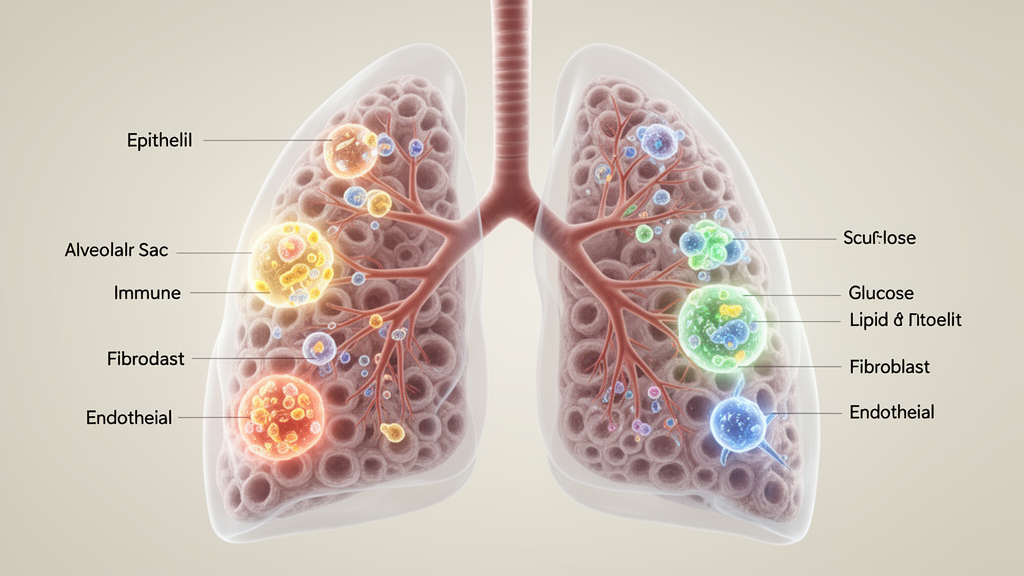
A 2026 review identifies altered glucose, lipid and amino-acid metabolism as interconnected features of pulmonary fibrosis, linking changes in lung fibroblasts, alveolar epithelial cells, macrophages and endothelial cells to activation, inflammation, matrix deposition and barrier dysfunction. The review assembles evidence from cell experiments and animal models, alongside human tissue and single-cell findings, but emphasizes that most therapeutic strategies remain preclinical and that metabolic changes may be causes, adaptations or components of a self-reinforcing disease state.
Pulmonary fibrosis progressively disrupts alveolar units and is characterized by excessive extracellular-matrix accumulation caused by abnormal fibroblast activation and proliferation. Idiopathic pulmonary fibrosis, the best-characterized form discussed in the review, has an estimated annual incidence of 0.9–9.3 cases per 100,000 people in Europe and North America and 3.5–13.0 per 100,000 in Asia and South America. Incidence rises with age, prevalence is higher among men, and median survival for most patients is reported as three to four years. Pirfenidone and nintedanib can slow progression but cannot reverse established fibrosis and are associated with adverse effects including gastrointestinal disturbances and hepatotoxicity.
Metabolic reprogramming refers to fundamental changes in a cell’s energy use and biosynthetic mode that help it adapt to internal and external pressures. The concept became widely recognized through the Warburg effect in cancer, where cells favor glycolysis even in oxygen-rich conditions. Across fibrotic organs, altered glucose and lipid metabolism can provide energy and precursors needed for cell activation, proliferation and extracellular-matrix secretion. In pulmonary fibrosis, the review treats metabolism as a multicellular process rather than an isolated change: fibroblasts, epithelial cells, immune cells and endothelial cells respond to injury while exchanging metabolites and signals that shape a pro-fibrotic environment.
Activated lung fibroblasts characteristically shift toward aerobic glycolysis, with PFKFB3, GLUT1, HK2 and PKM2 identified as important regulatory nodes. In mouse models of pulmonary fibrosis, genetic deletion or small-molecule inhibition of PFKFB3 reduced myofibroblast differentiation and ameliorated fibrosis, while GLUT1 knockdown blocked myofibroblast differentiation and bleomycin-induced fibrosis. The PI3K–Akt–mTOR axis regulates several glycolytic programs: lipopolysaccharide increased PFKFB3 through this pathway, and the pathway inhibitors LY294002 and rapamycin reversed that response. Tanshinone IIA reduced HK2 expression and ATP citrate lyase activity in experimental systems, while SIK2, PCBP3, circHIPK3 and the integrin β3–PKM2 axis were reported as additional regulators. These findings nominate potential intervention points, but they do not establish that inhibiting one enzyme will be sufficient or safe in patients.
Fibroblast lipid and amino-acid metabolism connect matrix production with inflammatory, oxidative and mechanical signals. Prostaglandin F2α can stimulate fibroblast proliferation and collagen production, while prostaglandin E synthase links lipid metabolism to AKT–HIF-1α-dependent glycolysis. Lysophosphatidic acid receptors LPA1 and LPA2 have distinct reported roles: LPA1 is associated with fibroblast recruitment and vascular leakage, whereas LPA2 promotes myofibroblast differentiation through regulation of TGF-β1. Impaired fatty-acid oxidation can lead to accumulation of intermediates such as diacylglycerol and ceramides, which activate profibrotic TGF-β1 signaling. Cigarette smoke exposure can reduce SIRT1, disrupt autophagic flux and lipophagy, and increase lipid accumulation in fibroblasts, while Drp1-dependent mitochondrial fragmentation can alter lipid metabolism through reactive oxygen species and HIF-1α.
Amino-acid pathways supply substrates needed for collagen and also integrate TGF-β1 signaling, oxidative stress and the mechanical environment. TGF-β1 can activate PI3K–Akt–mTORC1 signaling and accumulate ATF4, promoting serine and glycine synthesis relevant to collagen production. NOX4, ARG1 and OAT form a regulatory route associated with arginine-to-proline conversion and TGF-β/Smad signaling. Under mechanical influences, Kindlin-2 can translocate to mitochondria and form a complex with PYCR1, increasing proline synthesis. Glutamine metabolism in pulmonary fibrosis differs from that in many tumor cells: the review describes its primary role as supporting amino-acid biosynthesis rather than simply supplying energy. TGF-β1-driven GLS1 expression supports myofibroblast differentiation, and extracellular glutamine depletion or GLS1 silencing blocked activation in experimental systems.
Alveolar epithelial cells show a closely linked shift in glycolysis and mitochondrial function. Fibrotic tissue contains elevated lactate, with the review reporting an approximately threefold increase relative to healthy tissue. In this setting, lactate can disturb the NAD+/NADH redox balance, accelerate AEC2 senescence and activate endoplasmic-reticulum stress through the ATF4–CHOP axis. Mitochondrial swelling, reduced oxidative phosphorylation, impaired mitochondrial autophagy and increased reactive oxygen species form a self-reinforcing cycle with glycolytic activation. IL-17A can inhibit PINK1-mediated mitochondrial autophagy, while PM2.5-associated reactive oxygen species activate HIF-1α and promote glycolysis and epithelial–mesenchymal transition. Lipid changes compound the injury by disturbing surfactant production and alveolar surface tension: ACSS3 can suppress CPT1A and fatty-acid oxidation, while reduced fatty-acid synthase expression in patient and mouse fibrotic tissue is associated with mitochondrial dysfunction and epithelial-cell death.
Macrophage metabolism links inflammation, epigenetic regulation and fibroblast activation. In silicosis models, macrophages increased glycolytic enzymes and acquired M2-like markers. HIF-1α supports this shift, and the glycolysis inhibitor 2-deoxyglucose reduced IL-1β expression, inflammation and fibrosis in mice. Lactate can also modify chromatin: in a PM2.5 fibrosis model, increased macrophage lactate promoted H3K18 lactylation at the Stub1 promoter, reduced CHIP expression and increased M2 polarization and TGF-β1 secretion. Lipid pathways also shape macrophage states. Reduced PPARG and increased SPP1 in IPF alveolar macrophages were associated with impaired fatty-acid uptake, oxidative capacity and abnormal lipid accumulation, while TREM2 and S1PR3 could promote profibrotic phenotypes through sphingomyelin metabolism or PI3K–Akt–STAT3 signaling. In scar-associated macrophages, RIPK3 can route arginine toward polyamine production, while PAD4-mediated citrullination promotes neutrophil extracellular traps and disrupts the balance between M1 and M2 cytokine responses.
Endothelial-cell metabolism contributes to the alveolar–capillary barrier and vascular integrity. Pulmonary microvascular endothelial cells rely partly on LDHA-mediated aerobic glycolysis during rapid proliferation. The ROCK2 inhibitor KD025 reduced glycolysis, promoted oxidative phosphorylation and improved barrier integrity in experimental systems, illustrating why restoring metabolic balance may differ from simply inhibiting glycolysis in every pulmonary cell type. Single-cell data identified changes in sphingomyelin and phospholipid metabolism, while endothelial-specific S1PR1 deletion increased vascular permeability and worsened fibrosis in models. Abnormal LDL accumulation linked to LDLR dysfunction can induce endothelial apoptosis and profibrotic transformation. Whether modifying lipid handling or VEGF signaling can safely protect the pulmonary microvasculature in patients remains unresolved.
Therapeutic strategies summarized in the review include inhibitors of PFKFB3, SIK2, GLS1, TREM2, S1PR3 and PAD4; compounds that promote fatty-acid oxidation through PPARα or CPT1A; and agents that redirect glutamine flux toward glutathione or away from collagen precursors. Other interventions target lactate transport, HIF-1α signaling, mitochondrial reactive oxygen species, LPCAT1-dependent phosphatidylcholine metabolism and the SENP1–Sirt3 axis. Tanshinone IIA, artesunate, epalrestat, mulberry pigment, trichodelphinine A and dichloroacetic acid have shown antifibrotic effects in experimental models, while pirfenidone and nintedanib have been reported to interfere with abnormal proline metabolism. These results support a move from blanket glycolysis inhibition toward cell-specific metabolic rebalancing, but they do not establish clinical efficacy. The review also notes inconsistencies between animal models and human IPF, gaps in the systemic picture of cell-to-cell metabolic communication, and unresolved questions about target specificity, drug safety and patient heterogeneity.
Subject of Research: Metabolic reprogramming across lung cell populations in pulmonary fibrosis
Article Title: Metabolic reprogramming in pulmonary fibrosis: mechanisms and therapeutic perspectives
Article References: Wu, Y., Su, X., Zhou, J., Zheng, S., Feng, Q., Zhuang, J., Yu, Z., Qiu, H., Xia, Y., Wu, J., Jin, C., & Wang, J. (2026). Metabolic reprogramming in pulmonary fibrosis: mechanisms and therapeutic perspectives. Frontiers in Medicine, 13, Article 1982119. https://doi.org/10.3389/fmed.2026.1982119
Image Credits: AI Generated
DOI: 10.3389/fmed.2026.1982119
Keywords: pulmonary fibrosis, metabolic reprogramming, fibroblasts, alveolar epithelial cells, macrophages, endothelial cells, glycolysis, lipid metabolism, amino-acid metabolism, antifibrotic therapy, idiopathic pulmonary fibrosis, preclinical research
News Source: Barbara Leach. (October 25, 2026). Review Maps Metabolic Targets Across Pulmonary Fibrosis Cell Types. Scienmag.