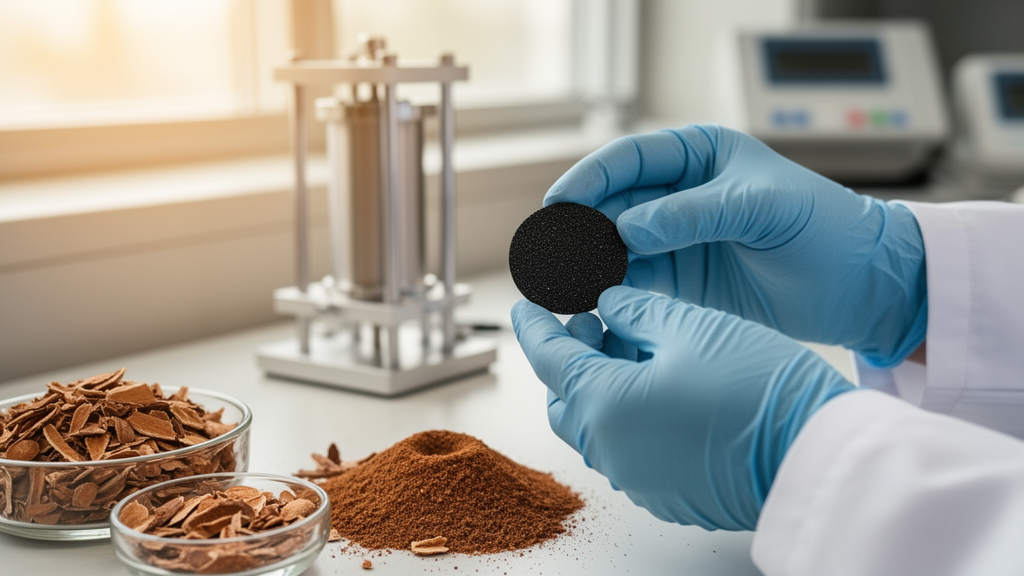
Researchers have converted waste almond shells into an activated carbon electrode material that, when combined with titanium dioxide nanoparticles, delivers a specific capacitance of 914 farads per gram at a current density of 1 ampere per gram. The study, published in the journal Ionics, reports that the composite outperformed the pristine carbon derived from the same biomass, which achieved 599.9 farads per gram under identical testing conditions in 3 molar potassium hydroxide electrolyte.
The team, led by Bernard Amankwah, Perseverance Dzikunu and Emmanuel Gikunoo, processed the Ghanaian agricultural waste stream through a dual chemical treatment. The almond shells were first pre-activated with calcium chloride and then subjected to potassium hydroxide chemical activation, a route the authors describe as a sustainable means of valorizing an underutilized biomass precursor. A portion of the resulting activated carbon was further modified with titanium dioxide nanoparticles to form an AC-TiO2 composite electrode, introducing pseudocapacitive charge storage mechanisms alongside the electrical double-layer capacitance of the carbon scaffold.
Structural characterization confirmed the composition and porosity of the two materials. X-ray diffraction identified the anatase phase of titanium dioxide in the composite, matching reference pattern JCPDS 21-1272, while Fourier-transform infrared spectroscopy and energy-dispersive X-ray analysis verified successful surface modification and elemental integration. Nitrogen adsorption measurements using the BET method revealed a mesopore-dominated structure in both electrodes, with the specific surface area rising from 105.5 square meters per gram for the pristine activated carbon to 144.6 square meters per gram after titanium dioxide incorporation.
Electrochemical performance was assessed using cyclic voltammetry, galvanostatic charge-discharge and electrochemical impedance spectroscopy. The composite’s capacitance advantage translated into higher energy density, which the authors attribute to the synergistic contribution of the metal oxide phase. Both electrodes demonstrated strong cycling durability, retaining at least 95 percent of their capacitance over 5000 charge-discharge cycles, a result the researchers describe as excellent stability for hybrid supercapacitor applications.
Quantitative analysis of the charge storage kinetics distinguished the mechanisms at work in the electrodes. B-value analysis and Dunn’s model both confirmed a mixed capacitive and diffusion-controlled charge storage process, indicating that energy is stored through a combination of fast surface adsorption and slower faradaic reactions rather than a single mechanism. This hybrid behavior is characteristic of composite electrodes in which carbon-based double-layer storage is augmented by pseudocapacitive materials such as transition metal oxides.
The findings position almond shell-derived activated carbon modified with titanium dioxide as a cost-effective and scalable electrode material for high-performance hybrid supercapacitors. By coupling an abundant agricultural waste product with a straightforward two-step chemical activation and a nanoparticle modification, the study offers a route to electrode materials that combine competitive electrochemical metrics with the sustainability credentials increasingly demanded in energy storage research.
Subject of Research: Waste almond shell-derived activated carbon modified with TiO2 as a hybrid supercapacitor electrode
Article Title: Electrochemical performance of waste almond shell-derived activated carbon as a hybrid supercapacitor electrode
Article References: Amankwah, B., Dzikunu, P., & Gikunoo, E. (2026). Electrochemical performance of waste almond shell-derived activated carbon as a hybrid supercapacitor electrode. Ionics. https://doi.org/10.1007/s11581-026-07608-7
Image Credits: AI Generated
DOI: 10.1007/s11581-026-07608-7
Keywords: supercapacitors, activated carbon, almond shells, titanium dioxide, biomass waste, pseudocapacitance, energy storage, electrochemistry, Ghana, cycling stability, Electrochemical, performance
News Source: Denise Maddox. (October 24, 2026). Almond Shell Waste Turned Into High-Performance Supercapacitor Electrode. Scienmag.