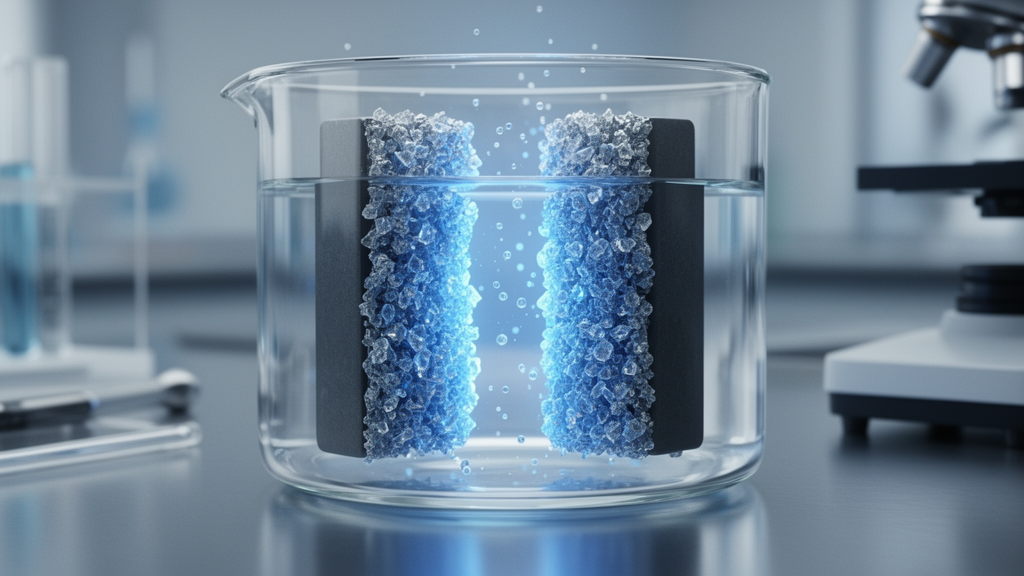
Researchers have assembled an aqueous asymmetric supercapacitor that pairs a lanthanum-doped nickel tungstate positive electrode with a vanadium nitride wrapped in reduced graphene oxide as the negative electrode. The device, described in a study published in the journal Ionics, operates over a nominal 1.6-volt window in a 3 M potassium hydroxide electrolyte with a polypropylene separator, and delivered 182 farads per gram at 1 ampere per gram with 98.3% capacitance retention after 10,000 cycles.
The centerpiece of the work is the positive electrode material, nickel tungstate doped with small amounts of lanthanum. After screening several compositions and calcination conditions, the team identified a formulation labeled 0.7% La-NiWO4-520 as the best performer. Characterization showed that this material forms an interconnected rod-like porous network. Nitrogen physisorption measurements gave a Brunauer-Emmett-Teller surface area of 208.436 square meters per gram, roughly double the 106.052 square meters per gram measured for the undoped NiWO4-520 sample.
Structural and chemical analyses supported the idea that the lanthanum dopant genuinely perturbs the host lattice. X-ray diffraction patterns showed disturbance of the average diffraction signal, while X-ray photoelectron spectroscopy confirmed the presence of lanthanum at the surface and revealed an additional oxygen component associated with defects and hydroxyl groups. The authors are careful on this point: because the O 1s photoelectron signal is surface sensitive and can contain overlapping contributions from oxygen-deficient environments and surface hydroxyl species, they treat it as a descriptor of surface chemistry rather than quantitative proof of bulk oxygen vacancies.
Electrochemically, the optimized positive electrode delivered a specific capacitance of 2290 farads per gram at a current density of 1 ampere per gram, calculated on the basis of the active-material mass, and retained 99.2% of that capacitance after 10,000 charge-discharge cycles. The team attaches an important caveat to this headline number: because a matched bare nickel-foam control was not available in the archived dataset, the 2290 farads per gram should be regarded as an apparent coated-electrode response on the stated active-material basis rather than a substrate-corrected intrinsic capacitance.
The negative electrode, vanadium nitride combined with reduced graphene oxide, provided a complementary charge-storage capacity of 280 farads per gram at 1 ampere per gram with 96.4% retention after 8000 cycles. Together, the two electrodes span the capacitance range needed to assemble a full asymmetric cell in which the positive and negative sides can be matched in stored charge.
Combining the two electrodes required careful mass balancing. The researchers sized the device using a theoretical charge-balance criterion, ensuring that the charge stored by the positive and negative electrodes could offset each other across the full operating voltage window. The resulting asymmetric device delivered a capacitance of 182 farads per gram at 1 ampere per gram, maintained 63.7% of its capacitance when the current density was pushed to 20 amperes per gram, and kept 98.3% of its initial capacitance after 10,000 cycles.
Energy and power performance was summarized in a Ragone plot constructed on the combined active-material basis. The device delivered approximately 95 watt-hours per kilogram at a power density of 1.5 kilowatts per kilogram. These are gravimetric values normalized to the active electrode materials, and the authors stress that they should not be read as areal or packaged-cell performance, since real full cells carry additional mass from current collectors, separators, electrolyte reservoirs and packaging that lowers practical energy density.
The study, published on 23 October 2026, is a laboratory-scale feasibility demonstration rather than a commercial prototype. The capacitance values are normalized to active material rather than whole electrodes, one key control measurement was unavailable, and the surface oxygen analysis remains interpretive by design. Even with those qualifications, the combination of roughly 95 watt-hours per kilogram on an active-material basis, near-total capacitance retention over 10,000 cycles and retention of more than 60% of capacitance at a tenfold higher current density supports the authors’ conclusion that lanthanum-modified nickel tungstate and vanadium nitride on reduced graphene oxide are a viable electrode couple for aqueous asymmetric supercapacitors.
What remains open is the quantitative interpretation of the numbers themselves. A substrate-corrected capacitance for the positive electrode would require a matched bare nickel-foam control, and the question of whether bulk oxygen vacancies contribute to the charge storage would need techniques beyond the surface-sensitive photoelectron measurements reported here. The study also leaves the translation from active-material metrics to packaged cell performance untested, which is where practical device comparisons are ultimately made.
Even so, the paper supplies both a promising material recipe and an unusually transparent accounting of how its headline numbers should be read. By stating explicitly that the 2290 farads per gram figure is an apparent coated-electrode response and that the Ragone plot values are active-material-normalized, the authors set a benchmark for how doped tungstate and vanadium nitride electrodes can be evaluated in future aqueous asymmetric supercapacitor studies.
Subject of Research: Lanthanum-doped NiWO4 and VN@rGO electrodes for an aqueous asymmetric supercapacitor
Article Title: Construction of an aqueous asymmetric supercapacitor based on La-doped NiWO4 and VN@rGO electrodes
Article References: Cong, L., Wang, X., Liu, Z., Bi, F., Liu, C., Liu, Y., Yan, G., & Wang, J. (2026). Construction of an aqueous asymmetric supercapacitor based on La-doped NiWO4 and VN@rGO electrodes. Ionics. https://doi.org/10.1007/s11581-026-07574-0
Image Credits: AI Generated
DOI: 10.1007/s11581-026-07574-0
Keywords: supercapacitor, La-doped NiWO4, vanadium nitride, reduced graphene oxide, aqueous electrolyte, energy storage, electrode materials, specific capacitance, Ragone plot, cycling stability, nickel tungstate, doping
News Source: Denise Maddox. (October 23, 2026). Lanthanum-Doped Nickel Tungstate Boosts Electrode Capacity in New Aqueous Supercapacitor. Scienmag.