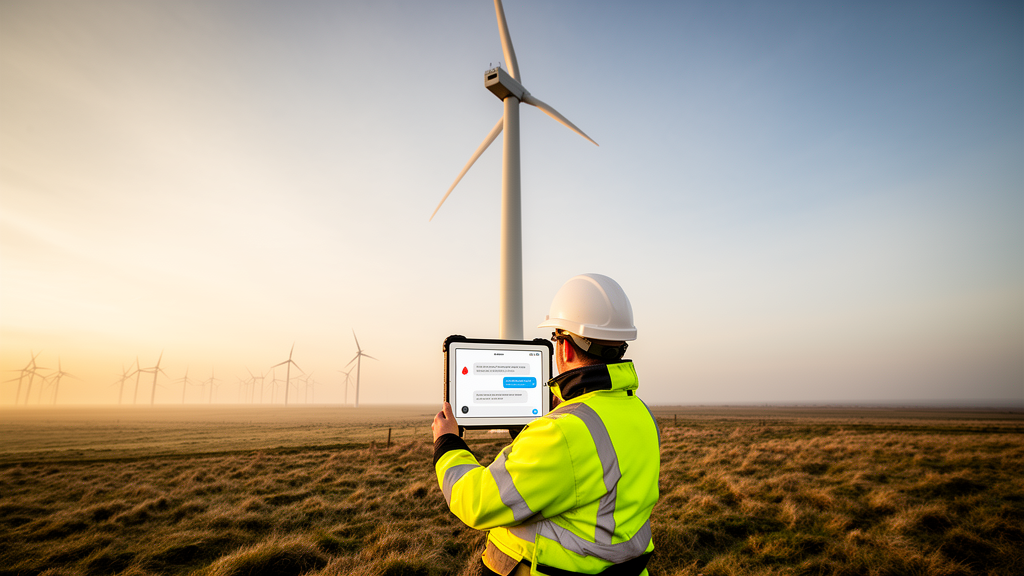
Wind turbines are towering, heavily stressed machines, and when a gearbox seizes or an electrical component fails, the downtime and repair bills can be enormous. A team of computer engineers at Dokuz Eylül University in Izmir, Türkiye, together with a colleague at Yaşar University, has now built and tested an end-to-end system that pairs industrial failure data with a small physical wind turbine prototype, live Internet of Things (IoT) sensors, machine learning models, and a large language model (LLM) that talks to operators in plain language. The study, published in the journal Wind Energy Science, describes a platform the authors call the Smart Wind Turbine Failure Prediction System, or SWTFPS, and reports that it can detect mechanical gearbox and electrical faults with strong performance while keeping humans in the conversational loop.
The starting point of the work is a well-known weakness of conventional monitoring. Industrial turbines are already equipped with supervisory control and data acquisition (SCADA) systems, but these typically raise alarms only when a sensor crosses a fixed threshold. Such methods struggle to interpret the complex, non-linear correlations among dozens of heterogeneous sensor streams, which is exactly the kind of pattern recognition at which machine learning excels. Previous research efforts have trained convolutional networks, recurrent models, and gradient-boosting classifiers on SCADA archives to predict bearing and gearbox problems hours, days, or even months in advance, but the authors argue that most of these systems rely on single data sources and present results through static dashboards rather than interactive interfaces.
SWTFPS is built around two core contributions. The first is a multi-modal real-time predictive engine that bridges historical industrial SCADA datasets with live hardware-level telemetry from a laboratory prototype. The second is a conversational decision-support framework that integrates the predictive engine with a domain-grounded LLM, translating high-frequency sensor states and failure probabilities into explainable, actionable natural language recommendations. According to the authors, this coupling of physical edge telemetry, immediate machine learning inference, and conversational reasoning within one platform is the study’s central novelty.
The hardware side of the project is deliberately modest. The team constructed a small vertical axis wind turbine prototype equipped with an anemometer, a wind vane, a DC generator, and control circuitry built around two Espressif ESP32 microcontrollers. The sensor suite is unusually rich for a prototype of this size: three DHT11 modules track temperature and humidity gradients, gas and sound sensors monitor atmospheric quality and acoustic emissions, a piezoelectric sensor detects structural vibrations, a line-detect sensor measures blade speed, and an INA219 module captures current and voltage from the turbine’s output. Data are transmitted to the ThingSpeak IoT platform on a 15-second cycle over HTTP and MQTT protocols, with dual ESP32 units operating on a network of at least 10 megabits per second bandwidth and below 50 milliseconds latency.
Training data came from a large public SCADA dataset covering 89 cumulative years of operation from 36 industrial-scale turbines across three geographically distinct wind farms. That dataset was heavily imbalanced, with 87.2 percent of records labeled Normal and only 12.8 percent labeled Failure, which is a realistic reflection of turbine operations but a challenge for classifiers. The researchers applied Pearson correlation filtering to remove redundant variables with correlation coefficients above 0.85, then used SHAP (SHapley Additive exPlanations) values to identify the seven most predictive features: ambient temperature, nacelle temperature, total active power, gearbox temperature, wind speed, absolute wind direction, and mean voltage. They also introduced a novel K means undersampling technique that reduced the surplus Normal class to representative centroids matching the Failure count, applying it only to training data to prevent data leakage.
Eleven machine learning algorithms were benchmarked with 5-fold cross-validation and systematic hyperparameter tuning. XGBoost emerged as the top performer on the SCADA data, achieving approximately 89.68 percent accuracy, a 90.08 percent F1 score, a 95.65 percent ROC-AUC, and a newly proposed overall performance metric score of 65.13 percent. The authors note that this result underlines a key lesson: data quality mattered more than data quantity, since a compact seven-feature, balanced model outperformed alternatives trained on raw high-dimensional data, where XGBoost’s failure-class precision had collapsed to 20.65 percent. The lightweight model is also well suited to real-time monitoring on constrained hardware such as the ESP32-based prototype.
The novel metric itself is worth noting. Because standard accuracy or ROC-AUC figures can look impressive even when false alarm rates or missed detections remain high on imbalanced datasets, the team formulated an overall performance score that combines F1 score, ROC-AUC, accuracy, precision, and recall with penalties for LogLoss, Brier error, false positive rate, and false negative rate. A sensitivity analysis varying the weights showed that the rankings of all 11 models remained stable, and the authors argue that prior wind turbine studies, which typically report only success-oriented metrics, could not be scored on this measure at all, a gap they hope future research will close.
Because inducing catastrophic failures on the prototype was impractical, the team used a two-stage teacher-student transfer learning workflow. The SCADA-trained XGBoost model acted as a teacher, pseudo-labeling the unlabeled prototype telemetry using only the features shared between the two datasets, such as temperatures, wind speed, and voltage. A LightGBM student model was then retrained on the full prototype feature set, including the new acoustic, gas, and vibration inputs. The student achieved 98.37 percent accuracy, a 99.16 percent F1 score, a 98.95 percent ROC-AUC, and 94.65 percent overall performance. Critically, an independent validation against a manually labeled, ground-truth-verified test set built from physical failure-injection logs showed the student was not merely mimicking its teacher: full multi-sensor integration raised recall from 92.56 percent to 99.07 percent and cut the false negative rate on true physical failures to 0.93 percent, with the vibration sensor delivering the largest standalone gain and acoustic and gas sensors adding diagnostic redundancy.
The conversational layer is perhaps the most eye-catching element. Rather than letting the Gemini-based LLM independently interpret raw sensor arrays, a practice that risks plausible-sounding hallucinations, the system grounds the model through retrieval-augmented generation and a deterministic sensor-pattern-to-action reference matrix. The Python back end first evaluates data streams against hard-coded engineering rules, then injects pre-validated domain context into the LLM’s prompt, so the model functions strictly as a natural language synthesizer of verified facts. In physical case studies, the system correctly flagged a deliberately jammed generator, noting the contradiction between high wind speeds and near-zero voltage and instructing an inspection of the rotor-generator coupling, and it issued an emergency thermal shutdown recommendation when an external heat source pushed the nacelle sensor past 50 degrees Celsius without inventing secondary faults. Real-time tests showed data transfer and analysis completing within 5 seconds, dashboard updates within 3 seconds, and chat responses within 10 seconds.
The authors are candid about the limits of their proof of concept. The high accuracy figures on the prototype data rest on pseudo-labels rather than full independent physical verification for the training set, the small laboratory turbine cannot perfectly reproduce the vibration and temperature signatures of massive industrial machines, and the affordable sensors and microcontrollers may lack the durability required for harsh wind farm conditions. Even so, the study demonstrates a credible template for the next generation of turbine maintenance: a single platform in which multi-modal sensors, gradient-boosted classifiers, explainability tools such as SHAP and LIME, and a safely grounded conversational assistant work together to catch failures before they ground a turbine.
Subject of Research: A real-time IoT and AI system with an LLM interface for predicting wind turbine mechanical and electrical failures
Article Title: A real-time IoT, LLM, AI-supported wind turbine failure prediction system
Article References: Saygı, İ. G., Mahyanbakhshayesh, S., Ak, B., Özcanhan, M. H., & Ünlütürk, M. S. (2026). A real-time IoT, LLM, AI-supported wind turbine failure prediction system. Wind Energy Science, 11(10), 3983-4003. https://doi.org/10.5194/wes-11-3983-2026
Image Credits: AI Generated
Keywords: wind energy, predictive maintenance, machine learning, IoT, large language models, XGBoost, LightGBM, SCADA, fault detection, explainable AI, sensor fusion, wind turbines
News Source: Faith Mcneil. (October 23, 2026). AI and a Chat Interface Team Up to Predict Wind Turbine Failures in Real Time. Scienmag.