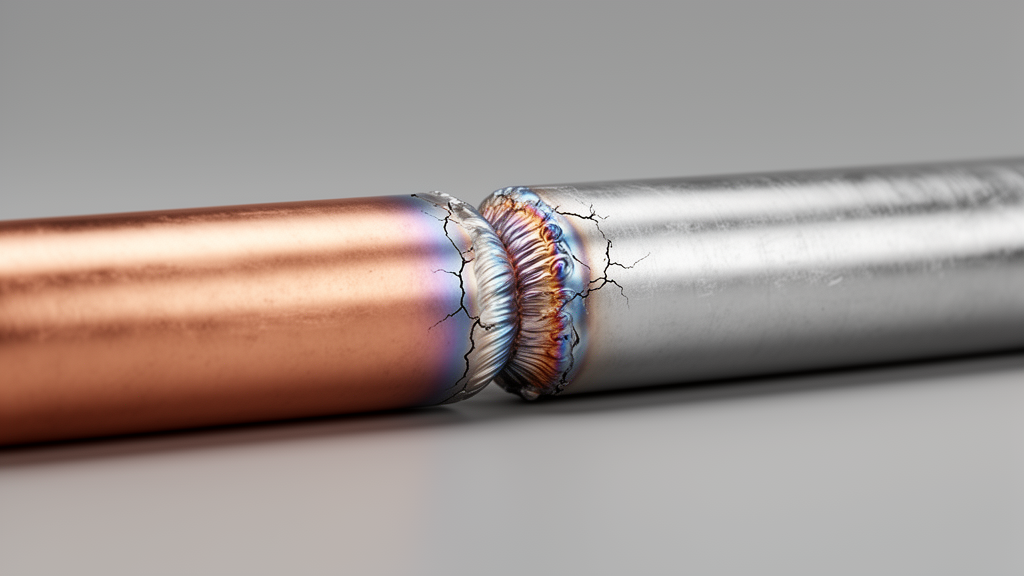
Engineers who join copper and aluminum cables with ultrasonic welding now have a clearer picture of what weakens the resulting joints, thanks to a finite element study published in Scientific Reports. A research team led by X. M. Cheng developed a thermomechanical coupling model of the process using Abaqus software, and used it to pinpoint where stress builds up inside a welded connection and how the tiny gaps left between wires shape the joint’s final strength.
Ultrasonic welding bonds metals through high-frequency vibration under pressure, generating frictional heat and intense plastic deformation at the interface. Capturing that interplay in a simulation is difficult, because the materials soften both from heating and from the ultrasonic vibrations themselves. The model therefore incorporated ultrasonic softening and thermal softening effects on the yield strength of the copper and aluminum cables, alongside a heat flux representing frictional heat generation and the heat produced by plastic deformation at the weld interface.
The team checked the model against reality by comparing its predictions with temperature measurements and morphological analysis of actual welded joints, reporting that the simulation proved both efficient and accurate. That validation matters, because the model’s conclusions about joint quality rest on whether it reproduces the real thermal and mechanical conditions inside a weld.
The simulation results point to a specific culprit for joint degradation: stress concentration at the edges of the aluminum wires. According to the study, this edge concentration reduces the effective load-bearing area of the joint, which the researchers identify as the primary cause of weakened connections. In practical terms, the parts of the joint that should carry mechanical load are instead undermined by localized stress at wire boundaries.
The study also examined the gaps that remain within the joint after welding. The analysis indicated that joint quality is optimal when the total gap volume is approximately 2.36 cubic millimeters, a condition under which the tensile strength reached 398.6 newtons at a welding energy of 300 joules. Because the work is a simulation study validated against measured temperatures and joint morphology, its conclusions describe modeled behavior supported by those comparisons rather than direct observations of every welding scenario.
Subject of Research: Finite element modeling of ultrasonic welding of copper/aluminum cables and joint gap characteristics
Article Title: Ultrasonic welding of Cu/Al cables: a study on the finite element model and characteristics of the gaps
Article References: Cheng, X. M., Liu, F. Y., Pan, X. T., & Yang, K. (2026). Ultrasonic welding of Cu/Al cables: a study on the finite element model and characteristics of the gaps. Scientific Reports. https://doi.org/10.1038/s41598-026-77425-5
Image Credits: AI Generated
DOI: 10.1038/s41598-026-77425-5
Keywords: ultrasonic welding, copper-aluminum cables, finite element model, thermomechanical coupling, Abaqus, stress concentration, joint gaps, tensile strength, weld interface, Scientific Reports, Ultrasonic, welding
News Source: Denise Maddox. (October 23, 2026). Simulations reveal why copper-aluminum cable welds fail at the edges. Scienmag.