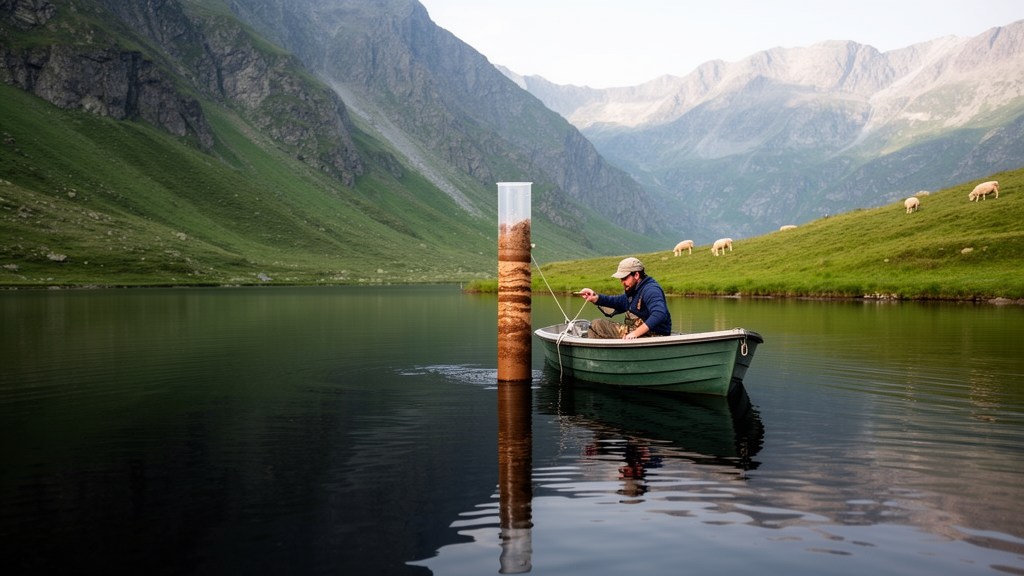
Beneath the waters of Tramacastilla Lake, a small reservoir tucked at 1,682 metres in the southern Pyrenees, lies a sediment archive that stretches back around 25,000 years. A team of Spanish and French researchers has now read that archive with an unusually broad toolkit, combining fossil pollen, sedimentary ancient DNA and microscopic charcoal to reconstruct how mountain landscapes changed since the last Ice Age. Their findings, published in Biogeosciences, suggest that today’s open, grassy subalpine scenery is neither a purely natural artefact of climate nor the product of human clearing alone, but the result of a partnership between the two that began roughly 6,000 years ago and has been renewed every generation since.
The study is the first integrated reconstruction of its kind for the Iberian Peninsula, and it tackles a question that has divided palaeoecologists for decades: were the treeless pastures of the Pyrenean subalpine belt opened by herders, or did climate do the heavy lifting? Traditional indicators of human activity in pollen records, such as cereal-type grains or plantain pollen, can be ambiguous in the Mediterranean region, because some of the same taxa also respond to natural climatic shifts. By layering multiple independent proxies from the same lake core, the researchers hoped to separate those signals with greater confidence than any single method allows.
The team retrieved two pairs of sediment cores from the lake’s deepest point in October 2020 and 2021, using a floating platform. Each core measured about nine metres long. The chronological backbone of the study rests on twenty-two radiocarbon dates processed at a laboratory in Seattle, woven into a Bayesian age-depth model that accounts for a sedimentary hiatus between roughly 20,000 and 15,000 years ago, when the lake appears to have been frozen for most of the year under glacial conditions. The uppermost two core sections showed signs of reworking and were excluded from the biological analyses to avoid distorting the record.
During the Last Glacial Maximum and the Lateglacial, the landscape around the lake was treeless and cold. Pollen from pine, wormwood, jointfir and goosefoot family plants dominated, consistent with other glacial-era records across the Pyrenees. When the Bølling warming arrived around 14,700 years ago, scattered pine formations persisted in an open steppe. The subsequent Allerød and Younger Dryas intervals are harder to read at this site because sedimentation rates were low, but the presence of deciduous oak and hazel pollen hints that tree populations survived nearby in regional refugia, supporting the idea that southern Europe served as a glacial sanctuary for temperate species.
The Early Holocene brought a dramatic transformation. As deglacial warming took hold, a mixed forest dominated by birch replaced the pine communities, an unusual pattern compared with other Pyrenean sites where hazel typically takes that role. The researchers propose that regular, low-intensity fires, probably ignited naturally by summer thunderstorms under a Mediterranean-influenced climate, gave pioneer birch an edge over hazel, which recovers more slowly after disturbance. Charcoal records show continuous fire occurrence through this period, yet the width-to-length ratio of charcoal particles indicates that grasses, not trees, were the main fuel, painting a picture of frequent but gentle ground fires in a landscape of high forest biomass.
The pivotal shift came around 8,200 years ago. An abrupt and sustained decline in plant biomass, recorded in pollen accumulation rates, coincides with a well-known cooling event that marks the start of the Mid-Holocene. Fire activity dropped sharply, and no fire episodes were detected for roughly seven centuries, suggesting cold, arid conditions had simply left too little fuel to burn. Crucially, no domestic animal DNA or clear anthropogenic indicators appear in the record at this stage, so the initial thinning of the forest cannot be blamed on people.
Then, between about 6,500 and 6,000 years ago, the story changes. Sedimentary ancient DNA from the cores revealed the first evidence of cattle and sheep around the lake, the earliest such continuous record of livestock in the Iberian Holocene. Runoff-dominated sediment layers signal increased erosion in the catchment, plant productivity declined across all vegetation types, and a cluster of fire episodes appeared precisely when a cave-based temperature reconstruction from the region shows its lowest Holocene values. The researchers interpret this conjunction as evidence that Neolithic pastoralists opportunistically exploited open ground created by climatic cooling, using fire to keep it open for grazing. Neither driver alone, they argue, explains the full pattern.
The Late Holocene deepened the human imprint. After about 4,000 years ago, charcoal accumulation reached its highest values around 2,100 years ago, and charcoal morphology shifted from herbaceous to woody fuel, indicating less frequent but more severe burns. Wild mammals such as red deer and brown bear, detected through DNA in older sediments, gave way to persistent livestock. Pollen of cereals and plantain climbed to their record highs. The authors also raise the possibility of selective management: deciduous oaks, whose acorns could have been valued as fodder, resist fire by resprouting and may have been deliberately spared, a practice echoing what landscape ecologists have called landscape fruiting. Meanwhile, the continued local presence of fire-sensitive fir suggests human impact never crossed the threshold that would have eliminated such vulnerable communities.
Perhaps the most methodologically interesting result is the comparison between pollen and sedimentary ancient DNA. The two proxies often disagreed. Anthropogenic taxa appear throughout the pollen record but only emerge in the DNA data around 6,000 years ago, implying that coarse pollen categories may overestimate early human influence by lumping in naturally occurring plants. Grasses, which dominate grazing diets, were underrepresented in the DNA record despite their prolific pollen, ruling out animal droppings as a major DNA source at this site. Tree taxa showed both convergent and divergent patterns depending on their pollen productivity. The researchers conclude that the two approaches are complementary, with DNA capturing local vegetation and pollen integrating the regional picture, though they caution that the taphonomy of lake sediment DNA still needs more study.
The implications reach into present-day conservation policy. The Pyrenean subalpine belt was grazed under transterminance, a system of short-distance seasonal livestock movement, until land abandonment in the last century triggered widespread reforestation. If these open landscapes are cultural artefacts sustained by millennia of low-intensity stewardship, as this study suggests, then protecting them may require deliberately emulating traditional grazing and burning practices rather than simply excluding human activity. The authors note that modern warming, rising atmospheric carbon dioxide and contemporary land-use pressures complicate direct translation of the past into management prescriptions. Still, their reconstruction supports the view that the Pyrenees host human-shaped biodiversity hotspots, and that without integrated management, rising temperatures could accelerate woody encroachment, elevate wildfire risk and quietly erase four millennia of ecological heritage.
Subject of Research: A 25,000-year multiproxy lake sediment reconstruction of climate and human interactions in the Pyrenean subalpine belt
Article Title: Human and climate-environment interactions in Pyrenean landscapes: a Lateglacial-Holocene multiproxy reconstruction
Article References: Julián-Posada, I., Gil-Romera, G., Moreno, A., Leys, B., Valero-Garcés, B., & González-Sampériz, P. (2026). Human and climate-environment interactions in Pyrenean landscapes: a Lateglacial-Holocene multiproxy reconstruction. Biogeosciences, 23(20), 7411-7446. https://doi.org/10.5194/bg-23-7411-2026
Image Credits: AI Generated
Keywords: Pyrenees, palaeoecology, sedimentary ancient DNA, pollen analysis, charcoal, Holocene, Neolithic pastoralism, fire history, Tramacastilla Lake, landscape management, Biogeosciences, Human
News Source: Violet Maxwell. (October 23, 2026). Lake mud reveals 25,000 years of climate and shepherds shaping the Pyrenees. Scienmag.