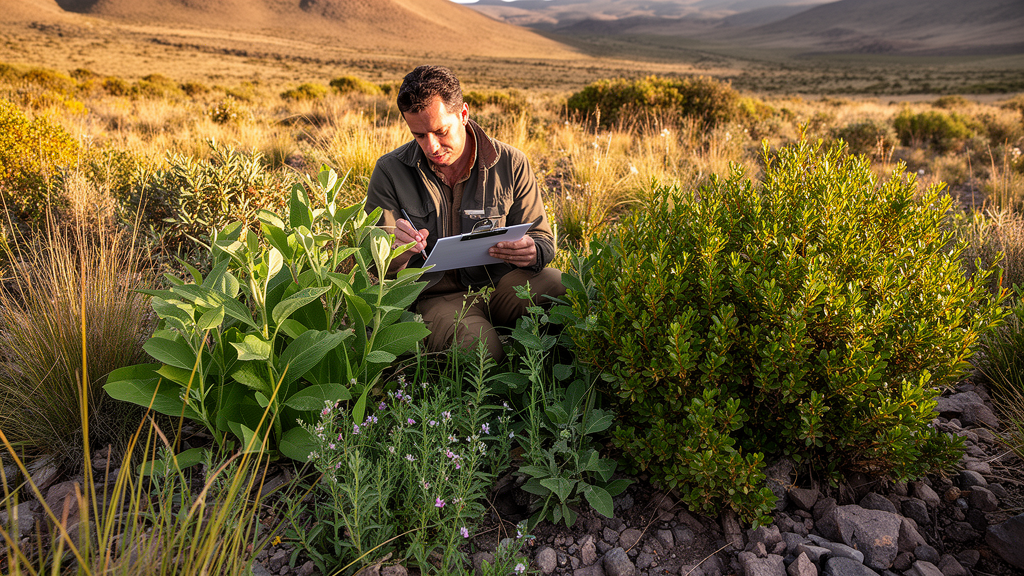
A repeated field survey of the high-altitude Wari-La region in Ladakh documented 82 vascular plant species belonging to 27 families. Researchers surveyed an elevation gradient of approximately 4,000–6,000 metres above mean sea level from April to October in 2023 and 2024. The study area encompassed Agyam, Tangyar, Wari-La and Sakti villages in Leh district, with Wari-La pass covering approximately 86 square kilometres between the Indus and Nubra valleys. The inventory provides a preliminary species-level account of an area that had received little systematic botanical attention and establishes a baseline for future floristic, ecological and ethnobotanical investigations.
This was a field-based floristic survey rather than a controlled ecological experiment. Investigators covered natural habitats across the altitudinal range, recorded the geographical coordinates of survey sites and collected representative specimens from multiple locations. Depending on the plant and its developmental stage, collections included roots, flowers and fruits. Specimens were pressed and dried in the field with newspaper, after which field information and taxonomy were recorded. The material was deposited at the National Institute of Sowa-Rigpa, allowing it to serve as a permanent reference for future identification and comparison.
Because no consistent literature or atlas described the plant species of the Wari-La sub-region, the researchers compiled accepted taxon names together with recorded elevations and habitat descriptions. Multiple specimens of each species were collected from different sites where possible. Identification was conducted at the National Institute of Sowa-Rigpa using the morphological characteristics of both fresh plants and mounted herbarium specimens. The process also drew on relevant floras, scientific publications and online taxonomic resources, including the eFlora of China, BSI Flora of India, eFlora of Pakistan, Flowers of India and other botanical databases.
The survey occurred in a high, cold and arid part of the Indian Trans-Himalayan region. Ladakh lies in the rain shadow of the Himalaya and is characterised by low precipitation, substantial temperature fluctuations, intense solar radiation, prolonged winter conditions and highly dissected terrain. Wari-La itself has no meteorological station. For climatic context, the study used data from Leh, approximately 80 kilometres away. Leh receives about 83 millimetres of annual precipitation, much of it as winter or occasional spring snow; mean monthly temperatures are reported as 5–10 °C, winter minima can reach approximately −28 °C, and summer maxima can reach about 25 °C. These are reference figures from Leh rather than direct measurements within the study area, an important limitation for interpreting conditions at Wari-La.
Asteraceae, the daisy family, was the most species-rich group in the inventory, accounting for 25 of the 82 recorded species. Brassicaceae, Fabaceae and Lamiaceae each contributed five species. Caryophyllaceae, Polygonaceae, Saxifragaceae and Ranunculaceae each had four, while Crassulaceae and Rosaceae each had three. Boraginaceae, Cyperaceae, Gentianaceae and Primulaceae contributed two species apiece. Thirteen additional families—Apiaceae, Caprifoliaceae, Cystopteridaceae, Ephedraceae, Euphorbiaceae, Liliaceae, Orobanchaceae, Plantaginaceae, Plumbaginaceae, Poaceae, Selaginellaceae, Urticaceae and Rhamnaceae—were represented by one species each. The species list therefore captured both the leading families in the survey and the smaller representation of other plant groups.
Photographs accompanying the study show examples drawn from this taxonomic range. They include Rhodiola pamiroalaica, Rhodiola wallichiana, woolly and three-lobed Waldheimia species, several Saussurea taxa, Saxifraga flagellaris, clustered Astragalus species, Artemisia salsoloides, Gentiana nubigena, Delphinium brunonianum, Ranunculus.longicaulis, several Nepeta and Cremanthodium species, and Primula macrophylla. Other illustrated records include Minuartia foliosa, Bistorta vivipara, Aster flaccidus, Dasiphora dryandanthoides, Heteropappus semiprostrata, Acantholimon lycopodioides, Ajania fruticulosa and Urtica hyperborea. The figures document particular members of the collected flora but do not provide population estimates for the photographed species.
The authors compared the Wari-La total with an earlier inventory of 355 vascular plants from Lower Sham in Ladakh. That study covered about 400 square kilometres, whereas the Wari-La survey area was approximately 86 square kilometres, and the two inventories were not equivalent in sampled area or geographic setting. The comparison therefore describes a difference between two recorded datasets rather than a trend through time. The Wari-La paper also referred to an unpublished expectation based on the flora of central Ladakh that approximately 25% of regional species might be unique to high-altitude zones. Because this proportion was not calculated directly from the new Wari-La inventory, the survey does not establish an exact percentage of species restricted to the pass.
Wari-La also has ethnobotanical importance. The area is described as an important source of high-altitude medicinal flora used by local Amchi healers, who practise Sowa-Rigpa, the traditional medical system of Ladakh. Across Ladakh as a whole, the published flora checklist contains 1,810 taxa in 530 genera and 91 families, with nearly 525 taxa used in traditional medicine. Wild plants also serve local needs as sources of vegetables, fuel, fodder, medicines, dyes and ornamental materials. The Wari-La species inventory does not itself investigate medicinal uses or test the safety or effectiveness of any plant or treatment; it identifies the regional flora against which more focused ethnobotanical work can proceed.
Pastoral activity forms an important part of life around Wari-La. Most residents remain in surrounding villages during winter and migrate to high-altitude grazing pastures in summer, where they keep yaks and other livestock in temporary camps or small huts made from mud and stone. The study notes that grazing pressure and human activity may affect the regeneration and distribution of sensitive alpine species. It therefore calls for long-term monitoring, detailed ecological investigation and sustainable grazing management. The present inventory cannot measure changes in abundance, population decline or climate effects: it is a baseline account of species occurrence rather than a long-term population study, although its repeated seasonal observations and preserved herbarium specimens can provide references for future comparisons.
Botanical knowledge of Ladakh remains incomplete because access is difficult, the collection season is short and geopolitical constraints have limited sustained fieldwork. Earlier plant collecting was concentrated largely along roads and in broad valleys, leaving remote mountain ranges and narrow sections of the Indus, Shyok and their tributaries less thoroughly surveyed. Research from the nineteenth century onward expanded the regional record through collections, floras and taxonomic studies, while a herbarium at the Defence Institute of High-Altitude Research was reported to hold more than 6,600 Ladakh specimens. Even so, basic estimates of richness in some subregions remain uncertain. The Wari-La inventory closes part of that geographic gap with 82 verified species records and provides a structured foundation for future work in a cold-desert environment shaped by elevation, aridity and highly variable access.
Subject of Research: Floristic inventory of 82 vascular plant species across the Wari-La high-altitude region of Ladakh, India
Article Title: Floristic diversity and vascular plant contributions of Wari-La trans Himalaya Ladakh India
Article References: Gurmet, P., Rinchen, T., Lhamo, S., Chorol, S., & Kareem, A. (2026). Floristic diversity and vascular plant contributions of Wari-La trans Himalaya Ladakh India. Discover Plants, 3(1), 475. https://doi.org/10.1007/s44372-026-00889-2
Image Credits: AI Generated
DOI: 10.1007/s44372-026-00889-2
Keywords: Wari-La, Ladakh, vascular plants, floristic diversity, high-altitude ecology, cold desert, Trans-Himalaya, botanical survey, Sowa-Rigpa, plant conservation, Floristic, diversity
News Source: Alan Morgan. (October 22, 2026). Wari-La Field Survey Records 82 Vascular Plant Species. Scienmag.