A comprehensive review concludes that textile organic electrochemical transistors have progressed from fibre-based prototypes into a broader family of wearable bioelectronic platforms, including printed, coated, embroidered, woven, stacked and vertical devices. The review finds that these transistors can amplify biochemical and physiological signals while operating in soft, conformal fabrics, but it also identifies long-term stability, washability, scalable manufacturing and standardized testing as unresolved barriers. The synthesis covers materials, device structures and laboratory demonstrations in ion and metabolite sensing, electrophysiology and neuromorphic systems. It does not report a new clinical trial, human validation of a finished garment or evidence that the technology is ready for routine medical use.
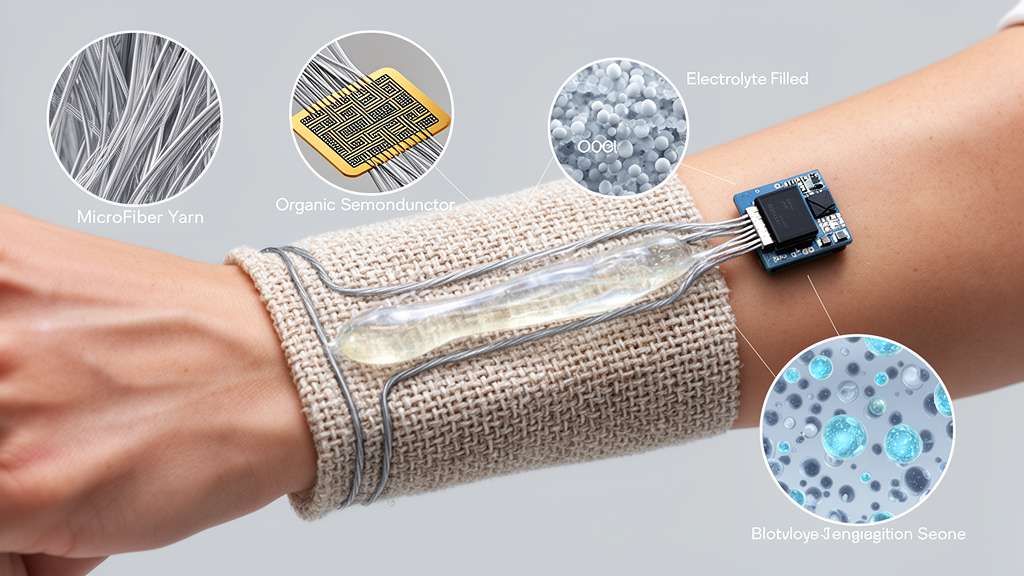
Textile organic electrochemical transistors, commonly abbreviated textile OECTs, are three-terminal devices with source, drain and gate electrodes, an organic mixed ionic-electronic conductor as the channel, and an electrolyte that ionically connects the gate to that channel. A drain voltage drives electronic current between source and drain, while the gate voltage causes ions to enter or leave the channel and alter its electrochemical doping state. Because this interaction occurs throughout the channel volume rather than being confined to an interface, small changes in ion concentration, redox state or interfacial charge can be translated into amplified changes in drain current. That coupling is especially useful for aqueous biological environments, including sweat, saliva, wound exudate and interstitial fluid, although the review emphasizes that the practical targets for these devices are sensing and bioelectronic interfaces rather than established clinical products.
PEDOT:PSS is overwhelmingly the channel material used in the textile OECT examples surveyed by the review. It combines high conductivity, good film formation, aqueous processability and compatibility with coating and printing methods suited to rough, porous and deformable substrates. In a typical p-type depletion-mode device, the channel is conductive at zero gate bias; a positive gate bias drives cations into the material, compensates its negative counterions and reduces the density of mobile holes, lowering the drain current. Modern n-type and ambipolar conductors are also under development, with electron-deficient backbones and side-chain engineering used to control electron transport, ion uptake, swelling and crystallinity. Nevertheless, the review finds that relatively few textile OECTs use materials other than PEDOT:PSS, leaving a gap between advances in molecular design and their use in fabric-based devices.
Channel materials must balance two competing requirements: ions must penetrate rapidly and uniformly to enable volumetric charging, while the conjugated polymer must retain enough electronic connectivity to carry the resulting carriers. Excessive ion uptake can produce swelling, structural disorder and reduced mobility, whereas tightly packed or crystalline films may support electronic transport while restricting ion access. Backbone planarity, molecular weight, side-chain polarity, crystallinity, film morphology and processing all affect that balance. The product of charge-carrier mobility and volumetric capacitance is consequently used as a material figure of merit because it relates directly to transconductance in the Bernards–Malliaras steady-state model. Electrolytes present a parallel problem: liquids offer high ionic conductivity but can leak, evaporate, become contaminated or undergo electrolysis, whereas hydrogels, ionogels, eutectogels and other quasi-solid systems aim to retain ionic conduction while improving mechanical integrity and solvent retention.
Gate electrodes also influence the electrical and electrochemical behavior of the complete transistor. Gold, platinum and Ag/AgCl are common gate materials because they are conductive and electrochemically stable, with Ag/AgCl providing a nearly non-polarizable, reference-like potential in aqueous media. The gate is normally designed to have a much larger capacitance than the channel so that most of the applied gate voltage appears across the channel-electrolyte interface. Carbon-based materials, including carbon cloth, graphite and graphene, and conducting polymers offer alternatives that can provide large electroactive surfaces, low-temperature processing and greater mechanical compliance than rigid metals. However, interfacial charge-transfer kinetics, gate polarization and parasitic faradaic reactions can affect the operating window and stability, making gate design a joint materials, electrochemical and manufacturing problem.
The review divides the field into three overlapping architecture families. Fibre-, yarn- and filament-based devices use conductive threads as channels, gates or electrodes in parallel, crossed, twisted or coaxial arrangements that can be sewn, embroidered, woven or knitted. Printed textile OECTs deposit or pattern functional materials in lateral layouts on woven, knitted or non-woven fabrics, offering a potential route to large-area and low-cost production. Vertical and stacked devices arrange electrodes above one another so charge transport occurs mainly through the thickness of the active layer. The shorter effective channel of a vertical device can support higher transconductance and faster switching, while fibre and printed approaches may be more straightforward routes to textile production. Because vertical geometries are now being built on fibres and printing is also used to assemble stacks, the categories increasingly overlap, and the review treats them as an organizing framework rather than mutually exclusive classes.
Biochemical sensing is the most mature application area in the literature summarized by the review. Textile OECTs have been reported for sodium, potassium, calcium, chloride, aluminium and lead ions, with selectivity supplied by ion-selective membranes, functional gate coatings or electrolyte engineering. Metabolite and biomarker demonstrations include glucose, lactate, urea, dopamine, uric acid, tyrosine, ascorbic acid, hydrogen peroxide, cortisol, adrenaline and lactic acid. Enzymes such as glucose oxidase, lactate oxidase and urease can be immobilized at the gate or, less commonly, in the electrolyte, with biochemical reactions altering gate potential, pH or ionic strength and thereby modulating channel current. One screen-printed glucose device reported a sensitivity of 18.41 µA mM−1 cm−2 across a stated clinically relevant concentration range of 20–1000 µM. Molecularly imprinted polymers can provide enzyme-free recognition, but their reported behavior remains sensitive to ionic strength, pH and other matrix effects.
Textile OECTs can also amplify weak bioelectric potentials because the gate responds to ionic activity at the skin interface. A double-stranded fibre transistor recorded electrocardiograms and, when operated with intrinsic amplification, increased the reported peak current from approximately 25 to 40 nA while resolving the P-Q-R-S-T waveform. A separate vertical fibre OECT implanted in rats supported continuous electrocardiogram monitoring for seven days, although that animal result does not establish a human clinical benefit. More recent architectures use electrospun nanofibrous electrodes, porous solid-state electrolytes and gas-permeable structures to improve ion transport, breathability and conformity. Pressure-sensitive fibre OECTs have also produced reproducible current increases over 0–40 kPa, with amplification reported up to 92% in the reviewed laboratory configuration. These results illustrate several transduction routes, but they come from different device designs, materials and test conditions rather than a standardized clinical comparison.
The same ionic-electronic coupling is being used for textile computation. One woven neuromorphic network contained 100 individually addressable P3CT neurofibres and 10 gate microfibres, exhibited paired-pulse facilitation and short- and long-term plasticity, and was used in a spatiotemporal spiking network for spoken-digit recognition with an average classification accuracy of 88.9%. Other fibre devices produced chemical-selective memory, with dopamine generating persistent conductivity changes under repeated stimulation in the reported experiments. Textile logic has likewise advanced from fibre inverters and multiplexers to AND and OR gates, while printed and stacked configurations support denser layouts. These are demonstrations of individual laboratory configurations; they do not show that complete garments containing standardized electronics, power management and data processing are ready for routine use.
The review identifies durable, reproducible, textile-compatible fabrication as the central translation challenge. Conductive coatings may crack, delaminate, dedope or swell, while electrolytes can lose solvent through sweat, humidity and laundering. Many studies report short-term bending or stretching, but systematic evidence on prolonged exposure to combined mechanical, chemical, thermal and biological stressors remains scarce. Washing procedures are also rarely standardized, restricting comparisons among devices. Reproducibility is further complicated by variations in yarn diameter, fibre composition, surface roughness, fabric porosity, coating uptake, contact resistance and local strain. Future reports need device counts, means, variation, fabrication yield and retained electrical and sensing performance after clearly defined mechanical, environmental and laundering protocols.
No single architecture currently combines all the requirements expected of a practical wearable product. Fibre and yarn systems provide the most direct integration with garments and excellent conformity, but coating uniformity, reliable contacts and reproducible channel-electrolyte junctions remain difficult. Printed planar systems suit scalable patterning and multiplexed arrays, yet porous fabrics can absorb ink unevenly, patterns may crack under strain and electrolytes can be lost during washing. Vertical and stacked geometries offer compactness and potentially rapid response, but require precise alignment, controlled layer thickness, strong interlayer adhesion and reliable electrolyte confinement. The review therefore presents textile OECTs as a promising convergence of organic electronics, wearable bioelectronics and textile engineering, while concluding that meaningful progress depends on durable materials, washable systems, reproducible manufacturing and common benchmarks evaluated under realistic conditions.
Subject of Research: Review of textile organic electrochemical transistors for wearable biosensing and bioelectronics
Article Title: Textile organic electrochemical transistors in biosensing and bioelectronics including materials architectures and emerging applications
Article References: Brendgen, R., & Schwarz-Pfeiffer, A. (2026). Textile organic electrochemical transistors in biosensing and bioelectronics including materials architectures and emerging applications. Discover Electrochemistry, 3(1), Article 89. https://doi.org/10.1007/s44373-026-00166-7
Image Credits: AI Generated
DOI: 10.1007/s44373-026-00166-7
Keywords: textile OECTs, wearable bioelectronics, organic transistors, biosensors, smart textiles, ionic-electronic coupling, PEDOT:PSS, electrophysiological monitoring, metabolite sensing, neuromorphic textiles, Textile, organic
News Source: Sylvia Mullen. (October 21, 2026). Textile organic electrochemical transistors in biosensing and bioelectronics including materials architectures and emerging applications. Scienmag.