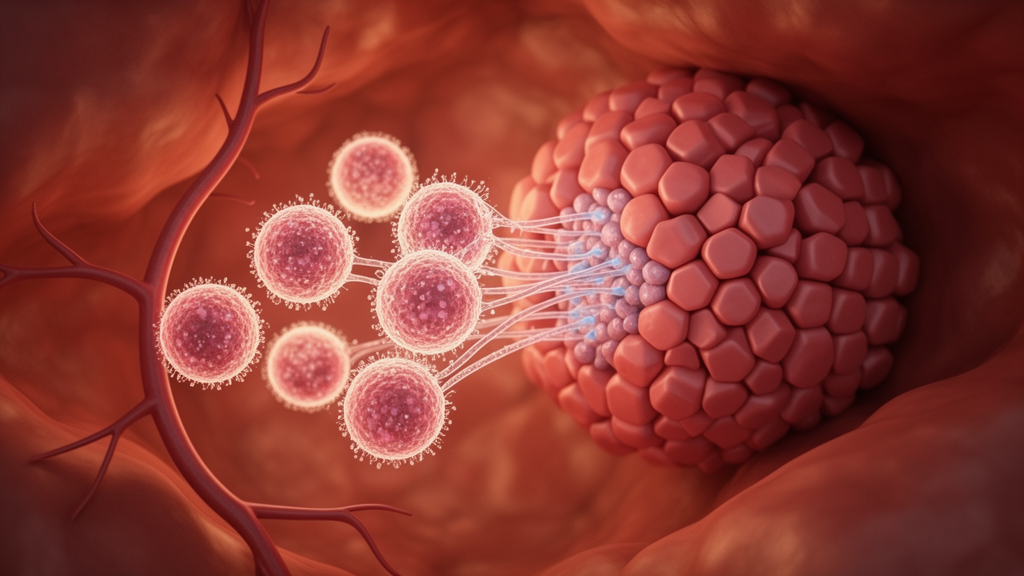
T cell receptor-engineered T cells can recognize peptide fragments of intracellular proteins, offering a route to treating hepatocellular carcinoma that is not restricted to proteins exposed on the tumor surface. A 2026 review concludes that the approach has advanced from candidate discovery into early clinical evaluation, including trials directed against alpha-fetoprotein and hepatitis B virus antigens, but that antigen heterogeneity, HLA restriction, a suppressive liver microenvironment and limited persistence continue to constrain its reach. The review assesses current engineering strategies, safety findings and manufacturing methods rather than reporting a new clinical trial, and emphasizes that most proposals for broader use remain preclinical or experimental.
Hepatocellular carcinoma accounts for approximately 75% to 85% of primary liver cancers and develops against a background of chronic disease, including hepatitis B virus, hepatitis C virus and metabolic liver disorders. The review cites 843,045 new liver cancer cases and 732,489 deaths globally in 2024, with a five-year relative survival rate of about 13%. Although surgery, transplantation, ablation, anti-angiogenic drugs and immune checkpoint inhibitors have expanded the treatment landscape, response rates in advanced disease remain limited.
A phase III trial of atezolizumab plus bevacizumab produced a 12-month overall-survival rate of 67.2%, better than sorafenib, while second-line nivolumab and pembrolizumab produced objective response rates of 20% and 18.3%, respectively, without statistically significant improvements in overall or progression-free survival over controls. These results establish why additional immune-based approaches are being investigated without implying that TCR-T therapy has already become standard care. The defining feature of TCR-T therapy is its ability to target antigens processed inside cells and displayed by major histocompatibility complex molecules.
A conventional T cell receptor is an alpha-beta heterodimer associated with the CD3 signaling complex; peptide recognition by the receptor is communicated intracellularly through tyrosine-based motifs in the CD3 chains. This differs from chimeric antigen receptor T cells, which usually detect a surface antigen directly through an antibody-derived binding domain. The review describes experimental comparisons in which TCR-T cells maintained proliferative capacity and lower coinhibitory-receptor expression under intense antigenic stimulation, but it cautions that the platforms should be viewed as complementary rather than competing, because each depends on a different form of antigen recognition.
Potential targets for HCC fall into several categories. Tumor-associated antigens include alpha-fetoprotein, which is expressed in up to 50% of HCCs but can also occur in nonmalignant liver tissue, particularly in some progenitor-cell populations during chronic inflammation. Cancer-germline antigens such as MAGE-1, MAGE-3, GAGE and BAGE were detected in subsets of HCC samples without expression in noncancerous liver tissue, while NY-ESO-1 responses were observed in patients with different disease stages.
Viral antigens are especially attractive in HBV-associated disease because viral peptides can be presented by infected hepatocytes. Neoantigens generated by tumor mutations offer greater potential specificity: two immunogenic candidates identified in tumors from 14 patients were derived from mutant ENTPD6 and ALG1, with the ENTPD6-directed cells subsequently validated in a mouse model. Shared driver mutations may make some neoantigens public, whereas most remain private to individual tumors.
Finding a tumor antigen is only one stage in selecting a therapeutic receptor. Single-cell RNA sequencing, paired T-cell receptor sequencing and barcoded peptide–MHC tetramers can connect receptor sequences with antigen specificity and activation states, while transcriptional markers such as CD39, PD-1, LAG-3, TIM-3, CD103, 4-1BB and OX40 help prioritize candidate populations. These approaches cannot establish tumor specificity from abundance or phenotype alone: many infiltrating lymphocytes are bystanders responding to viral or microbial antigens, and genuine tumor-reactive cells are often rare.
Functional testing, peptide–HLA cross-reactivity analysis and validation against normal tissues remain necessary before a receptor reaches preclinical development. Manufacturing begins when autologous T cells are isolated, activated, equipped with a therapeutic receptor, expanded and returned to the patient. Lentiviral and retroviral vectors are established delivery methods, while nonviral approaches include transposons, CRISPR–Cas9, base editing and transient RNA electroporation.
Integrating vectors can produce variable transgene copy numbers and retain endogenous receptor chains that pair with introduced chains, potentially creating autoreactive or alloreactive receptors. Genome editing can replace endogenous alpha and beta chains, and the review describes the use of zinc-finger nucleases and CRISPR–Cas9 to redirect specificity with high functional avidity. Transient RNA delivery avoids insertional mutagenesis but may require repeated infusions because the receptor is expressed only temporarily.
Circular messenger RNA resists exonuclease degradation and can sustain protein translation in primary T cells for more than seven days, although it remains a transient expression strategy. Safety is the central constraint on translating the platform into routine HCC care. Three principal mechanisms of injury are recognized: on-target, off-tumor recognition when the same peptide–HLA complex appears on healthy cells; off-target cross-reactivity with unrelated self-peptides; and alloreactivity caused by mispaired or incompletely controlled receptors.
In a phase I trial of ADP-A2AFP TCR-T cells in advanced HCC or gastric hepatoid carcinoma, cytokine release syndrome occurred in six of 21 patients, including one grade 4 event, while no immune cell-associated neurotoxicity syndrome was reported. In a six-patient study of the HBV-specific SCG101 product, all patients developed cytokine release syndrome, four had grade 3 events, and all experienced transient grade 3 or 4 transaminase elevations. These small, heterogeneous trials do not permit direct comparisons, and the severity of liver toxicity is especially consequential when malignant disease already involves the liver.
Past trials outside HCC illustrate why affinity engineering requires caution. An affinity-enhanced MAGE-A3 receptor unexpectedly recognized a titin-derived peptide, producing fatal cardiac toxicity, while another anti-MAGE-A3 program caused severe neurological injury that investigators linked to previously unrecognized MAGE-A12 expression in the brain. These events show that a receptor’s equilibrium binding affinity does not fully predict which peptide–HLA complexes it will engage in a patient.
The review therefore advocates broad peptide screening, human proteome analysis, physiologically relevant cultures and organoid-based testing, as well as cautious dose escalation and close monitoring. Inducible suicide systems and logic-gated receptors, including designs that require both a tumor antigen and a second confirming signal, are proposed as controllable safeguards, although they have not yet been clinically validated for HCC. Even a safe and selective receptor may fail once it enters the tumor.
HCC commonly contains regulatory T cells, myeloid-derived suppressor cells and tumor-associated macrophages that release inhibitory cytokines and chemokines. TGF-β signaling from cancer-associated fibroblasts can suppress CXCR3 expression and restrict T-cell migration, while extracellular matrix proteins form physical barriers. HCC-derived exosomes can also promote PD-L1 transport to tumor-associated macrophages through GOLM1, intensifying suppression of CD8 T cells.
Metabolic competition adds another layer: lactate can inhibit NFAT signaling and favor regulatory T-cell expansion, while regulatory T cells release IL-10 and IL-35 that reduce transferred-cell proliferation. Proposed countermeasures include deleting inhibitory receptors, adding chemokine receptors, supporting cells with IL-7, IL-15 or IL-21, introducing c-Jun or other transcriptional changes, and combining treatment with agents that alter metabolism or ferroptosis. These approaches have shown promise in models; their clinical value in HCC remains unproven.
Recurrent HCC after liver transplantation presents a particularly difficult test because anticancer treatment must coexist with immunosuppression that protects the graft. HBV-specific TCR-T cells have nevertheless produced signals of activity in this setting: in a reported transplant recipient, the cells survived and expanded, lowered circulating hepatitis B surface antigen and did not worsen liver inflammation or cause other major toxicity. Maintenance drugs such as tacrolimus and mycophenolate nevertheless inhibit pathways required for T-cell activation and proliferation.
Transiently drug-resistant TCR-T cells have therefore been engineered by delivering receptor and resistance-associated messenger RNAs, retaining function for three to five days before returning to sensitivity. The review also identifies AFP-L3 and des-gamma-carboxy prothrombin as potential biomarkers for early recurrence, but prospective studies are still needed to establish their utility for selecting and monitoring patients. Looking ahead, the authors prioritize four linked objectives: making cells function within the immunosuppressive liver environment, widening eligibility beyond narrow HLA and antigen combinations, using artificial intelligence to accelerate receptor discovery and design, and making safety more predictable.
Public neoantigens, prevalent HBV antigens and HLA-agnostic gamma-delta T-cell approaches could broaden access, although each requires dedicated validation. Computational pipelines may integrate sequencing, immunopeptidomics, HLA typing and receptor repertoires, and an AFP-directed example used AlphaFold2 and a structure-based deep-learning scan to identify a receptor variant with improved antigen sensitivity and activation of both CD4 and CD8 cells. Such predictions cannot substitute for experimental testing.
The review’s overall conclusion is measured: TCR-T therapy is an evolving option for selected patients with HCC, with early clinical signals and substantial technical promise, but durable benefit will require better target selection, scalable manufacturing, biomarker-guided patient stratification, randomized comparisons and long-term surveillance of persistence, immune escape, secondary malignancy risk and treatment toxicity.
Subject of Research: T cell receptor-engineered T-cell therapy for hepatocellular carcinoma
Article Title: T cell receptor-engineered T cells for hepatocellular carcinoma: next steps and future perspectives
Article References: Li, Z., Shu, J., Zhang, Q., Su, S., Zhou, J., Luan, Y., Xu, J., Gu, J., & Huang, X. (2026). T cell receptor-engineered T cells for hepatocellular carcinoma: next steps and future perspectives. Clinical Cancer Bulletin, 5(1), Article 23. https://doi.org/10.1007/s44272-026-00075-1
Image Credits: AI Generated
DOI: 10.1007/s44272-026-00075-1
Keywords: hepatocellular carcinoma, TCR-T therapy, adoptive cell therapy, tumor antigens, neoantigens, hepatitis B virus, gene engineering, tumor microenvironment, liver transplantation, cancer immunotherapy, cell, receptor-engineered
News Source: Nathaniel Bowman. (October 21, 2026). TCR-engineered T cells advance toward harder liver cancer targets. Scienmag.