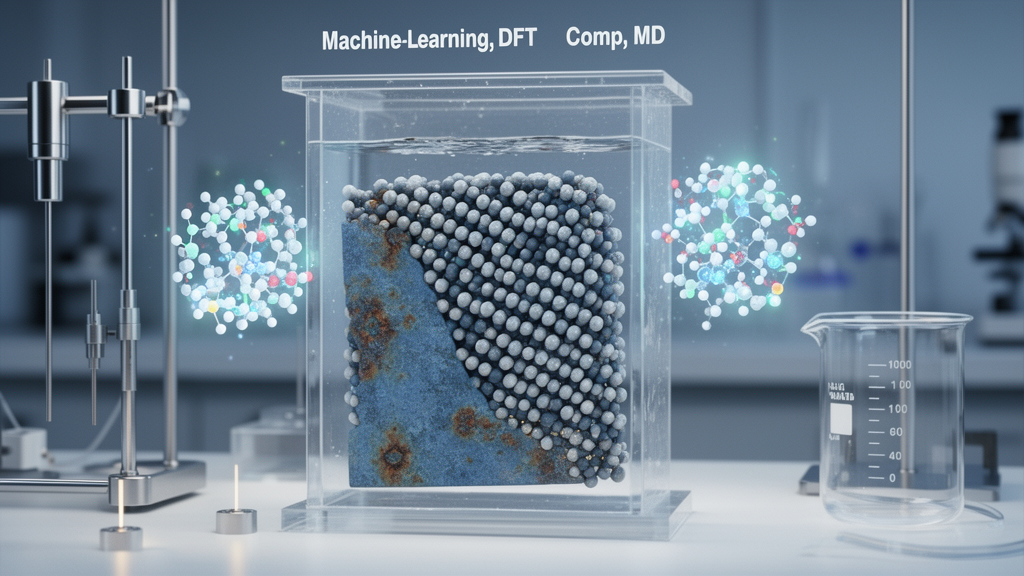
A critical review of computational corrosion research concludes that combining machine learning, density functional theory and molecular dynamics could accelerate the design of corrosion inhibitors, but current systems remain fragmented, data-starved and weakly validated for dependable industrial use. The analysis focuses mainly on organic inhibitors for mild steel in acidic environments, where hydrochloric and sulfuric acids are used in pickling, acid cleaning, petroleum refining and chemical processing. Rather than demonstrating a new inhibitor, the review evaluates how three computational approaches can be linked coherently and identifies the experimental, computational and data standards required to turn computational predictions into experimentally grounded candidates.
Corrosion of mild steel in acid proceeds through an electrochemical cycle in which iron dissolves at anodic sites while hydrogen ions are reduced to hydrogen at cathodic regions. Chloride and other aggressive ions can destabilize surface films, alter interfacial charge and promote localized attack, while the actual steel–solution boundary remains dynamic rather than uniform. Conventional techniques such as electrochemical impedance spectroscopy, potentiodynamic polarization and weight loss provide essential performance measurements but infer molecular behavior indirectly. The review argues that this creates a gap between observed inhibition and understood mechanism: competing adsorption, protonation, surface restructuring and film formation are often simplified even when a candidate appears effective.
Organic corrosion inhibitors are among the most extensively investigated protection strategies for metallic systems in aggressive acidic media. Their performance is commonly linked to heteroatoms and functional groups that enable adsorption on metal surfaces and the formation of protective molecular films. Recent work has shifted toward rational molecular design guided by quantum-chemical descriptors and data-driven methods, including amino acids, triazole derivatives, Schiff bases, ionic liquids, plant-derived extracts, polymers and nano-enabled systems. The review highlights that these materials can involve multi-site adsorption, synergistic interactions and hybrid physical and chemical inhibition pathways, making conventional electrochemical interpretation alone insufficient for some modern inhibitors.
Density functional theory, or DFT, supplies the electronic layer of the proposed workflow. It calculates quantities associated with electron donation, acceptance and adsorption, including the energies of the highest occupied and lowest unoccupied molecular orbitals, the energy gap between them, dipole moment, chemical hardness, softness, chemical potential, electronegativity and electrophilicity. These descriptors can be combined with experimentally measured inhibition efficiency to train predictive models, allowing a much larger molecular search than laboratory testing alone would permit. Many studies associate higher HOMO energies, lower energy gaps and related reactivity measures with better inhibition, but the relationships are dataset-dependent and cannot be assumed to transfer unchanged to different inhibitor families or corrosive media.
The central weakness of DFT is that it usually presents a static picture. Gas-phase calculations or implicit-solvent models may omit the protonation states, water structure, chloride competition and time-dependent rearrangement that control adsorption in acidic solution. Frontier molecular orbital maps are therefore best treated as qualitative electronic indicators rather than direct predictions of how strongly a compound will adsorb under operating conditions. The review calls for calculations that use explicit solvent and appropriate protonation states, together with experimental checks on whether the proposed electronic mechanism agrees with electrochemical and surface observations. Even then, DFT cannot by itself establish the long-term stability of a protective film or how an inhibitor will behave on a changing industrial surface.
Molecular dynamics, or MD, adds time and interfacial detail. Simulations of metal slabs, commonly including Fe(110), can follow inhibitor migration, rotation, adsorption geometry, film organization and displacement by hydronium or chloride ions. Explicit water and ions make it possible to examine solvent-mediated interactions, near-parallel molecular alignment, heteroatom anchoring and cooperative film formation that are difficult to infer from static calculations. MD can also produce numerical features such as adsorption energy, binding distance and interfacial stability for use in machine-learning models. Published simulations reviewed in the paper, however, commonly lasted from hundreds of picoseconds to about one nanosecond, used simplified force fields and varied little in temperature or concentration. Such windows can reveal initial adsorption yet remain insufficient for confidently describing slow restructuring, desorption or long-term film stability.
Machine learning offers the missing scalability. Random forests, support vector regression, artificial neural networks, gradient-boosting models and newer graph-based approaches can correlate molecular structures, quantum descriptors, interfacial properties and measured inhibition efficiency, then rank candidates that would be impractical to test exhaustively. Feature-importance tools such as SHAP can reveal which descriptors a model relies upon, while clustering methods can group compounds by structural similarity. The review also examines a high-throughput pipeline that converts amino-acid structures into machine-readable representations, uses droplet-microarray experiments to create corrosion-response maps, and combines interpretable models with DFT and electrochemical validation. Such a loop could direct scarce laboratory effort toward the most informative experiments if its outputs remain physically meaningful.
Yet the models reviewed often achieve high accuracy within narrow datasets while failing to generalize. Training sets can contain only tens to a few hundred measurements, and reported metadata may omit acid type and concentration, inhibitor dose, immersion time, temperature, steel composition, surface preparation or the electrochemical method used to calculate the target. Units and reporting formats also vary. Random-forest importance rankings can shift when descriptor distributions change, support vector performance depends on kernel selection, and deep networks are often applied to datasets too small and chemically narrow to support their capacity. Metrics such as mean absolute error, root mean squared error and R² describe fit or prediction error, but they do not establish physical validity, robustness under changing conditions or reliability outside the training domain.
The review identifies datasets as the most urgent bottleneck. Experimental corrosion results are dispersed across papers and supplements, while general chemistry and materials databases contain molecular or structural information without standardized corrosion measurements. No current source integrates experimental inhibition efficiency, complete test conditions, DFT descriptors and MD-derived interfacial properties in a corrosion-specific format. The proposed solution is an open benchmark database with harmonized units, explicit uncertainty, external test sets and grouped splits that keep related inhibitor families or chemical conditions from leaking between training and testing. Models should be tested on unseen acids, alloys and inhibitor classes, with uncertainty propagated through every computational stage rather than reduced to a single accuracy score.
Case studies in the review illustrate the gap between promising accuracy and industrial relevance. Combined ML–DFT–MD screening of benzimidazole derivatives produced predicted inhibition efficiencies above 98%, but cross-validation was modest and experimental validation was limited. Other studies reported very high R² values, protection above 85% or 95% inhibition, and confirmation of protective films by microscopy, while being restricted to particular ionic liquids, concentrations, exposure times or chemical families. GNN and ensemble models reportedly achieved R² above 0.90 on unified datasets, yet performance declined for flexible molecules and fragmented data. These observations are reported results from individual studies, not evidence that an integrated platform has already been validated for industrial deployment.
Software fragmentation is an additional barrier. Typical workflows manually transfer information among quantum-chemistry packages, molecular-dynamics programs and Python-based machine-learning tools, making end-to-end reproduction difficult and limiting genuine multiscale integration. Computational cost also matters: DFT becomes expensive for large molecules and extended metal–electrolyte interfaces, while MD requires longer simulations and explicit solvation to sample adsorption dynamics reliably. The review recommends modular tools with shared interfaces, open workflow templates and surrogate models, including machine-learned interatomic potentials, that can reduce the computational burden. Such measures would need to preserve consistency among units, physical assumptions and experimental labels rather than merely accelerating disconnected calculations.
The authors’ preferred end point is a closed-loop discovery system in which simulation guides experiments, validated measurements return to the dataset and uncertainty-aware models decide what to test next. Physics-informed and explainable models could link predictions to adsorption energy, molecular orientation, ion competition and surface coverage, while generative methods could propose candidates satisfying performance and chemical constraints. The review also considers longer-term possibilities in which sensor data feed digital twins for adjusting inhibitor formulation and dosage, but this remains a prospective application rather than a demonstrated industrial capability. The same distinction applies to industrial-scale screening: the proposed workflow is a roadmap, not a validated discovery platform.
Overall, the review finds that no single method can deliver reliable inhibitor design on its own. DFT offers electronic resolution but limited dynamics, MD captures interfacial behavior under constrained conditions, and machine learning scales predictions while remaining dependent on data, interpretability and external validation. Near-term progress therefore depends less on adding another algorithm than on aligning the physical model, experimental protocol and data pipeline. A genuinely integrated workflow would explicitly model solvation, protonation and competitive adsorption; test predictions across multiple acidic environments; use long-term and industrial conditions; and maintain an auditable trail from candidate ranking to experimental confirmation. The result would be a roadmap, not a finished discovery platform, but it identifies a concrete route toward corrosion-inhibitor development that is less dependent on trial and error and more accountable to physical evidence.
Subject of Research: Critical review of integrated machine learning, density functional theory and molecular dynamics for corrosion-inhibitor design
Article Title: Integrating machine learning, density functional theory, and molecular dynamics for smart corrosion inhibitor design: a critical review
Article References: Mohammed, N. J., Yusop, M. R., & Othman, N. K. (2026). Integrating machine learning, density functional theory, and molecular dynamics for smart corrosion inhibitor design: a critical review. Journal of Saudi Chemical Society, 30(3), Article 41. https://doi.org/10.1007/s44442-026-00089-3
Image Credits: AI Generated
DOI: 10.1007/s44442-026-00089-3
Keywords: corrosion inhibition, mild steel, machine learning, density functional theory, molecular dynamics, computational chemistry, predictive modeling, acidic corrosion, materials informatics, quantum chemistry, Integrating, machine
News Source: Teresa Odom. (October 21, 2026). Integrating machine learning, density functional theory, and molecular dynamics for smart corrosion inhibitor design: a critical review. Scienmag.