A laboratory study of five sisal-fiber epoxy laminates found that the formulation containing three layers of sisal mat had the best reported mechanical performance, with a tensile strength of 88.1 MPa, a flexural strength of 132.10 MPa and an elongation of 5.50%. Each laminate also contained fine biochar particles derived from sisal fibers at a fixed loading of 5 wt%. The results were reported in the Journal of Materials Science.
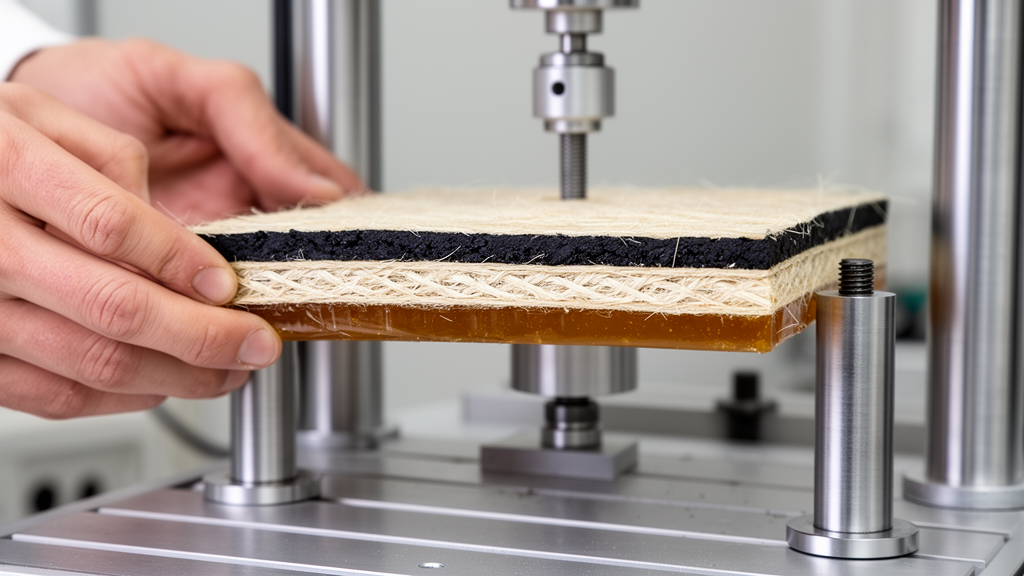
For the experimental series, the researchers produced biochar through controlled pyrolysis of sisal fibers and incorporated the particles into an epoxy matrix as filler. They then made five laminates containing zero, one, two, three or four layers of sisal mat using the hand lay-up method. Mechanical performance improved incrementally as the number of mat layers increased, with the three-layer formulation recording the highest reported values. The available abstract does not provide numerical results for all five formulations, so the size of the improvement between adjacent samples cannot be determined from the supplied evidence.
The three-layer composite’s elongation value of 5.50% was reported alongside its tensile and flexural strengths, but the abstract does not describe the deformation sequence, failure mode or test conditions. It likewise does not provide individual measurements, error bars or other statistical measures of variation. The study therefore establishes the strongest reported result within this laboratory series, but the supplied material does not show how reproducible that result would be across larger batches, different processing conditions or service environments.
Physical-property measurements showed density rising from 1.10 to 1.31 g/cm3 across the tested material series. At the same time, thermal conductivity decreased from 1.30 to 1.16 W/m K, which the researchers described as improved insulation. These changes were measured properties of the composites, not evidence of a quantified trade-off between reinforcement and heat transfer. The abstract also does not identify which individual formulation produced either endpoint, report measurement uncertainty or compare the thermal performance with conventional fiber-reinforced epoxy systems.
Scanning electron microscopy showed that the sisal-derived biochar was dispersed homogeneously and that adhesion between the sisal fiber and epoxy matrix was strong. The supplied source does not support additional conclusions about load transfer, interfacial defects or the causes of the measured mechanical behavior. By combining sisal fiber mats with particles made from the same plant fiber, the researchers developed a hybrid composite aimed at improving strength and thermal behavior while retaining a sustainability objective. However, the abstract reports no lifecycle assessment, comparison with other composite materials, recycling test or long-term durability measurement, so it does not demonstrate an end-to-end environmental advantage or suitability for a finished engineering structure.
Subject of Research: Laboratory characterization of sisal-fiber and sisal-biochar reinforced epoxy laminates
Article Title: Development and characterization of sustainable hybrid epoxy biocomposites reinforced with sisal fiber mats and sisal-derived biochar particles
Article References: Arunraja, K. M., Lavanya, R., Arunkumar, S., & Senthilkumar, V. (2026). Development and characterization of sustainable hybrid epoxy biocomposites reinforced with sisal fiber mats and sisal-derived biochar particles. Journal of Materials Science. https://doi.org/10.1007/s10853-026-13918-y
Image Credits: AI Generated
DOI: 10.1007/s10853-026-13918-y
Keywords: sisal fiber, biochar, epoxy composite, biocomposites, tensile strength, flexural strength, thermal conductivity, scanning electron microscopy, sustainable materials, Development, characterization, sustainable
News Source: Denise Maddox. (October 21, 2026). Three-layer sisal-biochar epoxy laminate achieves 88.1 MPa tensile strength. Scienmag.