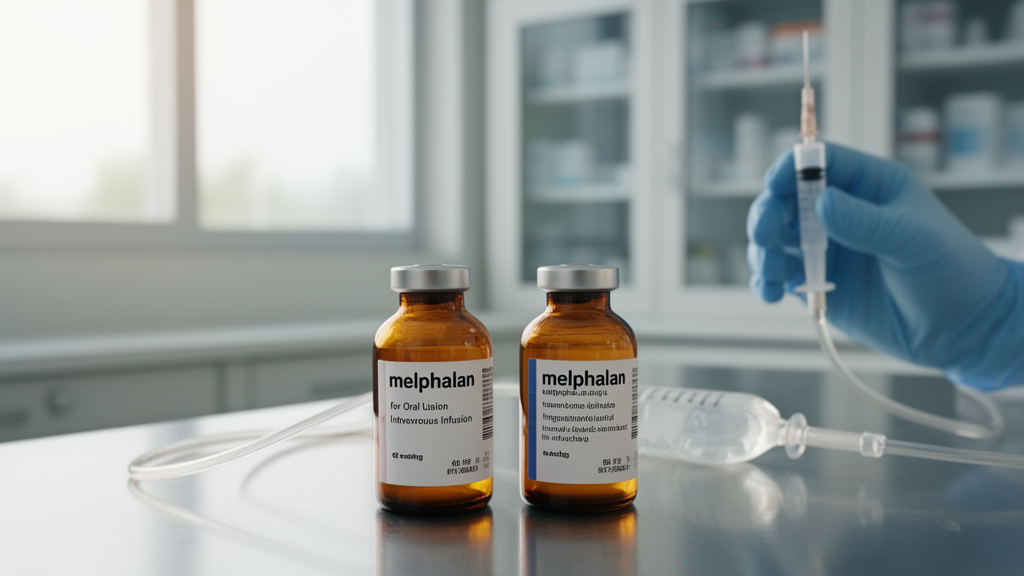
A single-center retrospective cohort study of 106 Chinese transplant recipients found similar complete response and 3-year survival outcomes after oral or intravenous melphalan conditioning for autologous stem cell transplantation. The analysis also identified differences in engraftment and adverse events, but did not establish that the formulations are equivalent.
The study included 76 patients with lymphoma and 30 with multiple myeloma who underwent transplantation at Shanxi Province Cancer Hospital between January 2015 and December 2023. Following propensity score matching, 53 patients received intravenous melphalan and 53 received oral melphalan. The primary endpoint was 3-year progression-free survival, and follow-up continued through September 2024.
Lymphoma patients received BEAM conditioning containing carmustine, etoposide, cytarabine and a total of 140 mg/m² melphalan on day −1. The dose was delivered as one intravenous infusion or two equal oral doses approximately 12 hours apart under fasting conditions. Multiple myeloma patients received 200 mg/m² over two days, either as two daily intravenous infusions or four divided oral doses.
Route assignment was not randomized. It reflected patient preference, financial considerations, discussion of off-label oral use and intermittent shortages of intravenous melphalan. Propensity matching addressed measured baseline factors but did not remove all imbalances, including sex distribution in non-Hodgkin lymphoma, time to transplantation in Hodgkin lymphoma and M-component type in multiple myeloma.
All matched patients achieved hematopoietic reconstitution. Among patients with lymphoma, median neutrophil engraftment took 10 days with intravenous melphalan and 12 days with oral melphalan (p = 0.025). In multiple myeloma, median platelet engraftment took 11 and 14 days, respectively (p = 0.021), while neutrophil engraftment was 11 days in both groups. Red blood cell and platelet transfusion requirements did not differ significantly.
Grade 3–4 anemia was more frequent with oral melphalan, affecting 37.74% of patients versus 18.87% with intravenous treatment (p = 0.031). Febrile neutropenia was less frequent with oral melphalan, occurring in 35.85% versus 56.60% (p = 0.032). Within the oral group, grade 3–4 anemia was associated with delayed platelet engraftment, appearing in 62.5% of patients with delayed engraftment and 21.4% of those without it (p = 0.008).
Gastrointestinal toxicity followed the opposite pattern. Diarrhea occurred in 18.87% of oral recipients and 37.74% of intravenous recipients (p = 0.031), while oral mucositis occurred in 7.55% and 33.96%, respectively (p = 0.001). Nausea or vomiting, elevated transaminases and electrolyte disorders did not differ significantly. No deaths occurred before day 100.
At day 100, complete response rates were 92.11% with intravenous melphalan and 81.58% with oral treatment in lymphoma (p = 0.123). In multiple myeloma, both groups had complete response rates of 40.00% (p = 1.000). Estimated 3-year progression-free survival was 78.9% versus 81.6% in lymphoma and 66.7% versus 73.3% in multiple myeloma; corresponding overall survival estimates were 89.5% versus 86.8% and 86.7% versus 80.0%. None of these comparisons was statistically significant.
Multivariable analyses did not identify melphalan route as an independent predictor of progression-free or overall survival. However, the retrospective single-center design, residual confounding, small subgroups, unequal follow-up in lymphoma and absence of pharmacokinetic measurements limit interpretation. Oral melphalan has reported bioavailability of 20–60%, so the observed clinical similarity does not demonstrate bioequivalence. The authors called for prospective multicenter studies with pharmacokinetic assessment.
Subject of Research: Comparative outcomes and toxicity of oral versus intravenous melphalan conditioning for autologous stem cell transplantation in lymphoma and multiple myeloma
Article Title: Oral versus intravenous melphalan for autologous stem cell transplantation conditioning in lymphoma and multiple myeloma: a retrospective cohort study
Article References: Wang, J., Guo, Y., Zhao, J., Wen, X., Su, L., Hao, Z., & Yang, J. (2026). Oral versus intravenous melphalan for autologous stem cell transplantation conditioning in lymphoma and multiple myeloma: a retrospective cohort study. Frontiers in Oncology, 16, Article 1923679. https://doi.org/10.3389/fonc.2026.1923679
Image Credits: AI Generated
DOI: 10.3389/fonc.2026.1923679
Keywords: melphalan, autologous stem cell transplantation, lymphoma, multiple myeloma, oral administration, intravenous administration, engraftment, treatment toxicity, propensity score matching, survival outcomes, Oral, versus
News Source: Nathaniel Bowman. (October 21, 2026). Chinese retrospective cohort links oral and intravenous melphalan to similar 3-year survival but different toxicity. Scienmag.