An Austria-wide citizen science field study found that amphibians colonized 111 of 289 newly installed garden mini-ponds during their first monitoring season, while signs of reproduction appeared in 29 ponds, or 10% of all monitored sites. The observations, collected in 2024, included 353 records involving 13 amphibian taxa and occurred in ponds that had generally been operating for only a few weeks when the first animals were recorded.
The project centered on the European green toad, Bufotes viridis, a pioneer species associated with temporary, often vegetation-free pools and a species categorized as Vulnerable in Austria. The researchers provided 300 standardized polyethylene mini-ponds to citizen scientists across Austria and installed two additional ponds at the Vienna Zoo. Of the 300 distributed to volunteers, 289 were confirmed by photographs to have been set up and were included in the monitoring results.
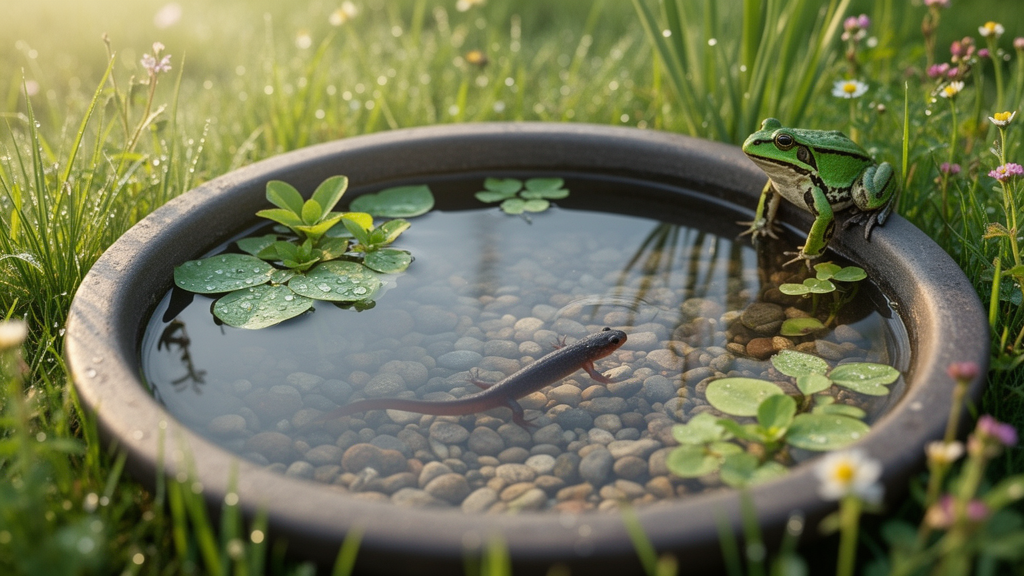
Each mini-pond measured 120 by 90 by 40 cm, held 150 litres of water and had a surface area of 0.98 m². The team selected the commercially available model with the largest surface-to-volume ratio that met their requirements. Ribbed sides and an attachable coconut-fiber mesh were intended to help animals leave the ponds. Participants were asked not to add soil, gravel, sand, stones, plants or wood, thereby maintaining broadly comparable early-successional, oligotrophic conditions, and to replenish the water regularly.
Pond placement prioritized the known post-2000 distribution of the European green toad in Austria. The researchers used the Austrian Herpetofauna Database, unpublished observations and records from iNaturalist to identify areas, including places associated with populations considered lost, such as Carinthia. Applicants were asked about existing garden ponds and whether amphibians had been observed on their properties, and satellite imagery was used to assess barriers and nearby water bodies. Most ponds were installed and filled during the first week of March 2024.
Monitoring was conducted through the custom AmphiApp smartphone application, which transferred observations to a web-integrated database. Citizen scientists were asked to inspect their ponds every second weekend from 2 March through 1 September 2024 and to report additional observations outside the schedule. Records included the date and time, geographic coordinates, relative water level, whether water had been added, a tentative identification, a description, a photograph and, optionally, an audio recording. The team validated the records and generally treated an observation as associated with a mini-pond when the animal was recorded within five metres, although such cases were rare.
Pelophylax species, which could not be distinguished reliably from photographs or recordings and were therefore treated as one taxon, generated 107 records from 47 ponds and represented 42.3% of all reports. The European green toad produced 59 records from 17 ponds, while the common toad, Bufo bufo, produced 17 records from 14. The smooth newt, Lissotriton vulgaris, was recorded in 12 ponds and the agile frog, Rana dalmatina, in 13. Other observations included the common frog, yellow-bellied toad, fire-bellied toad, European tree frog, alpine newt and crested newt. Reports generally increased during the expected aquatic season, with most made from May through September.
Signs of reproduction—including amplexus, eggs, larvae or metamorphs—were recorded in 29 of the 289 ponds. Evidence of reproduction was reported for eight identified taxa: the smooth newt in six of the 12 ponds where the species was recorded; Pelophylax species in five of 47; the European green toad in three of 17; the common toad in two of 14; the yellow-bellied toad in two of five; and one each for the European tree frog, common frog and alpine newt. The researchers could not confirm reproduction for the agile frog, fire-bellied toad or crested newt. An additional 19 ponds contained reproductive signs that could only be classified as Anura.
To account for the likelihood that amphibians present in a pond went unobserved, the researchers fitted Bayesian single-species occupancy models with the spOccupancy R package. Records were organized into 14 two-week intervals, and only observations within each taxon’s typical reproductive activity period were used. Models were fitted for the smooth newt, European green toad, yellow-bellied toad and Pelophylax species, the four taxa detected in at least 10 intervals. Per-interval detection probabilities were estimated at 0.107, with a 95% Bayesian credible interval of 0.052–0.176, for the European green toad and 0.154, with an interval of 0.062–0.274, for the yellow-bellied toad. Cumulative probabilities over the respective activity periods ranged from 0.658 for the European green toad to 0.836 for the smooth newt. The models found no significant differences among the four species.
These findings provide first-season evidence that small, newly created ponds can attract amphibians and support reproductive activity, but they do not establish the ponds’ long-term effectiveness. The study covered one active season, used fortnightly observations by mostly untrained citizen scientists and could model only four taxa because other species had too few detections across enough intervals. Most volunteers sampled during daylight, which likely reduced detection of nocturnal species, while brief aquatic residency also limited detection of explosive breeders. The authors anticipate that additional species and amphibians may use the ponds during a second season, but that possibility remains a forecast rather than a measured result.
Subject of Research: First-season amphibian colonization and reproduction in Austrian garden mini-ponds monitored through citizen science
Article Title: Early amphibian colonizers of man-made mini-ponds: first results of a citizen science experiment
Article References: Siebert, J., Burgstaller, S., Kornilev, Y. V., Krall, M. M., Hamernik, D., Kremser, J., Loupal, A., Spießberger, M., Zaller, J. G., Schweiger, S., Graf, W., Dörler, D., Heigl, F., & Landler, L. (2025). Early amphibian colonizers of man-made mini-ponds: first results of a citizen science experiment. Herpetozoa, 38, 231-240. https://doi.org/10.3897/herpetozoa.38.e153679
Image Credits: AI Generated
DOI: 10.3897/herpetozoa.38.e153679
Keywords: amphibian conservation, citizen science, garden ponds, European green toad, breeding habitats, occupancy modelling, detection probability, Austria, habitat creation, Early, amphibian, colonizers
News Source: Margaret Porter. (October 20, 2026). Citizen science field study finds amphibian colonization and breeding in Austrian garden mini-ponds during first season. Scienmag.