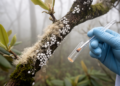
A field survey of the Lucanian side of Pollino National Park identified 150 bryophyte taxa, comprising 136 mosses and 14 liverworts. Of these, 41 taxa—39 mosses and two liverworts—were new to the Basilicata regional checklist, while 10 moss taxa recorded before 1968 were confirmed for the region.
The survey was conducted by the Working Group for Bryology of the Italian Botanical Society. Its findings show that the bryophyte flora of Pollino National Park and Basilicata remains incompletely documented. The most recent checklist cited in the study recorded 272 taxa for Basilicata, including 232 mosses and 40 liverworts, and placed the region, together with Molise, among those with the fewest reported bryophytes in Italy. Much of the historical information on Pollino’s mosses came from incomplete studies dating from the late 19th and early 20th centuries, although more recent work had expanded the regional inventory.
The surveyed area lies in Basilicata at elevations from about 950 to 2,000 metres above sea level. The route began in beech forests at Acqua Tremola and continued toward Serra di Crispo and Grande Porta del Pollino. It then passed the seasonal Lago Fondo and Lago Duglia, Pietra Castello, and woodland containing European silver fir. The field party subsequently examined the Fosso Jannace gorge, including its wetlands, waterfalls and riparian vegetation, then investigated the area around the La Catusa spring and the Frido stream before exploring the ophiolitic rock outcrops and Mediterranean vegetation of Timpa delle Murge.
Mosses and liverworts were identified using the published identification guides cited by the investigators, and nomenclature followed Hodgetts and colleagues. Species distributions were assessed against the 2023 Checklist of Italian Bryophytes. The published inventory gives each taxon’s collection locality, habitat and Italian IUCN threat category, with an asterisk identifying taxa new to Basilicata and a cross identifying mosses reported before 1968. Specimens were retained in the herbaria of the excursion participants.
Several finds were notable for their restricted Italian distributions. Lescuraea saviana, a subalpine moss previously reported in Italy from Molise and the Laga mountains of Abruzzo, was collected from the bark of Pinus leucodermis at Serra di Crispo, 2,050 metres above sea level. Timmia norvegica was found on rocks at the same elevation, while Tortella fragilis occurred on soil there. Tortula laureri, previously reported in Italy only from nineteenth-century localities in Lombardy, Trentino-Alto Adige and Friuli-Venezia Giulia, was collected on rocks at Piano Jannace, 1,926 metres above sea level.
Other boreal and arctic-montane taxa included Herzogiella striatella, collected from a beech stump along the Pietra Castello path toward Lago Fondo at 1,876 metres, and Rhizomnium magnifolium, found on soil along a stream near Lago Duglia at 1,387 metres. The investigators characterized this group as having southern biogeographical limits in the Pollino Massif and interpreted its presence as consistent with species that occupied the Italian Peninsula during the ice ages and persisted as isolated postglacial relics.
The ophiolitic outcrops at Timpa delle Murge supported a distinctive flora of rock-dwelling bryophytes. Grimmia alpestris, previously reported from the Alpine arc, Sardinia’s Mount Gennargentu and Mount Etna in Sicily, was found on basaltic rocks at 1,216 metres. Grimmia funalis, a subarctic-subalpine species, and Schistidium papillosum, an arctic-alpine moss previously reported in Italy from Val d’Aosta to Tuscany, were also collected there. The investigators identified these outcrops as the southernmost refuge in their distribution area for several rare rock-dwelling taxa.
Brachydontium trichodes, a Mediterranean mountain moss classified as Endangered in Italy, was collected on rocks near Lago Duglia at 1,375 metres. Before the survey, it had been reported in Italy only from Valganna in Lombardy and the Tuscan-Emilian Apennines. Most observed taxa were classified as Least Concern, but Grimmia alpestris and Schistidium papillosum were listed as Vulnerable, while Grimmia tergestina and Lewinskya shawii were classified as Near Threatened. The collection of several uncommon species on ophiolitic rocks underlined the conservation value of that habitat.
The study was limited to a field excursion on the Lucanian side of the park, so its results do not establish the total bryophyte richness of the entire Pollino National Park. The authors said the findings indicate that additional exploration is needed to characterize Pollino’s bryophyte flora more completely. They specifically called for extending research to the Calabrian side and for broader bryological work in Italian territories that remain uncharted or only partially documented. The findings support the value of protected areas for biodiversity, including less-studied plant groups such as bryophytes.
Subject of Research: Field documentation of bryophyte diversity in the Lucanian sector of Pollino National Park
Article Title: Contribution to the knowledge of the bryophyte flora of the Lucanian side of the Pollino National Park
Article References: Aleffi, M., Cogoni, A., Colacino, C., Evangelista, E., Perego, S., Privitera, M., Puglisi, M., Puntillo, D., Sguazzin, F., Tacchi, R., & Poponessi, S. (2024). Contribution to the knowledge of the bryophyte flora of the Lucanian side of the Pollino National Park. Italian Botanist, 18, 225-243. https://doi.org/10.3897/italianbotanist.18.143739
Image Credits: AI Generated
DOI: 10.3897/italianbotanist.18.143739
Keywords: Pollino National Park, bryophyte flora, Basilicata, field survey, mosses, liverworts, floristic records, biodiversity, conservation status, Contribution, knowledge, bryophyte
News Source: Margaret Porter. (October 20, 2026). Pollino National Park field survey records 41 bryophyte taxa new to Basilicata. Scienmag.