• HOME
  • NEWS
  • EXPLORE
    • CAREER
      • Companies
      • Jobs
    • EVENTS
    • iGEM
      • News
      • Team
    • PHOTOS
    • VIDEO
    • WIKI
  • BLOG
  • COMMUNITY
    • FACEBOOK
    • INSTAGRAM
    • TWITTER
Tuesday, October 20, 2026
BIOENGINEER.ORG
No Result
View All Result
  • Login
  • HOME
  • NEWS
  • EXPLORE
    • CAREER
      • Companies
      • Jobs
        • Lecturer
        • PhD Studentship
        • Postdoc
        • Research Assistant
    • EVENTS
    • iGEM
      • News
      • Team
    • PHOTOS
    • VIDEO
    • WIKI
  • BLOG
  • COMMUNITY
    • FACEBOOK
    • INSTAGRAM
    • TWITTER
No Result
View All Result
Bioengineer.org
No Result
View All Result
Home NEWS Science News Cancer

Early tumor shrinkage associated with longer progression-free survival in measurable advanced gastric or gastroesophageal junction cancer

by
October 20, 2026
in Cancer
Reading Time: 2 mins read
0
Early tumor shrinkage associated with longer progression-free survival in measurable advanced gastric or gastroesophageal junction cancer

Early Tumor Shrinkage Predicts Longer Survival in Gastric Cancer Patients on Immunotherapy

Share on FacebookShare on TwitterShare on LinkedinShare on RedditShare on Telegram

The abstract of a retrospective single-center study reports that early tumor shrinkage (ETS) during first-line immune checkpoint inhibitor–based chemotherapy was associated with longer subsequent progression-free survival in patients with measurable unresectable advanced gastric or gastroesophageal junction adenocarcinoma. The analysis included 162 previously untreated patients who received first-line therapy between November 2021 and July 2025; 90 patients with measurable disease formed the ETS cohort.

ETS was defined as a reduction of at least 20% in the sum of target-lesion diameters at the first radiological assessment, evaluated under RECIST version 1.1. Among the 90 patients in the ETS cohort, 70, or 77.8%, experienced ETS. Best overall response was complete response in 11 patients (12.2%), partial response in 75 (83.3%), stable disease in two (2.2%) and progressive disease in two (2.2%), producing an objective response rate of 95.6%.

Because ETS was assessed after baseline, survival analyses used a fixed Day-90 landmark. At that landmark, ETS-positive patients had longer overall survival than ETS-negative patients, with a hazard ratio of 0.369 (95% confidence interval 0.181–0.752; p=0.006). They also had longer progression-free survival, with a hazard ratio of 0.395 (95% confidence interval 0.206–0.755; p=0.005). In the primary multivariable progression-free survival model, which included 84 patients and 51 events, ETS remained associated with favorable progression-free survival (hazard ratio 0.382, 95% confidence interval 0.197–0.740; p=0.004). A separate continuous analysis found a consistent association between the magnitude of tumor reduction and progression-free survival: the hazard ratio was 0.876 per 10-percentage-point greater reduction (95% confidence interval 0.777–0.987; p=0.030).

The findings indicate that ETS may be an on-treatment marker associated with early treatment sensitivity in this population, but the study does not establish clinical utility. Its retrospective, single-center design limits the strength and generalizability of the results, and the investigators stated that external validation is required. The reported associations also do not demonstrate that ETS causes longer survival. The available published abstract does not provide the full protocol, detailed model specification or other analyses needed for a complete assessment of the study.

Subject of Research: Association between early tumor shrinkage and progression-free survival during first-line immune checkpoint inhibitor–based chemotherapy in measurable advanced gastric or gastroesophageal junction cancer

Article Title: Early tumor shrinkage during first-line immune checkpoint inhibitor–based chemotherapy is associated with progression-free survival in measurable unresectable gastric cancer

Article References: Ushimaru, Y., Yamamoto, K., Omori, T., Kudo, T., Sakai, D., Yanagimoto, Y., Kawabata, R., Masuike, Y., Yamamoto, K., Fujikawa, K., Adachi, K., Matsuura, N., Momose, K., Kanemura, T., Sakano, Y., Kobayashi, Y., Kitakaze, M., Yokota, Y., Kubo, M., … Miyata, H. (2026). Early tumor shrinkage during first-line immune checkpoint inhibitor–based chemotherapy is associated with progression-free survival in measurable unresectable gastric cancer. BMC Cancer. https://doi.org/10.1186/s12885-026-17003-0

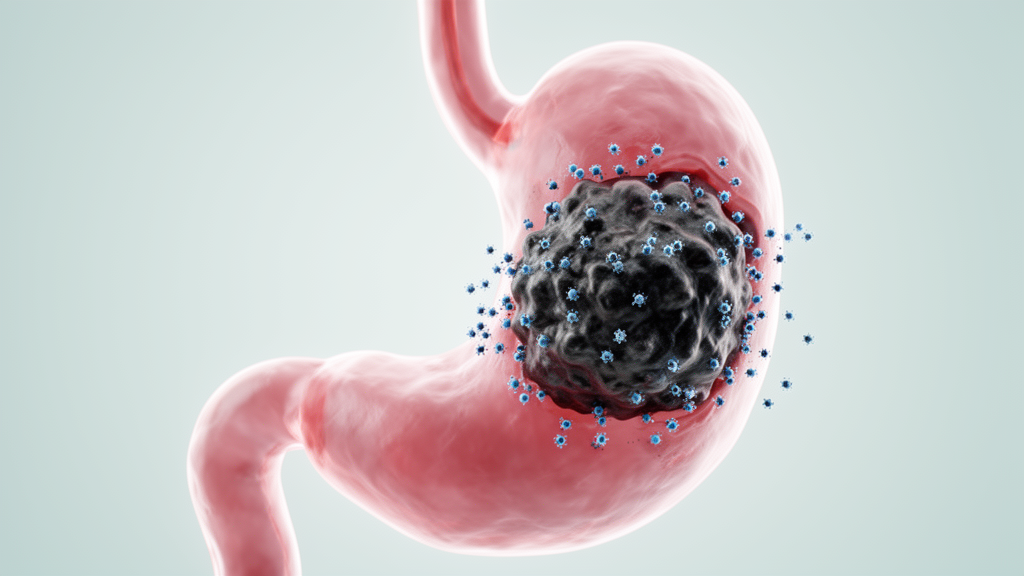
Image Credits: AI Generated

DOI: 10.1186/s12885-026-17003-0

Keywords: early tumor shrinkage, advanced gastric cancer, gastroesophageal junction cancer, immune checkpoint inhibitors, first-line chemotherapy, progression-free survival, overall survival, retrospective cohort study, RECIST 1.1, survival analysis, Early, tumor

News Source: Nathaniel Bowman. (October 20, 2026). Early tumor shrinkage associated with longer progression-free survival in measurable advanced gastric or gastroesophageal junction cancer. Scienmag.


Tags: advanced gastric cancerearlyearly tumor shrinkagefirst-line chemotherapyGastroesophageal junction cancerImmune checkpoint inhibitorsoverall survivalprogression-free survivalRECIST 1.1retrospective cohort studysurvival analysistümör
Share12Tweet7Share2ShareShareShare1

Related Posts

MAPK1 variant linked to cervical disease in 300-person study; simulations predict stronger SCH772984 binding to mutant

MAPK1 variant linked to cervical disease in 300-person study; simulations predict stronger SCH772984 binding to mutant

October 20, 2026
CCL21-ICAM1 synthetic niche accelerates lytic hit delivery by OT-I T cells against B16 melanoma in vitro

CCL21-ICAM1 synthetic niche accelerates lytic hit delivery by OT-I T cells against B16 melanoma in vitro

October 20, 2026

CT co-registration yields more stable D90 verification in 30-patient retrospective lung cancer study

October 20, 2026

Randomized phase III trial with a factorial design assessing the efficacy and safety of darolutamide and stereotactic dose-escalated radiotherapy in patients with high-risk localized prostate cancer: the PEACE 7 (GETUG-AFU 45) study protocol

October 20, 2026

POPULAR NEWS

  • Qualitative systematic review identifies social-capital themes in healthcare AI implementation

    Qualitative systematic review identifies social-capital themes in healthcare AI implementation

    29 shares
    Share 12 Tweet 7
  • Resident Physicians Had Lower Mental Health Visit Rates Than Matched Non-Physicians in Retrospective Cohort Study

    29 shares
    Share 12 Tweet 7
  • Case report links uncertain initial injury with later multidrug-resistant wound colonization in a 20-year-old man

    29 shares
    Share 12 Tweet 7
  • UVB photoprotection by thiourea and (thio)semicarbazone derivatives: cellular and molecular evidence

    29 shares
    Share 12 Tweet 7

About

We bring you the latest biotechnology news from best research centers and universities around the world. Check our website.

Follow us

Recent News

Qualitative systematic review identifies social-capital themes in healthcare AI implementation

Resident Physicians Had Lower Mental Health Visit Rates Than Matched Non-Physicians in Retrospective Cohort Study

Case report links uncertain initial injury with later multidrug-resistant wound colonization in a 20-year-old man

Subscribe to Blog via Email

Enter your email address to subscribe to this blog and receive notifications of new posts by email.

Join 85 other subscribers
  • Contact Us

Bioengineer.org © Copyright 2023 All Rights Reserved.

Welcome Back!

Login to your account below

Forgotten Password?

Retrieve your password

Please enter your username or email address to reset your password.

Log In
No Result
View All Result
  • Homepages
    • Home Page 1
    • Home Page 2
  • News
  • National
  • Business
  • Health
  • Lifestyle
  • Science

Bioengineer.org © Copyright 2023 All Rights Reserved.