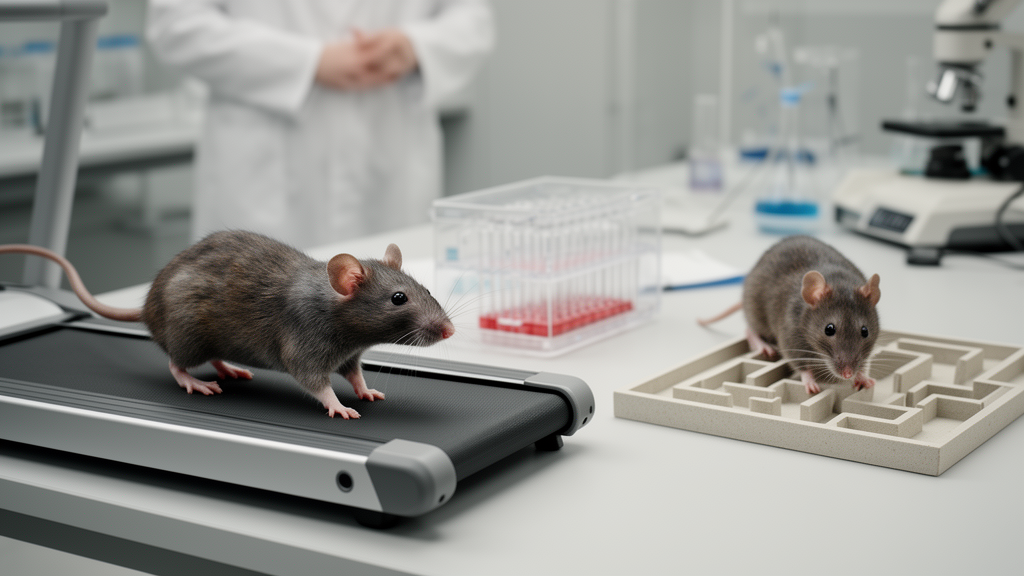
In an eight-week experiment with 40 male Wistar rats, endurance training was associated with significantly higher hippocampal brain-derived neurotrophic factor (BDNF) concentrations than a control group, rotarod training, and a program combining endurance followed by rotarod training. The biochemical results did not consistently correspond to better performance across the cognitive tests. Rats assigned to rotarod followed by endurance training showed lower escape latency during acquisition in the Morris Water Maze than the control and rotarod-only groups, but the groups did not differ significantly in Novel Object Recognition or passive avoidance performance.
The researchers randomly divided the animals into five groups of eight: endurance training, rotarod training, endurance followed by rotarod training, rotarod followed by endurance training, and control. After eight weeks, the investigators evaluated spatial learning and memory with the Morris Water Maze, recognition memory with a Novel Object Recognition test, and aversive memory with a passive avoidance test. They measured BDNF concentrations in the hippocampus using an enzyme-linked immunosorbent assay. The study was designed to compare the effects of different training programs rather than test a training program in people.
Endurance-trained rats had higher hippocampal BDNF concentrations than control animals, animals in the rotarod-only group, and animals in the endurance-plus-rotarod group, with the reported differences reaching p < 0.05. The rotarod-plus-endurance group also had higher BDNF concentrations than the rotarod-only group. The supplied results do not report a significant difference between the endurance-only and rotarod-plus-endurance groups, so the findings do not establish that one program produced the highest BDNF concentration across all five groups. Nor do the measurements show that a larger BDNF response was consistently accompanied by stronger behavioral performance.
Spatial learning improved across acquisition trials in the Morris Water Maze. During that phase, the rotarod-plus-endurance group had a lower overall escape latency than the rotarod-only and control groups, with differences reported at p < 0.05. Post hoc comparisons in the probe trial did not reveal significant differences among the groups. The study found no significant between-group differences in Novel Object Recognition or passive avoidance performance. These outcomes show that the clearest group-level behavioral difference was confined to acquisition performance in one spatial-learning task, rather than extending across all three measures of cognition.
Taken together, the findings indicate that different exercise programs were associated with distinct patterns of hippocampal BDNF and cognitive performance in this rat experiment. They do not demonstrate that training sequence caused the observed differences, that BDNF changes mediated the behavioral results, or that either training program offers a cognitive advantage in humans. The scope was limited by the use of 40 male Wistar rats, five experimental groups, three cognitive assessments, and an eight-week training period; effects in females, other animal populations, and people therefore were not established. The article was published as an early-access, peer-reviewed research article in BMC Neuroscience and was identified as still subject to further editing before replacement by the final Version of Record.
Subject of Research: Experimental comparison of training programs, hippocampal BDNF, and cognition in male Wistar rats
Article Title: Differential effects of endurance and motor skill training on hippocampal BDNF levels and cognitive performance in male Wistar rats
Article References: Sadeghi, M., Komaki, A., & Nazem, F. (2026). Differential effects of endurance and motor skill training on hippocampal BDNF levels and cognitive performance in male Wistar rats. BMC Neuroscience. https://doi.org/10.1186/s12868-026-01060-z
Image Credits: AI Generated
DOI: 10.1186/s12868-026-01060-z
Keywords: BDNF, hippocampus, endurance training, rotarod training, rat cognition, spatial learning, Morris Water Maze, recognition memory, passive avoidance, exercise, Differential, effects
News Source: Cassandra Pierce. (October 20, 2026). Rat study finds exercise-dependent BDNF and cognitive responses. Scienmag.