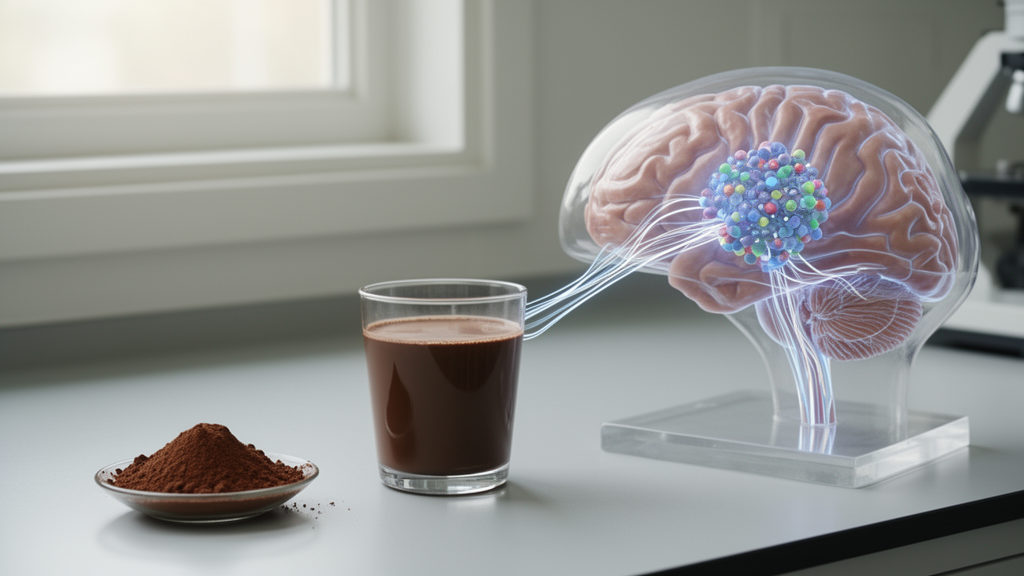
A biochemical study of methylxanthines suggests that theobromine, a stimulant-like compound best known as a constituent of cocoa, can inhibit primary amine oxidase and monoamine oxidase activity in human adipose tissue. At 2.5 mM, theobromine reduced benzylamine oxidation by approximately 50%, matching the effect observed with caffeine in that assay. Separate experiments estimated an inhibition constant of 276 ± 44 micromolar for primary amine oxidase, with theobromine showing stronger inhibitory potency than caffeine. The results, considered alongside evidence from models of Parkinson’s disease, provide a mechanistic rationale for further investigation, but they do not establish that chocolate or dietary theobromine prevents or treats the disorder.
Theobromine is 3,7-dimethylxanthine, one of the principal naturally occurring methylxanthines alongside caffeine and theophylline. It is a bitter, purine-related alkaloid found principally in the seeds of the cocoa tree, with cocoa beans containing approximately 3.3% the compound. Other dietary sources include kola nut, guarana, tea and yaupon holly. The molecule has a reported elimination half-life of roughly six to eight hours and produces milder central nervous system stimulation than caffeine. Caffeine has an additional methyl group, crosses the blood–brain barrier more efficiently and is generally a stronger stimulant. Theobromine is also formed in the human body during caffeine metabolism, making exposure common rather than strictly dietary.
Parkinson’s disease is a progressive neurodegenerative disorder defined by the loss of dopaminergic neurons in the substantia nigra and the accumulation of aggregated α-synuclein in Lewy bodies. Dopamine degeneration reduces dopamine signaling in basal-ganglia circuits involved in motor control, while non-motor features can include cognitive impairment, depression, sleep disturbance and autonomic dysfunction. The disease is not explained solely by dopamine-cell loss: cellular and animal evidence also implicates lysosomal, endosomal and mitochondrial dysfunction, α-synuclein propagation and immune responses. The clinical phase follows preclinical neurodegeneration and a prodromal period in which subtle or non-motor symptoms may already be present.
The enzyme most directly relevant to dopamine breakdown is monoamine oxidase B, or MAO-B, a flavin adenin dinucleotide-dependent enzyme located on the outer mitochondrial membrane. MAO-B oxidatively deaminates dopamine and other monoamines, generating 3,4-dihydroxyphenylacetaldehyde and an equimolar amount of hydrogen peroxide. The aldehyde can modify proteins and nucleic acids. Hydrogen peroxide can react with ferrous iron in the Fenton reaction to generate hydroxyl radicals, which can damage cellular components. These reactions are especially relevant in an aging Parkinson’s brain, where MAO-B activity and cerebral iron are reported to rise, glutathione-mediated peroxide detoxification may be reduced, and aldehyde dehydrogenase expression in the substantia nigra is diminished.
MAO-A and MAO-B share approximately 70% amino-acid sequence homology and closely similar catalytic pockets, but they differ in substrate preferences and inhibitor selectivity. MAO-A preferentially metabolizes serotonin, norepinephrine, epinephrine and melatonin. MAO-B acts strongly on benzylamine and phenethylamine and is largely expressed in astrocytes and serotonergic neurons; dopamine is a common substrate for both isoforms. Selegiline, rasagiline and safinamide are established MAO-B inhibitors used in Parkinson’s disease treatment. By reducing dopamine breakdown, they can increase dopamine availability and lower levodopa requirements, but no treatment has yet been conclusively demonstrated to halt the underlying neuronal degeneration.
Theobromine may intersect with Parkinson’s biology through several pathways. As a non-selective adenosine-receptor antagonist, it acts on A1, A2A, A2B and A3 receptors, which regulate intracellular cyclic adenosine monophosphate through G proteins. It also competitively inhibits phosphodiesterases that hydrolyze cyclic signaling molecules, potentially increasing cAMP. In a mouse experiment, oral theobromine raised brain levels of phosphorylated vasodilator-stimulated phosphoprotein, phosphorylated cAMP response element-binding protein and brain-derived neurotrophic factor, while the treated animals performed better in a three-lever motor-learning task. These findings concern experimental signaling and behavior in mice, not a clinical effect in people with Parkinson’s disease.
Other animal studies have reported neuroprotective or cognitive effects under conditions that differ from Parkinson’s disease but are relevant to neurodegeneration broadly. In rats subjected to transient global cerebral ischemia and reperfusion, theobromine reduced thiobarbituric acid reactive substances, a marker of lipid peroxidation, and increased glutathione content. In six-month-old rats fed a high-cholesterol diet, administration of 30 mg of theobromine mitigated induced memory and cognitive impairment. In a chronic cerebral hypoperfusion model, theobromine reduced latency to fall in the rotarod test, increased latency in the elevated-plus-maze test and enhanced novel-object recognition memory. Mouse hippocampal recordings further indicated enhanced synaptic transmission alongside reduced magnitude of long-term potentiation; adenosine A1 and A2A receptor antagonists blocked the respective effects.
Caffeine, theobromine’s better-studied chemical relative, has stronger epidemiological and laboratory support in the Parkinson’s field. In the Honolulu Heart Program, 8,004 Japanese-American men were followed for 30 years, and midlife coffee consumption of at least 784 mg per kg per day was associated with an approximately fivefold reduction in the risk of Parkinson’s disease by age 65 compared with non-coffee consumers, after adjustment for age and smoking. Inverse associations also appeared in the Health Professionals’ Follow-Up Study, involving 47,351 men, the Nurses’ Health Study, involving 88,565 women, and other prospective or case-control investigations. Animal models show caffeine protecting dopaminergic neurons against the mitochondrial toxins MPTP, 6-hydroxydopamine and rotenone, as well as reducing pathological changes in an α-synuclein fibril model. These caffeine findings cannot be assumed to apply equally to theobromine.
Structural analysis helps explain why theobromine may still be useful as a research starting point. Its xanthine scaffold carries methyl substituents at positions 3 and 7, and these appear to influence both enzyme inhibition and receptor activity. Position 3 methylation is important for MAO-B inhibition, while position 7 methylation can enhance MAO-B inhibition and A2A-receptor antagonism. Theobromine’s non-competitive inhibition of primary amine oxidase was proposed to involve hydrogen bonding between its nitrogen at position 1 and amino-acid residues in the enzyme, although the enzyme’s ping-pong catalytic mechanism complicates interpretation of this kinetic pattern. Theobromine also inhibits PARP-1, a nuclear enzyme involved in DNA repair and immune regulation, providing another laboratory pathway potentially relevant to inflammatory responses.
The central limitation is the mismatch between laboratory promise and clinical evidence. The reported methylxanthine experiments examined enzyme inhibition in human adipose tissue rather than the brains of people with Parkinson’s disease, and they do not show that theobromine inhibits both dopamine-metabolizing MAO isoforms in patients. There are no reported randomized controlled trials of theobromine for Parkinson’s disease, and it remains unknown whether ordinary dietary intake produces brain concentrations sufficient to alter MAO-B or adenosine signaling meaningfully. Many mechanistic studies use concentrations that may exceed those achieved in vivo. Common MPTP, 6-hydroxydopamine and α-synuclein models reproduce selected aspects of neurodegeneration rather than the full, heterogeneous human disorder.
Human observational evidence for theobromine itself is also limited. A reported positive association between dietary theobromine and cognitive performance in a representative United States population, and a finding linking intake with less cognitive decline among older men, do not establish a causal effect. Another study reported a positive correlation between theobromine intake and depression, highlighting the limits and potentially adverse signals in the available data. Chocolate and cocoa contain numerous bioactive compounds, so associations involving those foods cannot isolate the contribution of theobromine. The current evidence therefore indicates biological plausibility and supports further controlled investigation; it does not show that cocoa provides protection against Parkinson’s disease or that theobromine should be used as a treatment.
Subject of Research: Laboratory evidence on theobromine’s potential neuroprotective and monoamine oxidase effects in Parkinson’s disease
Article Title: Theobromine and Parkinson’s disease
Article References: Kondeva-Burdina, M., Bacheva, E., & Mitkov, J. (2026). Theobromine and Parkinson’s disease. Pharmacia, 73, Article e189281. https://doi.org/10.3897/pharmacia.73.e189281
Image Credits: AI Generated
DOI: 10.3897/pharmacia.73.e189281
Keywords: theobromine, Parkinson’s disease, monoamine oxidase B, dopamine metabolism, adenosine receptors, cacao, neurodegeneration, animal models, clinical evidence, Parkinson, disease, scientific research
News Source: Diana Fleming. (October 20, 2026). Theobromine Shows Parkinson’s Promise, but Human Evidence Remains Thin. Scienmag.