A study of patients undergoing diagnostic workup for suspected prostate cancer found that tumor-derived extracellular vesicles carrying the miR-302/367 microRNA cluster can reprogram monocyte-derived macrophages toward an M2-like, immunoregulatory state. Patients with prostate cancer had macrophages skewed away from pro-inflammatory M1-like features, and this shift was associated with histological grade. The findings identify a circulating signaling axis that may connect prostate-cancer cells with systemic myeloid conditioning.
The researchers analyzed peripheral blood immune cells from patients undergoing diagnostic evaluation for suspected prostate cancer and isolated extracellular vesicles from plasma liquid-biopsy samples for functional experiments. Peripheral blood monocytes were also isolated and differentiated into macrophages ex vivo. In patient-derived macrophages, elevated miR-302/367-cluster levels coincided with reduced inflammatory cytokine production and diminished antigen-presenting characteristics, while the cells displayed more M2-like features. The association between macrophage phenotype and histological grade indicates that the observed cellular changes varied with tumor grade, although the experiments do not establish that microRNA activity causes grade progression.
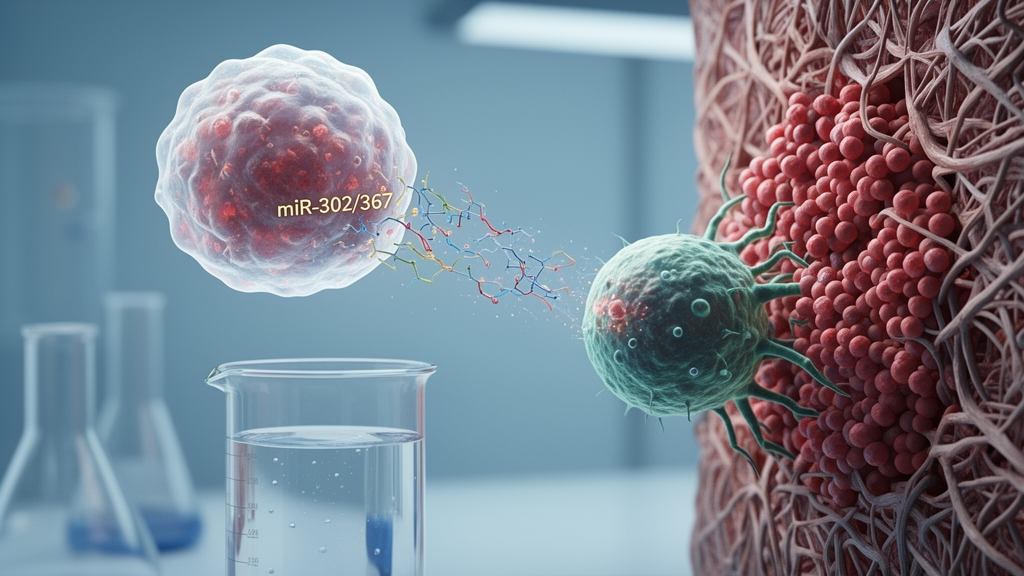
Functional inhibition implicated two microRNAs within the cluster. Blocking miR-302a-5p and miR-367-3p restored M1-like characteristics across all prostate-cancer grades examined while sparing macrophages derived from biopsy-negative controls. Complementary experiments showed that prostate-cancer cells released extracellular vesicles enriched in these microRNAs. Exposure to the vesicles induced an M2-like program in monocyte-derived macrophages, whereas removing the microRNAs from the vesicles promoted M1-like polarization. Vesicles isolated from plasma of prostate-cancer patients reproduced this pattern, supporting the possible clinical relevance of the tumor-derived vesicle pathway.
Together, the results support an extracellular-vesicle miR-302/367 axis as a functional regulator of macrophage reprogramming in prostate cancer. The study used patient-derived immune cells, tumor-cell vesicles, plasma vesicles and ex vivo monocyte differentiation, providing mechanistic evidence that circulating tumor material can influence macrophage state. It does not demonstrate that the pathway determines treatment response or clinical outcomes in people, nor does the supplied evidence show that liquid-biopsy measurement of miR-302/367 can independently diagnose prostate cancer. The findings are best understood as laboratory evidence of an immune-suppressive interaction between tumor-derived vesicles and myeloid cells, with additional work needed to establish its significance in patients.
Subject of Research: Tumor-derived extracellular-vesicle miR-302/367 signaling and macrophage reprogramming in prostate cancer
Article Title: Liquid biopsy identifies tumor-derived mir-302/367 cluster as a macrophage-reprogramming axis sustaining immune cold prostate cancer
Article References: Raia, T., Pecoraro, M., Matteocci, A., Ceci, V., Pediconi, N., Trocchianesi, S., Saracini, S., Gugliuzza, G., Laschena, L., Caioli, A., di Norscia, F., Conte, F., Ferretti, E., Panebianco, V., Chiurchiù, V., & Catanzaro, G. (2026). Liquid biopsy identifies tumor-derived mir-302/367 cluster as a macrophage-reprogramming axis sustaining immune cold prostate cancer. Journal of Experimental & Clinical Cancer Research. https://doi.org/10.1186/s13046-026-03856-7
Image Credits: AI Generated
DOI: 10.1186/s13046-026-03856-7
Keywords: prostate cancer, liquid biopsy, extracellular vesicles, miR-302/367, macrophages, tumor microenvironment, immune suppression, myeloid conditioning, Liquid, biopsy, identifies, tumor-derived
News Source: Nathaniel Bowman. (October 20, 2026). Liquid biopsy identifies tumor-derived mir-302/367 cluster as a macrophage-reprogramming axis sustaining immune cold prostate cancer. Scienmag.