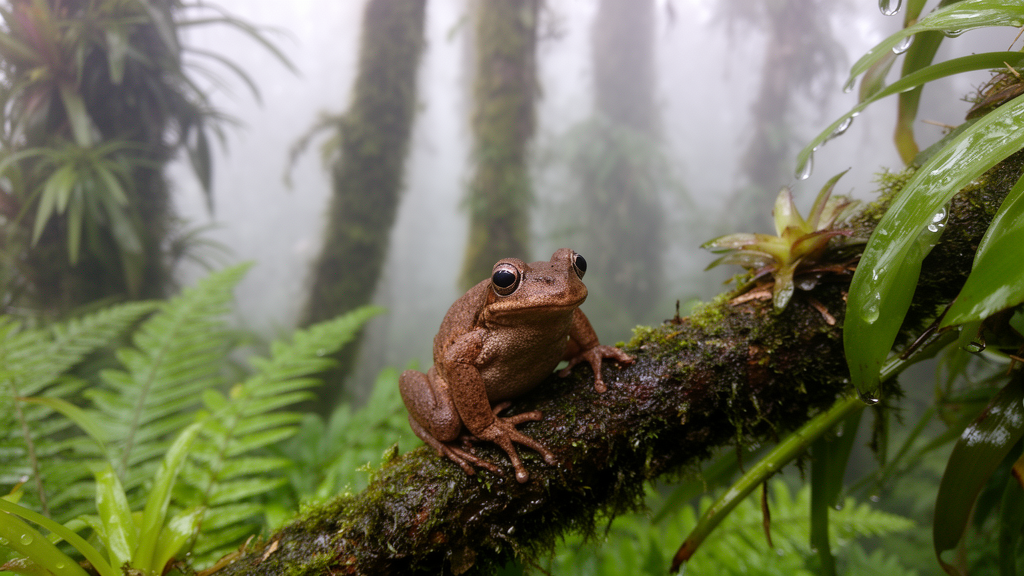
Deep in the cloud forests of the Ecuadorian Andes, perched on a moss-covered shrub branch some 3,042 meters above sea level, a small brown frog sat unnoticed by science until now. Researchers conducting field surveys in the Cerro Candelaria Private Protected Area, in Tungurahua Province, have formally described a new species of rain frog, Pristimantis normaewingae, and in doing so have redrawn the evolutionary map of an entire species group. The discovery, published in the journal Evolutionary Systematics, adds a seventh named species to the Pristimantis anaiae species group and strengthens evidence that the upper Rio Pastaza watershed is a hotbed of explosive adaptive radiation.
The new frog belongs to Pristimantis, a genus so species-rich in the northern Andes that its known diversity has grown exponentially over the past decade. Fourteen new species of this genus alone have been described in the upper Rio Pastaza watershed since 2010, most of them endemic to the region. The anaiae species group, first recognized in 2022 thanks to genetic data, is a distinctive lineage of small terrestrial frogs characterized by the absence of vocal slits and a tympanic membrane, and by large dark round areas with thin clear borders on the sacral region of the back. The group had previously contained six named species; the new work pushes that count to seven, with two additional candidate species still awaiting formal description.
To untangle the relationships within this group, the team generated DNA sequence data from 32 individuals, producing 86 consensus sequences across four genetic markers: three mitochondrial genes, 12S rRNA, 16S rRNA, and NADH dehydrogenase subunit 1 (ND1), plus one nuclear gene, Recombination Activating Gene 1 (RAG1). These markers are widely used and widely available in amphibian phylogenetics, which allowed the researchers to fold their new samples into existing datasets. Sequencing was carried out on Oxford Nanopore portable devices at two laboratories, the Nucleic Acid Sequencing Laboratory of the Instituto Nacional de Biodiversidad (INABIO) in Quito and Sumak Kawsay in Situ in the Pastaza rainforest, with consensus sequences showing expected divergence from traditional Sanger sequencing of just 0.00 to 0.04 percent, far too small to affect phylogenetic conclusions.
The resulting phylogeny, built from a concatenated matrix of 3,864 base pairs for 46 individuals and analyzed under maximum likelihood in IQ-TREE with ultrafast bootstrapping and SH-aLRT support tests, confirmed the monophyly of the anaiae species group with maximal support of 100/100. But the expanded sampling revealed a new internal structure: two well-supported subclades that had not been visible in the earlier hypothesis. Subclade A pairs the new species, P. normaewingae, with its sister species P. kunam from Sangay National Park, with branch support of 86.5/99. Subclade B contains two branches, one uniting P. venegasi with a sister pair of P. anaiae and an undescribed candidate species, and another placing P. glendae as sister to P. resistencia, with that pair in turn sister to a second candidate species, and the whole assemblage sister to P. maryanneae.
Notably, the study provides the first genetic sequences of the holotype of P. maryanneae, a species described in 2022 but never before included in a phylogenetic analysis. Its placement, sister to the clade containing P. resistencia and P. glendae, validates the original morphological description and confirms the species’ monophyly. New populations of P. maryanneae from surrounding mountains in the upper Pastaza valley, including Finca Palmonte and Bosque Protector Hacienda Guamag, also revealed a striking range of color morphs, from pale cream and orange to yellow and light brown, with juveniles sometimes showing dark or green coloration.
Genetic distances reinforce the distinctness of the new species. The uncorrected p-distance at 16S rRNA between P. normaewingae and its closest relative P. kunam averages 5.93 percent, ranging from 5.15 to 7.55 percent, while the distance between P. glendae and P. maryanneae averages 8.12 percent. Morphologically, P. normaewingae can be distinguished from all other members of the group by a combination of features: incomplete oval marks in the sacral region rather than complete ones, a dorsolateral row of enlarged tubercles that is less conspicuous than that of P. kunam, and a light blue iris crossed by a wide horizontal copper band with black reticulations. Females measure 25.0 to 30.6 millimeters in snout-vent length, while males are considerably smaller at 16.7 to 22.3 millimeters, and the species shows marked sexual dimorphism in dorsal coloration, with males ranging from reddish brown to orange brown.
The holotype, an adult female, was collected on 23 November 2022 on a shrub branch covered with moss, 170 centimeters above the ground. The type series ultimately comprises 38 specimens, including six adult females, 23 adult males, and nine juveniles, all deposited in the herpetology repository of the Ecuadorian Museum of Natural History. The species is known only from the type locality in Cerro Candelaria at elevations of 2,550 to 3,150 meters, in eastern Andean cloud forest dominated by bromeliads on the forest floor and on branches, Clusia trees, palms, and Weinmannia, with dense epiphytes, mosses, ferns, lichens, and orchids. Sympatric frogs include members of the Pristimantis gladiator complex, P. tungurahua, P. marcoreyesi, and an unidentified Niceforonia species.
The specific epithet honors Norma Ewing, a conservationist and animal rescue volunteer from the United States whose lifelong care for orphaned and injured animals, rooted in a childhood on a farm, the authors chose to recognize. Because so little is known about the species’ population status and distribution, the researchers recommend assigning it to the Data Deficient category of the IUCN Red List, though they note that its only known population lies within the protected boundaries of the Cerro Candelaria Private Protected Area, a 2,696-hectare reserve spanning elevations from 1,500 to 3,840 meters that has already yielded five new frog species as type localities.
Geographically, the anaiae species group stretches along the eastern Andean slopes of central Ecuador, from Sumaco volcano in the north to the central part of Sangay National Park in the south. But the diversity is strikingly concentrated: five named species plus two undescribed candidates cluster in the upper Rio Pastaza watershed, while only single species occupy the northern and southern extremes of the range. Members of the group have been found between 1,200 and 3,150 meters on low vegetation, medium-sized bushes, ferns, and grasses in cloud forest and high Andean forest. The researchers suggest that the Rio Pastaza valley and its surrounding mountains represent an ancient geologic zone of explosive radiation, where microclimatic variation from one mountain to another has driven speciation and diversification, echoing patterns documented in other Andean groups since the 1980s.
The findings carry clear conservation implications. The Llanganates-Sangay Ecological Corridor, which spans 94,362 hectares between the two national parks and ranges from 760 to 3,812 meters in elevation, is emerging as one of the most biodiverse and endemic-rich areas in Ecuador, with high value for connectivity, biogeography, and evolution across mammals, amphibians, birds, and plants. The authors argue that additional sampling from surrounding mountains, particularly the intermediate altitudes of the eastern slopes of Cerro Negro and Cerro Candelaria and the Llanganates mountains, will be essential to fully understand how this remarkable frog radiation unfolded. For now, the misty slopes south of the Rio Pastaza continue to yield surprises, and with two candidate species already flagged in the phylogeny, more names may soon be added to the roster of Ecuador’s hidden amphibian diversity.
Subject of Research: Phylogenetics and description of a new Pristimantis frog species from the Ecuadorian Andes
Article Title: Phylogenetic diversity of the Pristimantis anaiae species group, with a description of a new species of Pristimantis ( Anura , Strabomantidae ) from Cerro Candelaria, Tungurahua, Ecuador
Article References: Reyes-Puig, J. P., Yánez-Muñoz, M. H., Libke, Z., Vinueza, P., & Carrión-Olmedo, J. C. (2024). Phylogenetic diversity of the Pristimantis anaiae species group, with a description of a new species of Pristimantis (Anura, Strabomantidae) from Cerro Candelaria, Tungurahua, Ecuador. Evolutionary Systematics, 8(1), 101-118. https://doi.org/10.3897/evolsyst.8.118855
Image Credits: AI Generated
DOI: 10.3897/evolsyst.8.118855
Keywords: Pristimantis, new species, Ecuador, Andes, phylogenetics, amphibians, cloud forest, adaptive radiation, conservation, taxonomy, Rio Pastaza, Nanopore sequencing
News Source: Gavin Prescott. (October 18, 2026). New Rain Frog Species Uncovered in Ecuador’s Cloud Forests Reveals Hidden Evolutionary Radiation. Scienmag.