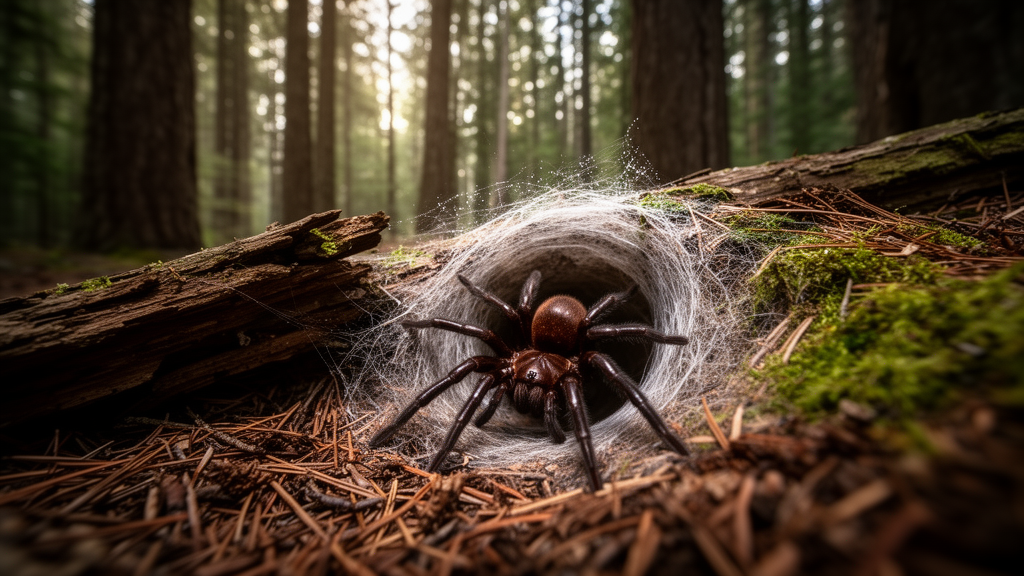
Deep in the moist conifer forests of northern Idaho, a small spider has been quietly building its funnel webs under rotten logs, unknown to science for millennia. Researchers have now formally described this secretive animal as Hexura vandal, a new species of mygalomorph funnel-web spider whose discovery pushes the known range of its genus roughly 500 kilometers east of where it was previously thought to live. The finding, published in the journal ZooKeys, marks the first taxonomic addition to this enigmatic group in nearly half a century and offers a rare glimpse into how ancient evolutionary lineages survive in isolated mountain refuges.
The genus Hexura was first established in 1885 and, until now, contained only two species, both confined to the Pacific Northwest’s Coastal Ranges and Cascade Mountains. Hexura picea ranges from southern Vancouver Island to central Oregon, while Hexura rothi occupies a smaller territory from central to southern Oregon. These spiders thrive in mesic conifer forests, spinning silken funnel-web retreats under or inside logs and within the moss mats that blanket the forest floor. Despite their ecological overlap in central Oregon, the two species are easily told apart by their spinnerets: H. picea bears three pairs, while H. rothi has only two.
Taxonomically, Hexura has had a turbulent history. The only prior revision, published in 1979 by Gertsch and Platnick, placed the genus within the atypoid family Mecicobothriidae. But that family was later shown to be non-monophyletic through a phylogenomic investigation of atypoid mygalomorphs, prompting the transfer of Hexura into the family Antrodiaetidae. Divergence estimates suggest the genus split into its known species between 60 and 180 million years ago, indicating that Hexura is a relictual lineage with an extraordinarily deep evolutionary history whose present-day distributions may reflect ancient biogeographic events rather than recent dispersal.
The biogeographic backdrop to the new discovery is the Columbia Basin, a dry intermontane region that formed and progressively xerified from the late Miocene to the early Pliocene. As it dried, the once-continuous mesic conifer forests of the Pacific Northwest were split, and the basin today acts as a significant barrier to moisture-adapted plants and animals. Scientists have long debated whether divergence between Cascade and Rocky Mountain populations of low-dispersal taxa reflects recent or ancient vicariant events. While related mygalomorph genera such as Antrodiaetus and Microhexura were already known from both mountain systems, Hexura had never been recorded east of the Cascades, making the Idaho population a genuine surprise.
To place the new species in evolutionary context, the research team employed Ultraconserved elements, or UCEs, a genome-wide sequencing approach capable of resolving relationships at both deep and shallow nodes of the tree of life. Genomic DNA was extracted from ethanol-preserved specimens, prepared into sequencing libraries with enzymatic shearing to a mean fragment length of 300 base pairs, and enriched using the Spider 2K probeset before sequencing on a NovaSeq X Plus platform. The resulting dataset, processed with the Phyluce pipeline and aligned with MAFFT, yielded 728 loci from a 60 percent occupancy matrix totaling 292,837 base pairs across 26 specimens representing all families within the superfamily Atypoidea.
The phylogenomic analyses, run under a maximum likelihood framework in IQ-TREE 2 and corroborated by a species tree inferred with ASTRAL-III, confirmed that the genus Hexura sits within the family Antrodiaetidae, sister to the clade containing Antrodiaetus and Atypoides. All three Hexura species were recovered as monophyletic with maximal support. Critically, the new Idaho species emerged as the sister lineage to H. picea, with H. rothi branching off earlier. This topology suggests that three pairs of spinnerets may be a derived character within the genus, with the two-paired condition of H. rothi representing the ancestral state retained from deeper in the lineage’s history.
Morphological evidence reinforced the molecular story. The researchers measured 27 somatic and two male sexual characters across 27 specimens, analyzing the data through principal component analysis, non-metric multidimensional scaling, and canonical variate analysis. While the unsupervised methods showed only subtle tendencies toward separation, the canonical variate analysis, which maximizes discrimination among predefined groups, cleanly distinguished all three species in morphospace. H. vandal can be diagnosed by a combination of traits: three pairs of spinnerets like H. picea but unlike H. rothi, very thin and long twisted spermathecal receptacles terminating in rhomboidal bulbs in females, and in males a palpal bulb with a heavy curved conductor and a fine embolus that is bifurcated at the apex, along with a narrower and longer ventral spine patch on the palpal tibia than seen in H. picea.
The new species is known only from an extremely restricted area in the Rocky Mountains of northern Idaho, near the town of Kooskia and surrounding localities in the Nez Perce National Forest north of the Lochsa River. It inhabits mid-elevation mixed conifer forests between roughly 1,050 and 1,300 meters, favoring cool, moist microhabitats such as north-facing slopes, riparian zones, and shaded canyons with dense fern understories. There it builds dense funnel webs inside or under rotten logs or within the moss mat, with the web entrance often visible from outside the retreat. Males mature during the summer, and captive females produced egg sacs in late May, suggesting that spiderlings hatch in spring, although none of the captive egg sacs proved viable.
The discovery carries real conservation weight. Multiple sampling campaigns radiating outward from the known localities failed to find additional populations, and although the remote, road-limited terrain makes comprehensive surveys difficult, the picture that emerges is of a species with a very small footprint. Logging is common throughout the area and represents a potential threat, particularly given the absence of protected habitat. Wildfires, which are increasing in frequency in the region, pose an additional danger, and the fire season overlaps directly with the spiders’ mating period. The authors assess H. vandal as threatened and likely endangered, and they argue that recognizing this unique lineage is the essential first step toward conservation measures that could secure its future.
Beyond its immediate significance for spider taxonomy, the finding resonates with a broader pattern in mygalomorph biogeography. Comparable discoveries, such as the Australian funnel-web Hadronyche anzses extending that family’s known range by 1,200 kilometers, or the documentation of the barychelid Idioctis parilarilao in Taiwan revealing unexpected distributional breadth, show how new locality records can overturn assumptions about where ancient lineages persist. Because mygalomorph spiders are habitat-faithful, cryptic, poor dispersers with long lifespans, they serve as excellent models for studying historical biogeography and vicariance. The apparent separation between Microhexura montivaga of the Appalachian Mountains and M. idahoana of the Pacific Northwest similarly illustrates how isolated montane systems can drive divergence in range-restricted taxa. The Idaho Hexura, perched 500 kilometers from its nearest relatives and carrying a genetic legacy tens of millions of years old, now stands as one of the clearest examples of how much hidden biodiversity still waits in the unglamorous corners of familiar forests, and how fragile such legacies can be in an era of accelerating environmental change.
Subject of Research: Taxonomic description and phylogenomics of a new species of mygalomorph funnel-web spider from Idaho
Article Title: Hidden in the woods: A new species of Hexura ( Araneae , Mygalomorphae , Antrodiaetidae ) from a highly restricted range in Idaho
Article References: Calatayud-Mascarell, A., Briggs, E. J., & Hamilton, C. A. (2026). Hidden in the woods: A new species of Hexura (Araneae, Mygalomorphae, Antrodiaetidae) from a highly restricted range in Idaho. ZooKeys, 1290, 339-355. https://doi.org/10.3897/zookeys.1290.200898
Image Credits: AI Generated
DOI: 10.3897/zookeys.1290.200898
Keywords: Hexura vandal, mygalomorph spiders, Antrodiaetidae, taxonomy, phylogenomics, Ultraconserved elements, Idaho, Rocky Mountains, biogeography, conservation, new species, ZooKeys
News Source: Gavin Prescott. (October 18, 2026). New Funnel-Web Spider Species Hidden in Idaho Woods Extends Ancient Lineage 500 km Inland. Scienmag.