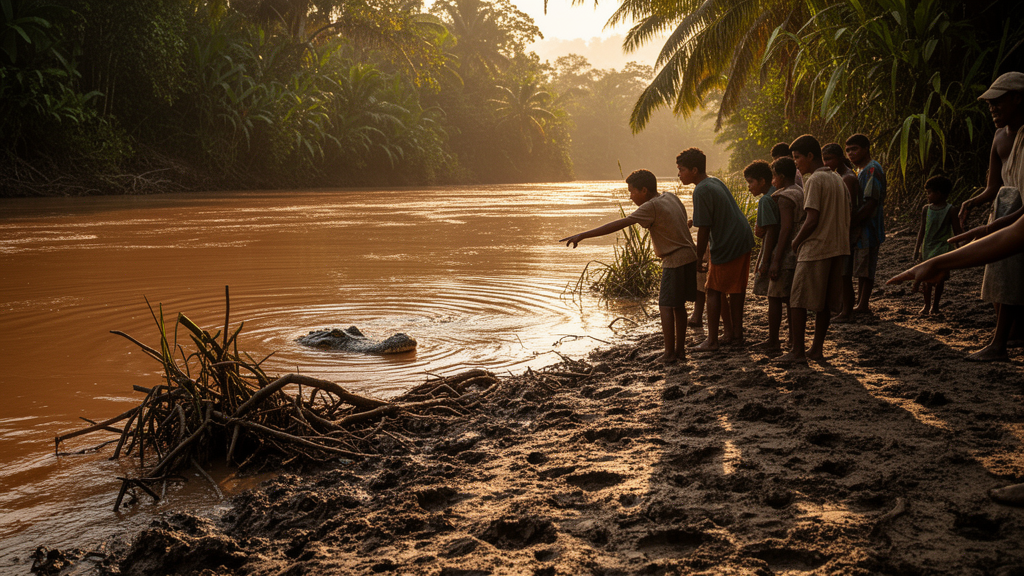
On the banks of the Segovia River, along the remote border between Honduras and Nicaragua, a routine morning of washing clothes turned into a violent encounter with one of Central America’s most formidable predators. A 12-year-old girl, wading briefly into the shallows to drink, was seized by an American crocodile (Crocodylus acutus) estimated at roughly two meters in length. The attack, which occurred on September 24, 2023, left the child with severe damage to her right tibia, including the loss of part of the muscle tissue in her calf, but she survived. The incident, now documented in the journal Neotropical Biology and Conservation, offers a rare and sobering case study of human-crocodile conflict in a region where such events remain poorly recorded.
The details of the encounter, reconstructed from reports by people near the site, illustrate how quickly these ambush predators can strike. The crocodile approached silently and without warning, catching the girl by surprise as she bent to drink. Her instinctive reaction, running immediately after the bite, caused part of the flesh on her calf to tear away from the bone. Within minutes, gunshots rang out from the riverbank as local residents located and killed the animal. The rapid escalation, from a quiet riverside chore to a maimed child and a dead crocodile, captures in miniature the dynamics that conservationists and biologists say are driving an underappreciated pattern of conflict across the region.
The American crocodile occupies a peculiar position in the conservation landscape of Central America. It is the only crocodile species distributed in Honduras, and it is listed in Appendix I of the Convention on International Trade in Endangered Species of Wild Fauna and Flora, the highest level of protection under that international agreement. Its range in the country spans the Pacific and Atlantic coasts, including offshore islands, with additional records in the central-western and central-eastern interior. The species is remarkably adaptable, inhabiting swamps, rivers, and lagoons from sea level up to elevations of 650 meters, and tolerating both freshwater and hypersaline environments. That flexibility has allowed it to persist in landscapes heavily modified by human activity, but it has also brought crocodiles into closer and more frequent contact with the people who share those waterways.
Interactions between humans and American crocodiles in Honduras have increased in recent years, though most documented cases involve hunting rather than attacks. Crocodiles are killed for their skins, for human consumption, or simply out of fear rooted in their terrifying reputation. Researchers argue that this fear is itself a product of negative experiences, real or remembered, in which crocodiles have attacked people. The new record from the Segovia River adds to a literature that remains strikingly thin. Before this report, only two attacks on humans had been documented in Honduras, a figure that stands in sharp contrast to neighboring countries where records are more abundant.
Across Central America, the documented toll of crocodile attacks reveals a pattern of uneven recording rather than uneven risk. Costa Rica has recorded approximately 56 events, five of them fatal, making it the regional hotspot for documented incidents. Panama follows with roughly 18 cases, three of them fatal. El Salvador and Nicaragua each have two documented cases. Honduras, despite sharing similar river systems and crocodile populations, has had almost nothing in the formal literature until now. The discrepancy almost certainly reflects differences in reporting infrastructure, scientific attention, and community engagement rather than genuine differences in how often crocodiles and people collide.
The Segovia River incident is notable not only for what happened but for where it happened. The attack occurred at an elevation of 149 meters, well within the species’ known altitudinal range but in a border region that has received little herpetological attention. The coordinates place the site in the Department of Olancho, a sparsely populated and heavily forested part of Honduras where rivers form natural boundaries and where wildlife monitoring is minimal. The fact that crocodiles are described as common in this stretch of the river suggests a population that has persisted despite hunting pressure, and one that local residents encounter regularly enough to regard as unremarkable until something goes wrong.
The researchers behind the new report place the attack within a broader framework of factors that influence crocodile attacks on humans. Such events, they note, tend to occur frequently in or on the shores of water bodies, in places with restricted access, or in areas already identified as risky due to the presence of crocodiles. The frequency of attacks is thought to be related to growing populations of the reptiles themselves, the destruction and fragmentation of their habitat, and the expansion of urban development into the areas surrounding the rivers, swamps, and lagoons where these large crocodilians rest and hunt. As human settlements push closer to crocodile habitat, the buffer zones that once separated the two species narrow, and the probability of dangerous encounters rises accordingly.
The killing of the crocodile after the attack reflects a pattern that conservation biologists have documented repeatedly in the region. Previous records from Honduras include the death of a crocodile killed for preying on cattle that drank at a riverbank, and a separate case in which a spectacled caiman (Caiman crocodilus) was run over on a road. Media reports from the country also describe people hunting crocodiles, though these accounts rarely make it into the scientific literature. The retaliatory killing of the Segovia River crocodile, while understandable from the perspective of a frightened community, removes an individual from a protected population and does nothing to address the underlying conditions that brought the animal and the child into contact in the first place.
What emerges from the case is a picture of a conflict that is real but chronically underreported, and therefore poorly managed. With only a handful of documented attacks across Honduras and its neighbors, there is little baseline data to inform safety messaging, habitat management, or community education. The researchers argue that understanding the causes of crocodile attacks, whether they stem from habitat encroachment, increasing crocodile numbers, or the simple fact that people must use rivers for washing, drinking, and fishing, is essential to reducing future incidents. Without systematic recording, each attack risks being treated as an isolated tragedy rather than part of a pattern that could be anticipated and mitigated.
For the girl on the Segovia River, the encounter ended with a survivable injury and a story that will likely be told in her community for years. For biologists, it represents a data point in a region where data points are scarce, and a reminder that the American crocodile, protected on paper but vulnerable in practice, continues to navigate an increasingly crowded landscape. As human populations grow and development pushes further into the wetlands and riverbanks that crocodiles have occupied for millions of years, the question is not whether such encounters will happen again, but whether the region will develop the monitoring, education, and coexistence strategies needed to ensure that the next attack does not end with another dead crocodile and another child in a hospital ward.
Subject of Research: A non-fatal American crocodile attack on a child at the Honduras-Nicaragua border and its implications for human-crocodile conflict
Article Title: A record of a non-fatal attack of an American crocodile ( Crocodylus acutus ) in the “Rio Segovia” on the Honduras-Nicaragua border
Article References: Cubas-Rodríguez, A. M., & Cupul-Magaña, F. G. (2024). A record of a non-fatal attack of an American crocodile (Crocodylus acutus) in the “Rio Segovia” on the Honduras-Nicaragua border. Neotropical Biology and Conservation, 19(2), 113-116. https://doi.org/10.3897/neotropical.19.e120434
Image Credits: AI Generated
DOI: 10.3897/neotropical.19.e120434
Keywords: American crocodile, Crocodylus acutus, human-wildlife conflict, Honduras, Segovia River, crocodile attack, Neotropical Biology and Conservation, CITES, Central America, wildlife conservation, Olancho, retaliatory killing
News Source: Margaret Porter. (October 18, 2026). Crocodile Attack on Honduran Riverbank Reveals Rising Human-Wildlife Conflict. Scienmag.