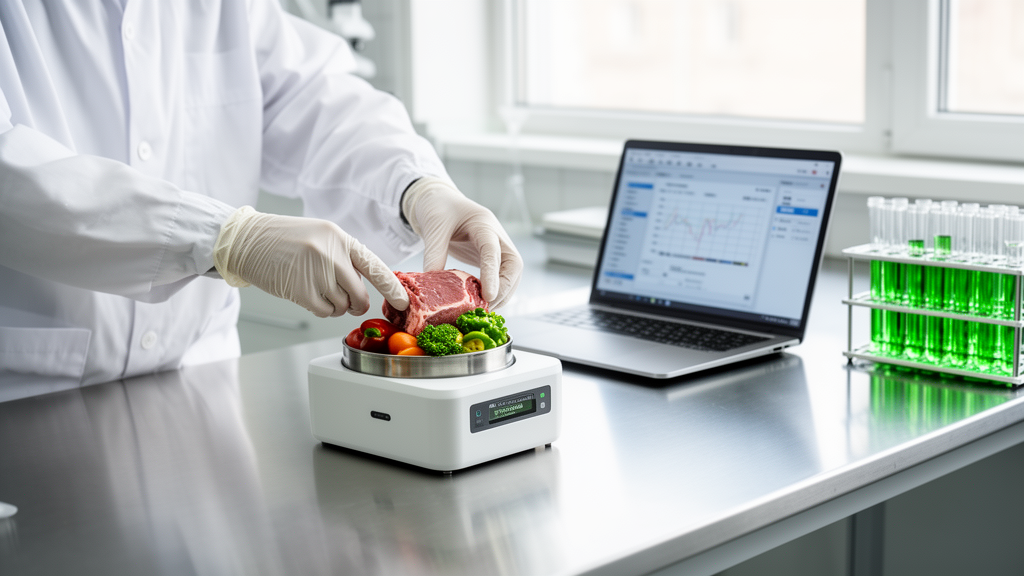
Every year, the world’s livestock and aquaculture industries deploy roughly 110,000 tonnes of antimicrobials to keep animals healthy and productive. That pharmaceutical arsenal saves lives on the farm, but it leaves a chemical shadow on the plate: residues of antibiotics, antiparasitics, hormones, sedatives and anti-inflammatory drugs can linger in meat, milk, eggs, honey and fishery products when dosing is careless, withdrawal periods are ignored or regulatory oversight falters. A sweeping review published in Food Chemistry: X argues that the tools to control this problem already exist — but they are scattered across analytical chemistry laboratories, digital technology startups and environmental science departments, and the real challenge is wiring them together into a single, intelligent, sustainable surveillance system.
The review, led by Marzieh Ramezani Farani and Yun Suk Huh with colleagues spanning Iran, the United Kingdom, Cambodia and South Korea, examines veterinary drug residue control from every angle: the pharmacology of how drugs accumulate in animal tissues, the regulatory frameworks that set maximum residue limits, the laboratory techniques that detect them, the artificial intelligence that interprets the signals, the blockchain that traces the records, and the green chemistry that keeps the whole enterprise environmentally defensible. Its central thesis is deceptively simple: reliable measurements are worthless without timely decisions, and timely decisions are worthless without traceable records. The farm-to-fork sequence — prevention during treatment, screening at collection or slaughter, laboratory confirmation, and traceable product control through retail — must function as one connected pipeline.
The pharmacokinetics of residue formation are more intricate than most consumers realize. Lipophilic molecules such as the macrocyclic lactone antiparasitics accumulate in fatty tissues and are excreted slowly, while hydrophilic beta-lactam antibiotics clear rapidly through urine but can appear temporarily in milk. Species, age, health status and production stage all shift the pharmacokinetic profile, which is why withdrawal periods vary so widely. Increasingly, physiologically based pharmacokinetic models are being used to estimate tissue depletion after different dose regimens. Zhang and colleagues developed an open-source, web-based model of tylosin in broiler chickens and laying hens that predicts concentrations in edible tissues, egg yolk and egg white, letting users explore alternative exposure scenarios interactively. Such tools could connect treatment records with prospective residue-depletion estimates, strengthening prevention within digital farm-to-fork systems — though the review is careful to note that model predictions must remain distinguished from analytical verification of compliance.
The health stakes are considerable. Direct toxicities from residue exposure include nephrotoxicity, hepatotoxicity, neurotoxicity, carcinogenicity, reproductive effects and endocrine disruption from hormonal agents and beta-agonists. Hypersensitivity reactions to beta-lactams and sulfonamides can occur even at very low concentrations in sensitized individuals, justifying particularly stringent maximum residue limits or outright prohibition of certain substances. Perhaps most insidiously, at sub-inhibitory concentrations antibiotics can favor resistant bacteria when the selective advantage exceeds the fitness cost of resistance — a mechanism demonstrated experimentally by Gullberg and colleagues. Yet the review emphasizes that the contribution of dietary residues to human antimicrobial resistance depends on bioavailable exposure and microbial context, and cannot be inferred from residue concentrations alone. Co-occurrence of residues and resistant bacteria does not establish transmission or causality.
Regulatory heterogeneity compounds the analytical challenge. The Joint FAO/WHO Expert Committee on Food Additives assesses toxicological and residue-depletion data to recommend acceptable daily intakes and maximum residue limits, which the Codex Alimentarius Commission adopts as global reference points in World Trade Organization dispute settlement. But uncertainty factors and policy considerations differ across markets, producing divergent limits that create trade friction. Codex adopted a limit of 10 micrograms per kilogram for ractopamine in cattle and pig muscle, whereas EU legislation prohibits its use for growth promotion entirely. A concrete example documented in US FDA Import Alert 16-131 found unapproved drug residues in 22 of 89 aquaculture samples imported from China between October 2006 and May 2007, triggering detention without physical examination of covered imports. Okunola and colleagues concluded that Codex limits cover only a minority of drug-product pairs, and that much of the heterogeneity arises precisely where Codex has been unable to set a standard.
On the analytical front, the review organizes detection into two tiers. Front-line screening — microbiological inhibitor tests, enzyme-linked immunosorbent assays, lateral flow immunoassays, electrochemical biosensors, surface-enhanced Raman spectroscopy and surface plasmon resonance — prioritizes speed and portability at collection points and slaughterhouses. Lateral flow devices now incorporate engineered labels like gold nanoparticles, quantum dots and up-conversion phosphors, achieving semi-quantitative and even multiplex analyses. Electrochemical sensors have demonstrated sub-nanogram-per-millilitre detection of tetracyclines, sulfonamides, aminoglycosides and beta-agonists using nanomaterials like graphene, carbon nanotubes and metal-organic frameworks. Confirmatory analysis, by contrast, relies on liquid chromatography coupled to tandem or high-resolution mass spectrometry, which can identify over 200 analytes in a single run and enable retrospective mining of full-scan data for emerging residues. The review stresses that a low detection limit alone does not establish suitability for routine surveillance: the imidocarb lateral flow assay required dilution for milk but extraction and defatting for beef, and its antibody showed 18.12 percent cross-reactivity with a related compound. Acceptable recovery does not demonstrate complete discrimination among coexisting drugs.
Artificial intelligence is transforming how these analytical signals are interpreted. Rather than relying on single peak integration and univariate thresholds, multivariate machine learning models exploit subtle relationships between instrument responses and residue concentrations, enhancing sensitivity and robustness in complex matrices such as meat, milk and eggs. Deep learning architectures have shown high performance processing hyperspectral images, Raman spectra and sensor array outputs for non-destructive screening at line speed. An embedded reader called VetStar achieved a mean average precision of 97.4 for interpreting colloidal gold immunoassay test cards, with roughly 5.4 seconds of on-device inference. Hyperspectral imaging combined with explainable AI detected ofloxacin residues in mutton, with SHAP-based wavelength attribution identifying the spectral regions driving predictions. SERS combined with self-optimizing machine learning achieved a coefficient of determination up to 0.996 for predicting ciprofloxacin and norfloxacin concentrations in milk. Yet the review cautions that feature attribution alone does not establish chemical specificity, and that explanation stability should be examined across independent samples, instruments and production batches before such tools enter official control workflows.
Internet-of-Things sensor networks and blockchain ledgers extend residue control beyond the laboratory. IoT-enabled biosensing packaging can track spoilage, migration or contaminant build-up in meat and dairy products, sending data wirelessly to quality-control platforms. A smartphone-based system called LumiCellSense combined a 16-well chip containing bioluminescent bacterial reporters with image processing, detecting ciprofloxacin in spiked whole milk at a threshold of 7.2 nanograms per millilitre. More ambitiously, a ZnMOF-74 and Mn:ZnS quantum-dot sensor array reported by Deng and colleagues used a smartphone application with cloud-based machine learning to examine enrofloxacin, chlortetracycline, oxytetracycline and tetracycline in milk, honey and beef, achieving 98 percent recognition accuracy and recoveries between 97.33 and 107.40 percent. Blockchain layers can record key compliance events with tamper-evident timestamping, and smart contracts could automate batch holds, releases and recalls when predefined safety criteria are met. But the review is clear that neither a cryptographic hash nor network consensus establishes that a sample was representative or an assay was correct — ledger integrity cannot validate the original measurement.
Green analytical chemistry adds an environmental dimension to the entire enterprise. Conventional LC-MS/MS techniques consume large volumes of organic solvents, energy and disposable materials, raising occupational hazards and life-cycle concerns. Microextraction methods such as solid-phase microextraction, stir-bar sorptive extraction and dispersive liquid-liquid microextraction can reduce extraction volumes, though the review notes that miniaturized enrichment does not eliminate substantial upstream solvent use — the portable SPME Arrow mass spectrometry workflow still required 20 millilitres of solvent per 5 grams of chicken tissue during preparation. Deep eutectic solvents derived from natural precursors offer substitution potential, but low volatility or natural origin does not establish low toxicity, and life-cycle assessments show that their environmental performance depends heavily on the comparator. He and colleagues coupled a 96-well electromembrane extraction platform using a deep eutectic solvent with LC-MS/MS for 22 veterinary drugs in honey, milk and eggs, achieving a 15-minute extraction with an AGREEprep greenness score of 0.67 — though the recovery range of 40 to 99 percent requires analyte-specific assessment.
The review proposes a three-phase implementation roadmap. Phase 1, during the first year, focuses on foundations: regulators and reference laboratories define priority drug-matrix combinations, sampling points and decision rules, while veterinarians and farmers maintain treatment records and verify withdrawal compliance. Phase 2, spanning years one to three, pilots connected workflows in selected supply chains, linking screening at collection or processing intake to batch identification, segregation of suspect products and laboratory confirmation. Phase 3, beyond year three, extends successful pilots across processing, distribution and retail, with confirmed non-compliance supporting targeted withdrawal or recall and investigation of the source farm. Across all phases, program evaluation should track withdrawal-record completeness, screening false-negative performance, confirmation turnaround and the proportion of implicated lots located during tracing exercises. The review ultimately argues that linking residue surveillance with antimicrobial-use, resistance and environmental data can support One Health action — while preserving the crucial distinction between residue compliance and antimicrobial resistance risk. Effective residue control, it concludes, requires reliable measurements linked to timely action, with digital tools adding value only when data quality, interoperability and accountable decisions are guaranteed.
Subject of Research: Food Safety
Article Title: Veterinary drug residues in animal-derived foods: From analytical detection to intelligent and sustainable surveillance
Article References: Farani, M. R., Mirzaee, D., Voosough, A., Hatami, A., Chanmey, K., Ashtiani, S.-H. M., Sheik, A., Alipourfard, I., Stratakos, A. C., Piletsky, S. A., Hwang, S.-K., & Huh, Y. S. (2026). Veterinary drug residues in animal-derived foods: From analytical detection to intelligent and sustainable surveillance. Food Chemistry: X, Article 104643. https://doi.org/10.1016/j.fochx.2026.104643
Image Credits: AI Generated
DOI: 10.1016/j.fochx.2026.104643
Keywords: veterinary drug residues, food safety, antimicrobial resistance, biosensors, artificial intelligence, green analytical chemistry, blockchain, IoT, Veterinary, drug, residues, animal-derived
News Source: Bethany Barker. (October 18, 2026). From Farm to Fork: AI, Biosensors and Green Chemistry Join Forces to Hunt Veterinary Drug Residues in Food. Scienmag.