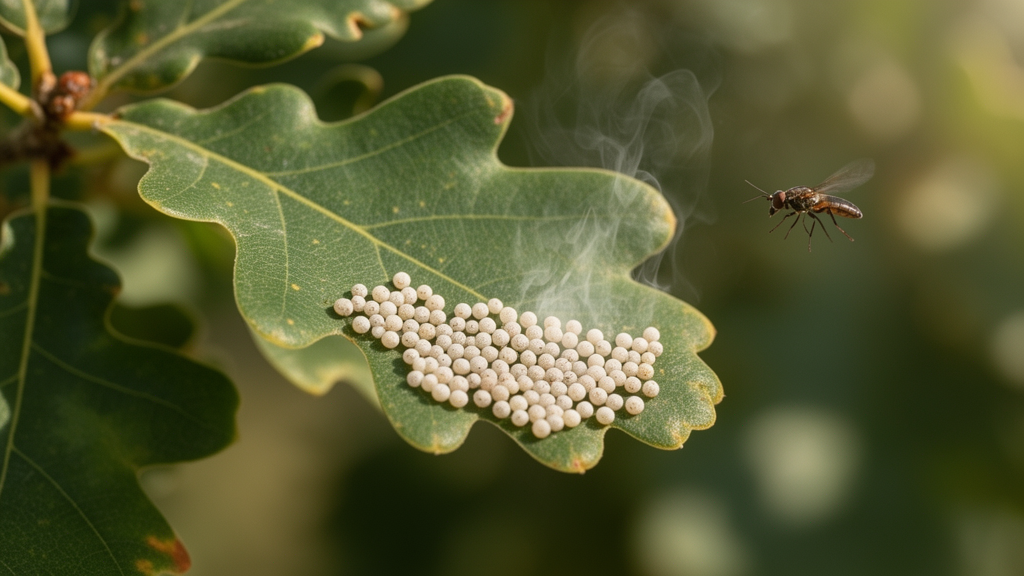
On the surface of an oak leaf, a cluster of silkworm eggs would seem to be one of the most vulnerable objects in nature. They sit in plain view, motionless, unable to run, hide, or fight. Yet a new study published in Insect Science shows that the eggs of the oak silkworm, Antheraea pernyi, are anything but passive targets. Researchers have discovered that naturally laid eggs emit a volatile compound, 2-ethyl-1-hexanol, that repels the parasitic wasps which would otherwise implant their own eggs inside them. The finding overturns a long-standing assumption in insect ecology: that eggs laid without physical coverings or chemical toxins are simply waiting to be consumed.
The research began with an observation that has puzzled entomologists working with this species. In laboratory settings, when eggs are manually removed from the substrate and washed before being offered to parasitoid wasps, they suffer heavy rates of parasitism. In the field, however, naturally laid eggs are attacked far less often. Something about the intact, naturally laid egg was deterring the wasps, and the research team, led by Professor Lian-Sheng Zang of the State Key Laboratory of Green Pesticides at Guizhou University, with doctoral candidate Hai-Xia Zhan as first author, set out to identify what it was.
Field experiments provided the first clue. Naturally laid eggs were attacked markedly less frequently by three species of egg parasitoid wasps. The specialist Mesocomys trabalae almost completely avoided intact eggs, while Anastatus japonicus made fewer contacts and fewer attempts to deposit its own eggs. Egg parasitoids such as these locate hosts through a combination of chemical and visual cues, searching for the volatile signatures that eggs and the surfaces around them release. Any compound that disrupts that search, or that signals a bad host, can dramatically reduce parasitism success.
Using behavioural assays combined with chemical analysis of the egg surfaces and their emissions, the team identified 2-ethyl-1-hexanol, abbreviated 2EH, as a compound distinctly associated with naturally laid eggs. Crucially, both wasp species could detect the chemical, and when they were exposed to it directly they showed clear avoidance behaviour. This established that 2EH is not merely a by-product of egg biology but an active signal in the chemical conversation between the silkworm eggs and their enemies.
The decisive experiment came next. When the researchers applied 2EH to eggs that had been washed clean of their natural chemical coating, parasitism dropped significantly. That single result confirmed the compound’s protective role: restoring the chemical restored the defence. It also explained the laboratory anomaly in a satisfying way. Washing removes 2EH, leaving the eggs chemically naked and highly attractive to the wasps, which is precisely why washed eggs have historically served as efficient hosts for rearing parasitoids in the lab.
“Our study reveals that exposed eggs are not inherently vulnerable but instead deploy an active volatile-based chemical defence,” explains Professor Lian-Sheng Zang, corresponding author of the study. “This challenges the conventional view that eggs without physical coverings or toxins are simply passive targets.” The statement captures a conceptual shift that ripples well beyond a single species. Insect eggs have traditionally been categorized along a spectrum of protection: some species bury their eggs inside plant tissue, others encase them in hardened shells, oothecae, or layers of hairs and wax, and still others arm them with alkaloids and other sequestered toxins. A fourth strategy, an airborne repellent that keeps enemies at a distance before they ever touch the egg, had received far less attention.
The technical implications of a volatile defence are considerable. Unlike a physical barrier, a volatile compound works at a distance, interfering with the host-location process itself. Egg parasitoids depend on olfactory cues to find cryptic, immobile targets, often following plant volatiles released in response to egg deposition or detecting cues on the egg surface during close-range contact. A compound such as 2EH, which the wasps can detect and avoid, effectively jam or repels that search. For the eggs, the strategy carries its own trade-offs in principle, since any volatile cue can potentially be exploited by other organisms, but in this system the net effect measured in the field was strongly protective against the wasp species tested.
The discovery also has immediate practical value. Oak silkworm eggs are widely used as alternative hosts for the mass rearing of parasitoid wasps deployed in biological control programmes against agricultural pests. Mass-rearing operations depend on getting wasps to parasitize the eggs efficiently, and the new results suggest that the repellent effect of 2EH could complicate or limit that process under some conditions. Understanding exactly how 2EH deters the wasps gives producers a chemical handle for optimizing these systems, whether by managing the compound’s presence on production eggs or by accounting for its effects when designing rearing protocols and release strategies.
Beyond the rearing facility, the work points toward greener approaches to pest management. 2-ethyl-1-hexanol is a naturally occurring compound, and the study raises the possibility of using it, or analogues inspired by it, as an environmentally friendly insect repellent. Push-pull and disrupt-the-cue strategies, which manipulate the odour landscape to steer pest insects away from crops or their hosts, are a growing branch of sustainable agriculture. A repellent that specifically protects a vulnerable life stage, the egg, against parasitoids or other egg-feeding enemies would be a welcome addition to that toolkit, particularly because it targets innate odour-guided behaviour rather than relying on broad-spectrum toxicity.
The authors are careful to note that much remains to be learned. Further research is needed to determine whether similar volatile-mediated defences occur in other insect species, how the eggs acquire or produce 2EH, and whether natural enemies might evolve countermeasures over evolutionary time. Researchers from the Guangdong Academy of Sciences, the Beijing Academy of Agriculture and Forestry Sciences, and international collaborators including Professor Guy Smagghe contributed to the study. For now, the message is clear and surprisingly elegant: even an egg lying in full view on an oak leaf can defend itself, not with armour, but with a scent its enemies have learned to avoid.
Subject of Research: Volatile chemical defence of oak silkworm eggs against parasitoid wasps
Article Title: Oak silkworm eggs use a natural chemical defence to keep parasitic wasps away
Article References: Oak silkworm eggs use a natural chemical defence to keep parasitic wasps away. (n.d.). Original publication
Image Credits: AI Generated
DOI: Not provided
Keywords: oak silkworm, Antheraea pernyi, 2-ethyl-1-hexanol, chemical ecology, egg parasitoids, volatile repellent, Insect Science, biological control, insect defence, pest management, Mesocomys trabalae, Anastatus japonicus
News Source: Gavin Prescott. (October 18, 2026). Exposed oak silkworm eggs fight back with a repellent chemical scent. Scienmag.