• HOME
  • NEWS
  • EXPLORE
    • CAREER
      • Companies
      • Jobs
    • EVENTS
    • iGEM
      • News
      • Team
    • PHOTOS
    • VIDEO
    • WIKI
  • BLOG
  • COMMUNITY
    • FACEBOOK
    • INSTAGRAM
    • TWITTER
Wednesday, December 24, 2025
BIOENGINEER.ORG
No Result
View All Result
  • Login
  • HOME
  • NEWS
  • EXPLORE
    • CAREER
      • Companies
      • Jobs
        • Lecturer
        • PhD Studentship
        • Postdoc
        • Research Assistant
    • EVENTS
    • iGEM
      • News
      • Team
    • PHOTOS
    • VIDEO
    • WIKI
  • BLOG
  • COMMUNITY
    • FACEBOOK
    • INSTAGRAM
    • TWITTER
  • HOME
  • NEWS
  • EXPLORE
    • CAREER
      • Companies
      • Jobs
        • Lecturer
        • PhD Studentship
        • Postdoc
        • Research Assistant
    • EVENTS
    • iGEM
      • News
      • Team
    • PHOTOS
    • VIDEO
    • WIKI
  • BLOG
  • COMMUNITY
    • FACEBOOK
    • INSTAGRAM
    • TWITTER
No Result
View All Result
Bioengineer.org
No Result
View All Result
Home NEWS Science News Microbiology

Tracking viral DNA in the cell

Bioengineer by Bioengineer
May 13, 2014
in Microbiology
Reading Time: 2 mins read
0
Share on FacebookShare on TwitterShare on LinkedinShare on RedditShare on Telegram

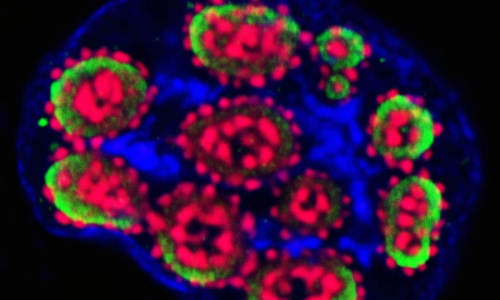
The medical, humanitarian and economical impact of viral diseases is devastating to humans and livestock. There are no adequate therapies available against most viral diseases, largely because the mechanisms by which viruses infect cells are poorly known. An interdisciplinary team of researchers from the University of Zurich headed by cell biologist Prof. Urs Greber now presents a method that can be used to display viral DNA in host cells at single-molecule resolution. The method gives unexpected insights into the distribution of viral DNA in cells, and the reaction of cells to viral DNA.
Tracking viral DNA in the cell

Grape-like structures of viral replication territories in the nucleus of a human cell visualized by click-chemistry and immuno-fluorescence confocal microscopy. Newly synthesized adenoviral DNA labeled by click chemistry is depicted in red, a viral DNA-binding protein in green, and the cellular DNA in blue. The cell nucleus with a faint blue periphery is 18 x 22 micrometers in size. Photo Credit: Nathalie Huber

Click chemistry detects viral DNA

For their studies, Greber and his team with PhD students I-Hsuan Wang, Vardan Andriasyan and senior research scientist Dr. Maarit Suomalainen used cell cultures and human adenoviruses causing respiratory disease and conjunctivitis, herpes viruses and vaccinia virus, the latter in collaboration with Dr. Jason Mercer and his PhD student Samuel Kilcher from the ETH Zurich. To label the DNA of an intact virus, the scientists turned to click chemistry — widely applicable chemical reaction types. Prof. Nathan Luedtke from the Institute of Organic Chemistry at the University of Zurich, and PhD student Anne Neef developed a new class of “clickable” chemical molecules. “Our molecule is incorporated into viral DNA without affecting the biological functions of the DNA, and it can be used to label the DNA for fluorescence microscopy,” says Luedtke.

Defense response of infected cells visible for the first time

Greber and his team infected human cells in culture with the chemically labeled viruses, and observed the behavior of the viral DNA during entry into cells. “Using this elegant method, we can reveal that not all the incoming viral DNA enters the cell nucleus as originally expected, but a significant fraction remains in the cytosol, the fluids of the cytoplasm,” explains Greber. According to the scientists, this phenomenon may be part of the antiviral defense reaction. “For the first time, we can display the localization of incoming viral DNA, and link it to anti-viral defense or infection mechanisms,” says Greber. The researchers show that cells of the same type take up different amounts of viral DNA into their nucleus. Greber suspects that the nucleus has antiviral defense reactions, akin to the cytosol, and these defense reactions are variable between cells. With the new method in hand, this is now subject to future studies. The scientists suggest that their procedure can be applied to other DNA viruses, or the HI virus (HIV).

Story Source:

The above story is based on materials provided by University of Zurich.

Share13Tweet8Share2ShareShareShare2

Related Posts

IMAGE

Cataloging nature’s hidden arsenal: Viruses that infect bacteria

December 10, 2020
IMAGE

The use of wild mammals in traditional medicine

December 9, 2020

Scientists shed new light on how lung bacteria defend against pneumonia

December 8, 2020

How poor oral hygiene may result in metabolic syndrome

December 8, 2020
Please login to join discussion

POPULAR NEWS

  • Nurses’ Views on Online Learning: Effects on Performance

    Nurses’ Views on Online Learning: Effects on Performance

    70 shares
    Share 28 Tweet 18
  • NSF funds machine-learning research at UNO and UNL to study energy requirements of walking in older adults

    71 shares
    Share 28 Tweet 18
  • Unraveling Levofloxacin’s Impact on Brain Function

    54 shares
    Share 22 Tweet 14
  • Exploring Audiology Accessibility in Johannesburg, South Africa

    51 shares
    Share 20 Tweet 13

About

We bring you the latest biotechnology news from best research centers and universities around the world. Check our website.

Follow us

Recent News

HPV Burden and Cervical Abnormalities in Libreville

HPV Burden and Cervical Abnormalities in Libreville

Muscle Health Transitions and Risks in Seniors

Subscribe to Blog via Email

Success! An email was just sent to confirm your subscription. Please find the email now and click 'Confirm' to start subscribing.

Join 70 other subscribers
  • Contact Us

Bioengineer.org © Copyright 2023 All Rights Reserved.

Welcome Back!

Login to your account below

Forgotten Password?

Retrieve your password

Please enter your username or email address to reset your password.

Log In
No Result
View All Result
  • Homepages
    • Home Page 1
    • Home Page 2
  • News
  • National
  • Business
  • Health
  • Lifestyle
  • Science

Bioengineer.org © Copyright 2023 All Rights Reserved.