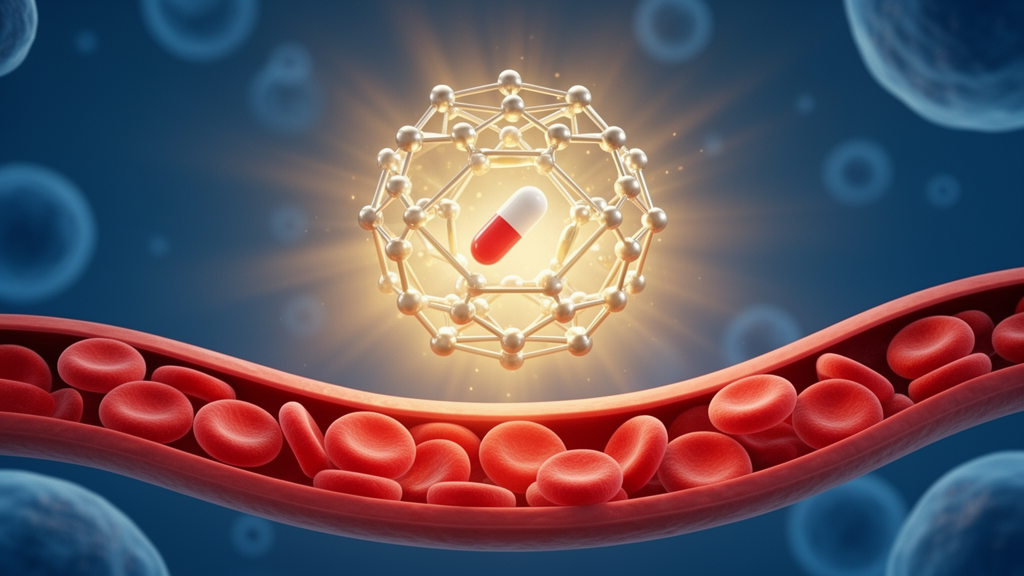
One of the most stubborn problems in modern pharmacology is deceptively simple: many drugs that work beautifully in a test tube never make it into the bloodstream in useful amounts. Ticagrelor, a widely prescribed antiplatelet agent that protects patients after heart attacks by blocking the P2Y12 receptor, is a textbook case. Classified as a Biopharmaceutics Classification System class IV compound, it suffers from both poor water solubility and limited membrane permeability, leaving its oral bioavailability at roughly 36 percent. A new study published in Results in Chemistry reports that wrapping the drug inside a synthetic molecular cage known as cucurbit[7]uril, abbreviated CB[7], can dramatically change that picture, boosting apparent solubility by nearly eighty-fold under acidic conditions and roughly doubling systemic drug exposure in mice.
The research team, led by Wenjuan Ma and Rongfang Lin of Fujian Medical University with co-first authors Jingjing Lin, Yiwei Liu, and Jiayuan Lai, set out to test an idea that goes beyond conventional formulation science. Pharmaceutical excipients are usually treated as passive helpers that improve dissolution or stability. But a growing body of evidence suggests that macrocyclic host molecules such as cyclodextrins and cucurbiturils can do more than dissolve their cargo: they can alter the cargo’s conformation, cellular uptake, and even its biological activity. CB[7], a rigid barrel-shaped molecule with a hydrophobic cavity and carbonyl-lined portals at both ends, is a particularly intriguing candidate because it binds neutral and positively charged guests with high affinity and has previously been shown to modify the behavior of platinum-based anticancer drugs.
To establish that ticagrelor and CB[7] actually form a complex, the researchers deployed a battery of complementary techniques. Job’s method of continuous variation, a classic supramolecular chemistry analysis, produced a maximum at a mole fraction of 0.5, supporting a 1:1 host-to-guest stoichiometry. Ultraviolet–visible titration data, fitted to a 1:1 binding model, yielded an apparent association constant of (3.90 ± 0.12) × 10⁴ M⁻¹ in 10 percent methanol and 0.1 M hydrochloric acid, with an excellent coefficient of determination of 0.9952. Proton nuclear magnetic resonance spectroscopy added further support: when CB[7] was added stepwise to ticagrelor, signals in both the aromatic and aliphatic regions shifted upfield by between 0.05 and 0.71 parts per million, a hallmark of guest molecules being shielded inside a host cavity.
Computational modelling provided a structural picture of the assembly. The team used GFN-xTB molecular dynamics at 500 K to generate two thousand candidate conformations, then refined the lowest-energy structure with density functional theory at the B3LYP-D3/6-31G(d,p) level. The calculated gas-phase association free energy came out at −53.3 kcal/mol, indicating favorable binding within the computational model. In the predicted geometry, part of the ticagrelor molecule sits inside the CB[7] cavity while several functional groups protrude near the carbonyl-lined portals, a positioning compatible with portal-associated noncovalent interactions. The authors are careful to note that the gas-phase calculation cannot be compared directly with the solution-phase binding constant, and that the specific orientation of the drug inside the cage has not been experimentally pinned down.
The practical payoff showed up most clearly in phase-solubility experiments. In 0.1 M hydrochloric acid, mimicking the acidic environment of the stomach, CB[7] enhanced the apparent solubility of ticagrelor by approximately 79-fold, with an apparent stability constant of (9.81 ± 0.73) × 10³ M⁻¹. In phosphate-buffered saline at pH 7.4, the enhancement was a more modest 7.5-fold, with a stability constant of (6.44 ± 0.41) × 10² M⁻¹. The authors caution that the two media differ in both pH and ionic composition, so the difference cannot be attributed solely to changes in drug ionization. Solid-state analysis told a complementary story: X-ray powder diffraction revealed that the characteristic crystalline peaks of free ticagrelor nearly vanished in the formulated powder, replaced by broadened peaks and a diffuse halo consistent with a predominantly amorphous solid state, a form that generally dissolves faster than crystals.
What elevates the study beyond a standard solubility exercise is its exploration of immunology. Ticagrelor is known to have anti-inflammatory effects independent of platelet inhibition, including attenuation of procoagulant extracellular-vesicle release and inflammasome-associated signaling. The researchers therefore examined how the formulation affected RAW264.7 macrophages, the workhorse immune cells of the mouse laboratory, after stimulating them with lipopolysaccharide to induce an inflammatory state. Macrophages exist on a functional spectrum: pro-inflammatory M1-like cells, marked by iNOS and CD80, drive tissue-damaging inflammation, while M2-like cells, marked by CD206, participate in repair and resolution. Excessive M1 skewing is a feature of many chronic inflammatory diseases.
The results were striking. Free ticagrelor reduced the proportion of iNOS-positive, CD206-negative M1-like cells in a dose-dependent manner, but the Tica@CB[7] formulation pushed the shift further, decreasing M1-like cells and increasing M2-like cells relative to the free drug. Immunofluorescence staining showed reduced iNOS and increased CD206 protein, and quantitative PCR revealed stronger downregulation of the pro-inflammatory genes Nos2 and Il1b alongside increased expression of Hmox1, a gene associated with antioxidant and resolution responses. Interestingly, the effect peaked at the nominal 1:1 drug-to-host ratio; raising the CB[7] concentration from 20 to 80 micromolar while holding ticagrelor constant produced no additional benefit. The authors note an important caveat: based on the measured binding constant, only about 34 percent of the drug would be complexed at the tested concentrations, and no physical-mixture control was evaluated, so the enhanced response cannot be attributed exclusively to the preformed complex.
A more complicated finding emerged when the team probed oxidative stress and cell death. Under inflammatory conditions, the formulation was associated with higher reactive-oxygen-species fluorescence, greater lipid peroxidation measured with the C11-BODIPY 581/591 probe, and increased proportions of Annexin V-positive dying cells compared with free ticagrelor. These responses were non-monotonic with CB[7] concentration, peaking at the equimolar composition. The study does not establish the mechanism of cell death or a causal link between oxidative stress and the macrophage phenotype shift, and the authors flag this as unresolved. Separately, the formulation promoted cholesterol efflux from macrophages, a process tied to anti-inflammatory polarization, with the largest efflux responses at higher CB[7] concentrations of 40 and 60 micromolar, a pattern distinct from the polarization data and suggesting that different components of the mixture drive different effects.
The in vivo experiments translated the laboratory findings into whole-animal pharmacology. When mice received the formulation by oral gavage at an equivalent ticagrelor dose of 100 milligrams per kilogram, the area under the plasma concentration–time curve over 18 hours rose 1.9-fold compared with free drug, from 3074.65 to 5812.76 nanogram-hours per milliliter, and the maximum plasma concentration increased 3.2-fold, from 376.50 to 1218.99 nanograms per milliliter. Peak concentrations arrived slightly earlier, at 2.40 versus 3.20 hours, while the elimination half-life and mean residence time were shorter. In a parallel seven-day dosing experiment followed by an inflammatory challenge with lipopolysaccharide, flow cytometry of circulating immune cells showed that mice given the formulation had a lower proportion of CD86-positive cells within the CD11b-positive, Ly6C-positive monocyte population, particularly at 12 and 24 hours after challenge, indicating a dampened inflammatory profile in the bloodstream.
The study stops well short of clinical translation, and its authors are appropriately measured about the limits of their data. The binding constant was measured under acidic conditions that do not match the cell-culture environment, the fraction of complexed drug during biological experiments is unknown, and cyclodextrin-based ticagrelor formulations reported by other groups cannot be compared quantitatively because of differing experimental conditions. Nevertheless, the work makes a compelling case that cucurbit[7]uril is not merely a solubilizing wrapper but an active formulation component capable of reshaping both the pharmacokinetics and the immunological behavior of a drug. If the approach holds up in further preclinical testing, molecular caging could become a general strategy for rescuing poorly soluble immunomodulatory compounds, a class of molecules that keeps growing as inflammation is implicated in ever more diseases.
Subject of Research: Cucurbit[7]uril host–guest complexation of the antiplatelet drug ticagrelor to enhance oral bioavailability and modulate macrophage inflammatory responses
Article Title: Cucurbit[7]uril complexation of ticagrelor: host–guest characterization, enhanced oral bioavailability, and immunomodulatory effects
Article References: Lin, J., Liu, Y., Lai, J., Xu, J., Lin, Y., Zhong, C., Lin, R., & Ma, W. (2026). Cucurbit[7]uril complexation of ticagrelor: host–guest characterization, enhanced oral bioavailability, and immunomodulatory effects. Results in Chemistry, 31, Article 103935. https://doi.org/10.1016/j.rechem.2026.103935
Image Credits: AI Generated
DOI: 10.1016/j.rechem.2026.103935
Keywords: cucurbit[7]uril, ticagrelor, host–guest chemistry, supramolecular chemistry, oral bioavailability, drug solubility, macrophage polarization, P2Y12 receptor, pharmacokinetics, immunomodulation, inclusion complex, drug delivery
News Source: Bethany Barker. (October 14, 2026). Molecular Cage Supercharges Blood-Thinner Absorption and Calms Inflammation in Mice. Scienmag.