Ovarian cancer remains the deadliest of all gynecological malignancies, a distinction it has earned not through sheer incidence but through a combination of late diagnosis, aggressive progression, and an stubborn tendency to develop resistance to platinum-based chemotherapy. Most patients are diagnosed only after the disease has spread beyond the ovary, and even those who respond initially to surgery and chemotherapy frequently relapse with tumors that no longer respond to treatment. Against this grim backdrop, a new systematic review published in Medical Oncology by Mojtaba Esmaeli and Maryam Dehghanpour Dehabadi of Gerash University of Medical Sciences in Iran takes a careful, evidence-based look at one of the most studied natural compounds in cancer research: curcumin, the golden-yellow polyphenol derived from the turmeric root, Curcuma longa.
The review, which systematically evaluated 21 preclinical studies of curcumin and its engineered formulations in ovarian cancer models, arrives at a nuanced conclusion. Curcumin, the authors report, appears to act on multiple molecular signaling pathways that ovarian cancer cells depend upon for survival, proliferation, and spread. These include the phosphoinositide 3-kinase (PI3K)/protein kinase B (Akt)/mechanistic target of rapamycin (mTOR) axis, the nuclear factor kappa B (NF-κB) pathway, the Janus kinase (JAK)/signal transducer and activator of transcription 3 (STAT3) cascade, and the Wnt/β-catenin signaling system. Each of these pathways plays a well-documented role in driving the malignant behavior of ovarian tumors, and the fact that a single dietary compound can modulate all of them simultaneously is precisely what has kept curcumin at the center of so much research attention.
The mechanistic details emerging from the reviewed studies are striking in their breadth. In cell culture and animal models, curcumin treatment was consistently associated with increased apoptosis, the programmed self-destruction of cancer cells, alongside reduced cellular proliferation. The compound also appears to inhibit epithelial-to-mesenchymal transition, or EMT, the developmental program that cancer cells hijack to become mobile, invasive, and resistant to therapy. EMT is considered a central driver of metastasis in ovarian cancer, a disease that spreads by seeding the peritoneal cavity rather than primarily through the bloodstream, so any agent that suppresses this plasticity is of considerable interest. One cited study found that curcumin prevented EMT-mediated ovarian cancer progression through the Nrf2/ETBR/ET-1 axis while simultaneously protecting kidney mitochondria from the damaging effects of cisplatin, suggesting a possible dual benefit of tumor suppression and protection of healthy tissue during chemotherapy.
Perhaps the most clinically relevant finding across the reviewed literature is curcumin’s apparent capacity to re-sensitize resistant tumors to standard chemotherapeutic agents. In several preclinical models, curcumin enhanced the effectiveness of cisplatin and paclitaxel, the two backbone drugs of ovarian cancer treatment. A 2025 study cited in the review demonstrated that pre-treatment with curcumin re-sensitized cisplatin-resistant SKOV3 ovarian cancer cells to the drug, while other work showed that curcumin regulated the miR-9-5p/BRCA1 axis to boost paclitaxel’s anti-cancer efficacy. A separate co-delivery study found that packaging curcumin together with the tumor suppressor protein p53 in a nanoparticle system enhanced the sensitivity of drug-resistant ovarian cancer cells to cisplatin. These findings speak directly to the central clinical problem in ovarian cancer management: platinum resistance, which transforms a treatable disease into a largely incurable one.
The review also highlights an emerging and, the authors caution, still preliminary frontier: curcumin’s interaction with the tumor microenvironment. Evidence from one recent study suggests that curcumin may influence the polarization of tumor-associated macrophages, the immune cells that tumors recruit and reprogram into allies that suppress anti-cancer immunity and promote growth. By shifting these macrophages away from their tumor-promoting state, curcumin could in principle help restore a more hostile environment for cancer cells. However, Esmaeli and Dehghanpour Dehabadi are explicit that this particular mechanism is currently supported by limited evidence, and they resist the temptation to overstate what remains an early observation. This restraint is characteristic of the review’s overall tone, which consistently distinguishes between well-supported findings and promising but underpowered signals.
Beneath all of this promise, however, lies a problem that has plagued curcumin research for decades: bioavailability. Curcumin in its free form is poorly absorbed by the body, rapidly metabolized, and quickly cleared, meaning that the concentrations achievable in human blood after oral consumption fall far below the levels at which its impressive cellular effects are observed in the laboratory. This pharmacokinetic weakness explains why decades of encouraging preclinical data have not translated into an approved curcumin-based cancer therapy, and it is the central obstacle that the review’s second major theme, nanotechnology, is designed to overcome.
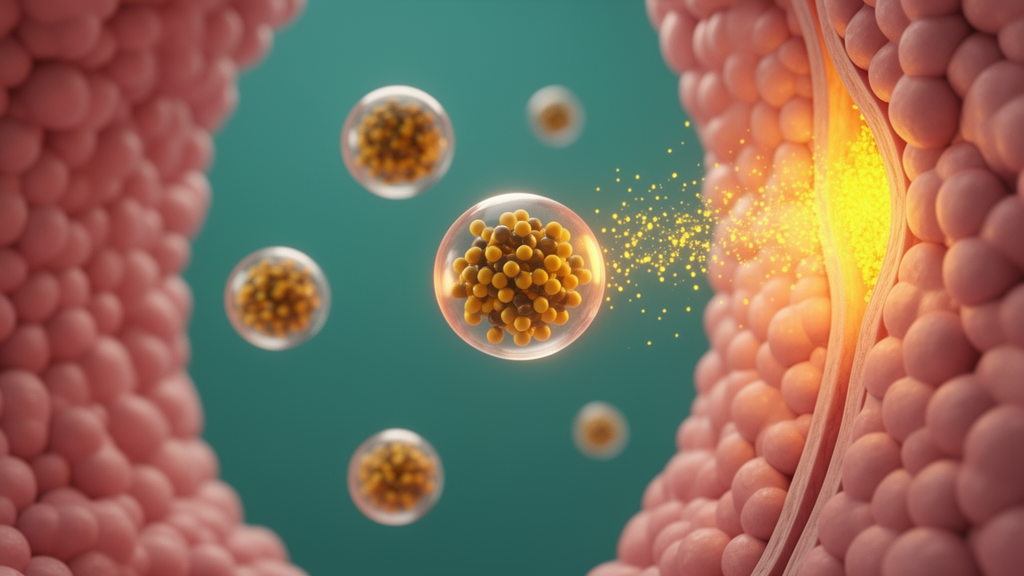
The reviewed studies describe a diverse arsenal of curcumin nanoformulations, including polymeric micelles, dendrosomes, liposomes, and core-shell nanoparticles, all engineered to protect the fragile polyphenol from degradation and deliver it more effectively to tumor tissue. The evidence suggests these systems substantially improve curcumin’s bioavailability and therapeutic performance compared with the free compound. One particularly inventive example cited in the review is a curcumin-loaded nanoparticle that undergoes phase transformation when exposed to low-intensity focused ultrasound, creating a tumor-targeted and pH-sensitive theranostic platform that combines treatment and imaging in a single vehicle. Another study documented that nanocurcumin preserved kidney function and hematological parameters in rats with chemically induced ovarian cancer treated with cisplatin, pointing toward a protective, supportive role alongside conventional therapy.
Nanoformulations also appear to amplify curcumin’s chemosensitizing effects. Dendrosomal nanocurcumin combined with oxaliplatin downregulated matrix metalloproteinases, enzymes that facilitate tissue invasion, in ovarian cancer cell lines, while curcumin nanoparticles enhanced cisplatin’s anticancer effect in rat ovarian carcinoma by inhibiting both the PI3K/AKT and JAK/STAT3 pathways. Co-delivery systems that package curcumin alongside conventional drugs, such as docetaxel-loaded nanomicelles, have shown enhanced anti-ovarian cancer activity in preclinical settings. Even synthetic derivatives of curcumin are entering the picture: the derivative ST09 was found to modulate the miR-199a-5p/DDR1 axis and regulate proliferation and migration in ovarian cancer cells, and ruthenium complexes bearing curcuminoid ligands showed antiproliferative activity against the A2780 ovarian tumor cell line while modulating NF-κB signaling.
The authors of the review are careful to frame all of this within its proper limits. Every one of the 21 studies they evaluated was preclinical, conducted in cell lines or animal models, and the field has learned repeatedly that dramatic results in a dish or a mouse do not guarantee success in patients. Early-phase clinical trials of curcumin in other contexts have established that the compound is generally safe and tolerable at high doses, and pharmacokinetic studies of various bioavailable formulations in healthy volunteers have mapped out how different delivery strategies affect curcumin’s absorption. But no clinical trial has yet confirmed that curcumin, in any formulation, improves outcomes for women with ovarian cancer. The review’s conclusion is correspondingly measured: curcumin may hold potential as a supportive treatment in ovarian cancer, but further clinical studies are necessary before any such role can be established.
What the review ultimately offers is a rigorous map of where the science currently stands. The mechanistic case for curcumin in ovarian cancer is coherent and multi-layered, spanning survival signaling, inflammatory pathways, metastatic plasticity, the immune microenvironment, and chemoresistance. The nanotechnology angle provides a plausible route around the compound’s longstanding bioavailability problem, and the chemosensitization data suggest that curcumin’s most realistic near-term value may lie not as a standalone therapy but as an adjunct that makes existing drugs work better. For the thousands of women diagnosed each year with a disease that too often resists conventional treatment, the hope is that this accumulating preclinical evidence will soon be tested where it matters most, in well-designed clinical trials.
Subject of Research: Mechanistic and translational potential of curcumin and its nanoformulations in preclinical ovarian cancer models
Article Title: Curcumin in ovarian cancer: mechanistic insights and translational potential
Article References: Esmaeli, M., & Dehghanpour Dehabadi, M. (2026). Curcumin in ovarian cancer: mechanistic insights and translational potential. Medical Oncology, 43(11), Article 333. https://doi.org/10.1007/s12032-026-03454-9
Image Credits: AI Generated
DOI: 10.1007/s12032-026-03454-9
Keywords: curcumin, ovarian cancer, PI3K/Akt/mTOR, NF-kB, JAK/STAT3, Wnt/beta-catenin, nanoparticles, chemotherapy resistance, apoptosis, epithelial-to-mesenchymal transition, tumor microenvironment, drug delivery
News Source: Nathaniel Bowman. (October 9, 2026). Curcumin Shows Promise Against Ovarian Cancer, but Nanotechnology May Hold the Key. Scienmag.