Bee pollen has long been celebrated as one of nature’s most complete foods, but a new study from Morocco suggests that where the pollen comes from may matter just as much as the fact that it exists at all. In research published in Food Science & Nutrition, a team of Moroccan and Saudi scientists carried out the most integrated characterization of Moroccan bee pollen to date, analyzing samples from eight different regions of the country and measuring everything from protein and mineral content to antioxidant capacity and the ability to block enzymes involved in sugar digestion. The results paint a picture of a nutrient-dense functional food whose chemistry is written by the flowers surrounding each hive.
The researchers collected pollen using traps fitted to hygienic beehives across Morocco’s Rabat-Salé-Kénitra, Fès-Meknès, and Tanger-Tétouan-Al Hoceïma regions between March and May 2023. Each sample was immediately frozen at minus 20 degrees Celsius to preserve its biochemical integrity. Back in the laboratory, the team used melissopalynology, the microscopic analysis of pollen grains, to determine the botanical origin of each sample, supplemented by scanning electron microscopy to visualize the intricate surface structures of the pollen grains themselves.
The palynological analysis revealed that every single sample was polyfloral, meaning the bees had foraged from multiple plant species rather than a single dominant flower. Eight plant families were identified across the collection, with the mustard family, Brassicaceae, appearing in seven of the eight samples, making it the most widespread floral resource in the study area. One sample from Sidi Slimane was the most botanically restricted, composed exclusively of Myrtaceae at 51 percent and Brassicaceae at 49 percent, while samples from Ouazzane and Douar Lafdoul showed the greatest botanical richness, containing four and five families respectively. This floral diversity proved to be far more than an ecological curiosity; it was the key variable underlying nearly every chemical difference the team later measured.
Physicochemical testing showed considerable variation across the samples. Moisture content ranged from just over 3 percent to nearly 27.5 percent, with most samples falling within the 10 to 30 percent range considered typical of fresh bee pollen. Water activity, a measure of the water available to spoilage microorganisms, remained between 0.31 and 0.42, safely below the 0.61 threshold at which yeasts and molds typically begin to proliferate. pH values clustered tightly around 5.0, and ash content, an indicator of total mineral load, ranged from 0.92 to 4.64 percent, all comfortably within the 6 percent maximum permitted by Brazilian and Argentinian regulations.
The mineral analysis, performed using inductively coupled plasma atomic emission spectroscopy, identified ten elements and confirmed potassium and calcium as the dominant macrominerals. Potassium concentrations spanned from 742 to 2,117 milligrams per kilogram, while calcium ranged from 677 to 2,197 milligrams per kilogram, with statistically significant variation between samples pointing to the influence of local soil and flora. Trace elements including iron, zinc, sodium, and selenium were also quantified. Critically, the team screened for heavy metal contamination and found that lead and cadmium, where detected at all, remained well below Codex and European Union safety limits. For a typical daily intake of 10 grams, estimated exposure to these metals would fall far beneath the tolerable thresholds established by the European Food Safety Authority, though the authors note that continued monitoring is advisable, particularly for children.
Nutritionally, the pollen proved to be a dense source of macronutrients. Total protein content ranged from 14.55 to 19.56 grams per 100 grams of dry weight, soluble carbohydrates from 17.2 to 28.87 grams per 100 grams, and lipids from 1.92 to 3.03 grams per 100 grams. Energy values ranged from roughly 157 to 205 kilocalories per 100 grams of dry weight. These figures align with the international literature on bee pollen, which typically reports protein contents between 10 and 40 grams per 100 grams, and they reinforce the product’s reputation as a protein-rich supplement comparable to legumes and certain oilseeds.
The bioactive profile was where the regional differences became most striking. Total phenolic content, measured by the Folin-Ciocalteu method and expressed as gallic acid equivalents, varied more than fourfold, from 4.19 to 17.39 milligrams per gram of dry weight. Flavonoid content ranged from 0.94 to 3.18 milligrams of quercetin equivalents per gram. High-performance liquid chromatography identified a diverse array of phenolic compounds across the samples, including gallic acid, naringin, rutin, vanillic acid, and p-coumaric acid. The sample from Ouazzane was the richest, yielding twenty distinct compounds, while the sample from Sidi Slimane contained only four. Intriguingly, the presence of naringin in samples containing citrus forage and rutin in samples rich in Brassicaceae and Papaveraceae species suggests that specific phenolic compounds could serve as chemical fingerprints for tracing the botanical origin of commercial pollen, a possibility the authors flag for targeted future investigation.
Antioxidant activity, assessed through three complementary assays, confirmed that the pollen extracts were potent radical scavengers. In the DPPH assay, the most active sample achieved 50 percent radical inhibition at a concentration of just 0.28 milligrams per milliliter, while ABTS values were even lower, indicating strong antiradical capacity. Ferric reducing power ranged from 87 to 147 micromoles of iron(II) equivalents per gram. One unexpected finding emerged from the correlation analysis: total phenolic content showed negative correlations with DPPH and ABTS activity, contradicting the usual assumption that more phenolics automatically mean more antioxidant power. The authors suggest this paradox may reflect the specific identity of the phenolic compounds present, the contribution of non-phenolic antioxidants such as vitamins and peptides, or antagonistic interactions within the complex pollen matrix.
Perhaps the most medically compelling results came from the enzyme inhibition assays. Because the digestive enzymes alpha-amylase and alpha-glucosidase break down dietary starch and sugars into glucose, inhibiting them can blunt the post-meal blood sugar spikes that drive type 2 diabetes complications. The pollen extracts inhibited both enzymes in a dose-dependent manner, with alpha-amylase IC50 values ranging from 263 to 954 micrograms per milliliter and alpha-glucosidase IC50 values from 145 to 670 micrograms per milliliter. Two samples stood out: the Sidi Slimane pollen, which was also the richest in phenolics and flavonoids, was the strongest alpha-amylase inhibitor, while the Boufekrane sample was the most potent against alpha-glucosidase. Although the synthetic drug acarbose remains far more powerful, the findings support the idea that flavonoids such as quercetin and luteolin, which can bind directly to the active sites of these enzymes, contribute meaningfully to the antihyperglycemic potential of pollen.
The study’s authors are careful to acknowledge its limitations. With only eight samples collected in a single spring season, the work provides an initial characterization rather than a definitive geographical or botanical profile, and the team calls for multi-season surveys, standardized color classification alongside palynological analysis, and advanced metabolomic profiling using HPLC-MS/MS to fully map the structure-activity relationships at play. In vivo and clinical trials will also be needed to confirm that the laboratory-measured bioactivities translate into real health benefits. Even so, the research establishes a valuable compositional baseline for Moroccan bee pollen and strengthens the case for this ancient food as a modern functional ingredient. As consumer demand for natural, health-promoting foods continues to grow, the humble pollen pellet, shaped by the flowers, soils, and climate of its origin, may prove to be one of the most chemically rich ingredients in the functional food arsenal.
Subject of Research: Nutritional, phytochemical, and functional characterization of bee pollen from eight regions of Morocco
Article Title: Multi‐Regional Characterization of Moroccan Bee Pollen: Nutritional, Bioactive, and Functional Properties
Article References: Diai, F., Bouddine, T., Kachmar, M. R., Kaddouri, M., Kassimi, C. E., Guirrou, I., Laaroussi, H., Al‐zharani, M., Nasr, F. A., Qurtam, A. A., Hajji, L., & Chakir, S. (2026). Multi‐Regional Characterization of Moroccan Bee Pollen: Nutritional, Bioactive, and Functional Properties. Food Science & Nutrition, 14(10), Article e72174. https://doi.org/10.1002/fsn3.72174
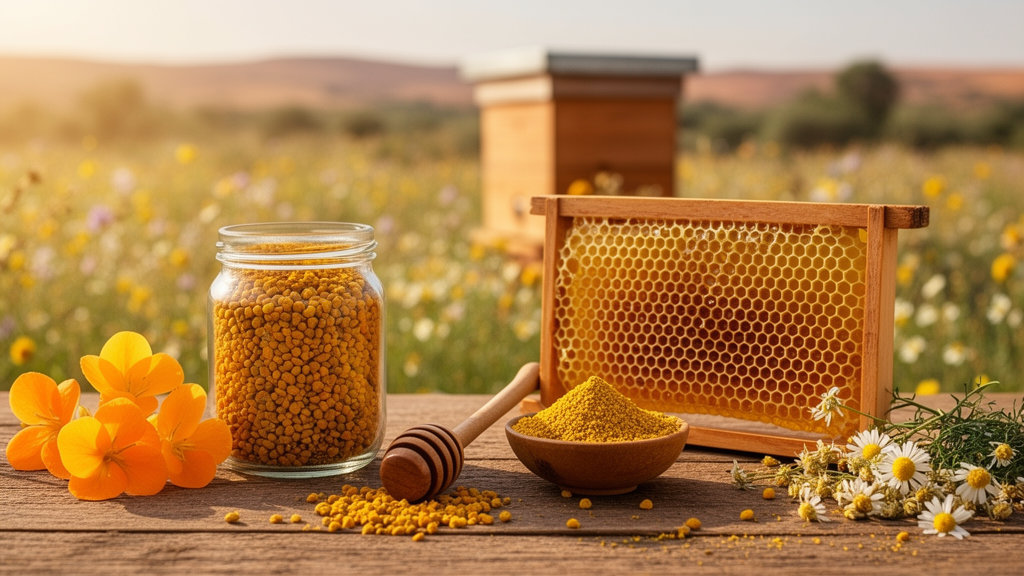
Image Credits: AI Generated
DOI: 10.1002/fsn3.72174
Keywords: bee pollen, Morocco, phenolic compounds, antioxidant activity, alpha-amylase inhibition, alpha-glucosidase inhibition, melissopalynology, mineral composition, functional food, type 2 diabetes, flavonoids, food science
News Source: Alan Morgan. (October 8, 2026). Moroccan Bee Pollen Reveals Potent Antioxidant and Blood Sugar Benefits. Scienmag.