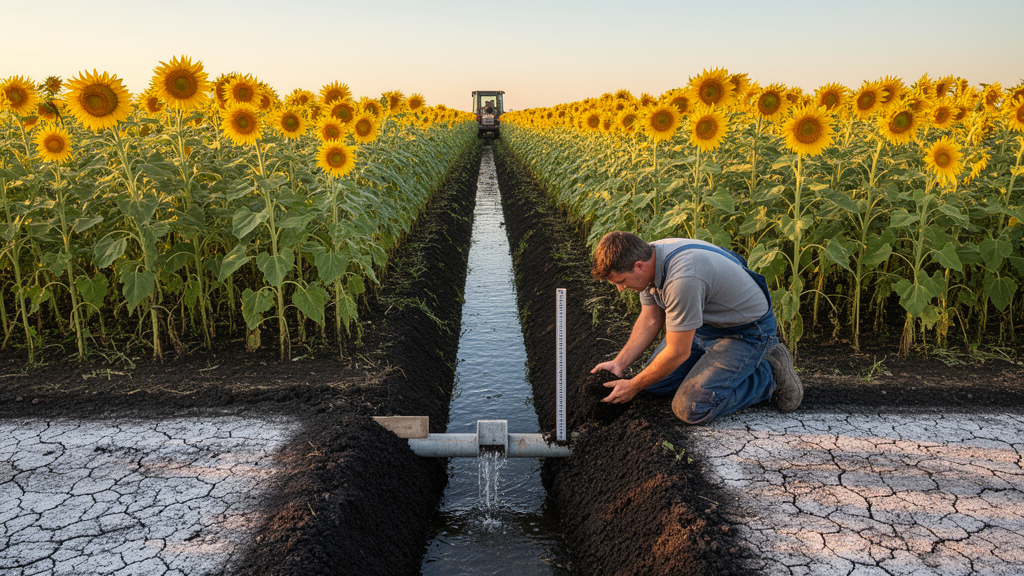
On the salt-affected farmlands of northern China, the first irrigation of the season has long been a blunt instrument. Farmers flood their fields before sowing, pushing water through the soil profile to push salts away from the seeds. The approach works, but it is thirsty, and in regions where every cubic meter of irrigation water is contested, the question of how much pre-sowing water is actually needed has become one of the most consequential in saline agriculture. A new field study from the Tumochuan Plain Irrigation District suggests the answer may be far less than convention dictates.
Researchers at Inner Mongolia Agricultural University spent two growing seasons, 2023 and 2024, testing pre-sowing irrigation depths of 60, 90, 120, and 150 millimeters on confectionery sunflower grown in mildly to moderately saline soil. The 150-millimeter depth represented the standard local practice, the baseline against which everything else was measured. Their goal was ambitious: to track not just soil water and salinity, but the underground bacterial communities, the architecture of sunflower roots, and ultimately the yield and water-use efficiency of the crop itself. The results, published in Plant and Soil, point to a sweet spot between 90 and 120 millimeters, a range that could reshape irrigation practice across millions of hectares of salt-affected farmland.
The physics of the problem begins in the root zone, the shallow band of soil where seeds germinate and roots forage for water. Salts dissolved in soil water interfere with a plant’s ability to take up moisture, a stress that compounds through the growing season and can sharply reduce yield. Pre-sowing irrigation is designed to leach these salts downward, out of the root zone, before the crop is even planted. Too little water, and the salts stay put; too much, and the farm pays a steep price in water consumption, often with diminishing returns as the extra water drains past the roots without meaningful additional desalination.
The study’s first striking finding concerns what happens when irrigation is trimmed from 150 to 120 millimeters. Reducing the depth by a fifth did not substantially decrease root-zone soil water content, meaning the crop’s moisture supply was essentially preserved. Yet the salinity outcome improved dramatically: at 120 millimeters, root-zone soil salinity declined by 37.80 to 41.22 percent, and the salinity control achieved per unit of irrigation water actually increased. In other words, the conventional 150-millimeter practice was not just wasteful, it was inefficient at the very task it was meant to perform.
Pushing the savings further, the 90-millimeter treatment still managed to reduce soil salinity by 32.04 to 38.78 percent. That is a substantial desalination effect from a depth 40 percent below local convention, and it earned the 90-millimeter treatment recognition for favorable water-saving and salinity control performance. The 60-millimeter depth, by contrast, did not make the shortlist of recommended treatments, underscoring that there is a floor below which leaching simply fails to move enough salt out of the root zone to protect the crop.
Beneath the soil surface, the treatments left fingerprints on the crop’s root system. The 90- and 120-millimeter irrigation depths generally increased root length density, root volume density, and root surface area density compared with conventional practice. This matters because root architecture is the plant’s first line of defense against both drought and salinity: a denser, more voluminous root system explores more soil, accesses more water, and dilutes the salt concentration each root must contend with. Both treatments also maintained comparatively high grain yield and high irrigation water use efficiency, the ratio of yield produced to water applied, which is the metric that ultimately decides whether a water-saving strategy is viable on a working farm.
Perhaps the most intriguing dimension of the study is microbial. At crop maturity in 2024, soils under the 90- and 120-millimeter treatments exhibited greater bacterial alpha-diversity, a measure of how many distinct bacterial species coexist in the soil, and higher relative abundance of several dominant bacterial taxa. Soil bacteria are not passive bystanders in saline fields; communities rich in halotolerant and plant-growth-promoting species can help crops withstand salt stress, mediate nutrient cycling, and influence how roots develop. The researchers found that bacterial alpha-diversity and the composition of dominant phyla were closely associated with root-zone water and salinity conditions, root traits, and yield-related variables, suggesting a coupled system in which irrigation decisions ripple through soil chemistry into the microbial community and back into the plant.
To weigh all of these outcomes against one another, the team employed a multi-criteria evaluation framework combining correlation analysis with the EWM-TOPSIS method, a decision-analysis technique that ranks treatments by their overall performance across multiple indicators simultaneously. When salinity control, root development, yield formation, and irrigation water use efficiency were all factored in, the analysis identified irrigation depths of 90 to 120 millimeters as providing favorable integrated performance. The two depths, however, offered subtly different strengths: the 90-millimeter treatment delivered greater water-saving and yield benefits, while the 120-millimeter treatment produced more stable improvements in salinity control and root development.
The practical recommendation that emerges is a pre-sowing irrigation depth of 90 to 120 millimeters for confectionery sunflower on mildly to moderately saline farmland. Within that window, farmers can choose according to their priorities: lean toward 90 millimeters where water scarcity is acute and yield protection is paramount, or toward 120 millimeters where salt accumulation is the dominant concern and a more robust root system is desired. Either choice conserves substantially more water than the 150-millimeter convention while sustaining production on land that would otherwise be marginal.
The implications extend well beyond the Tumochuan Plain. Soil salinization affects vast and growing areas of the world’s irrigated cropland, and climate change is expected to accelerate primary salinization in the twenty-first century, particularly in arid and semi-arid regions where irrigation is already the dominant water use. Studies like this one demonstrate that the traditional trade-off between saving water and controlling salt may be softer than assumed, and that the hidden lever of soil microbial communities, responsive to how water is applied, offers an additional dimension of management that conventional irrigation planning has largely ignored. For salt-stressed farmland from Inner Mongolia to the Mediterranean, the message is that less water, applied with precision, may do more with less in every sense of the phrase.
Subject of Research: Water-saving pre-sowing irrigation for soil water-salt regulation, bacterial communities, and sunflower yield in saline farmland
Article Title: Optimizing water-saving pre-sowing irrigation for root-zone water-salt regulation, bacterial communities, and sunflower yield in mildly to moderately saline farmland
Article References: Cao, L., Zhang, J., Fan, X., Wu, Y., Li, H., Du, W., Shi, H., & Li, W. (2026). Optimizing water-saving pre-sowing irrigation for root-zone water-salt regulation, bacterial communities, and sunflower yield in mildly to moderately saline farmland. Plant and Soil. https://doi.org/10.1007/s11104-026-09094-2
Image Credits: AI Generated
DOI: 10.1007/s11104-026-09094-2
Keywords: pre-sowing irrigation, soil salinity, sunflower, soil bacterial communities, root development, irrigation water use efficiency, saline farmland, water-saving agriculture, root zone, confectionery sunflower, Tumochuan Plain, soil water content
News Source: Alan Morgan. (October 8, 2026). Cutting Pre-Sowing Irrigation to 90–120 mm Saves Water and Salt-Stressed Sunflower Yields. Scienmag.