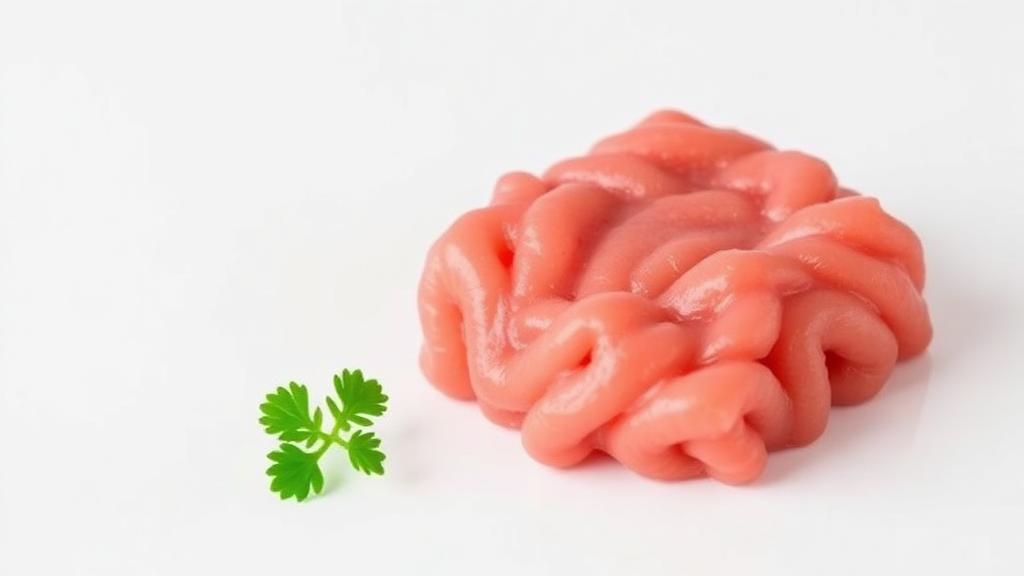
Three-dimensional food printing has long promised a future in which meals are tailored to individual nutritional needs, shaped into elaborate geometries, and produced on demand. Yet meat has remained one of the most stubborn materials for the technology. Ground pork, like most minced meats, simply does not behave like printer ink: it flows unevenly, slumps under its own weight, and fails to hold the delicate layered architecture that a print head deposits. A new study published in Food Chemistry: X by Ligen Wu, Anna Wang, and Qihan Cui tackles this problem at two levels at once — the macroscopic behavior of the printed paste and the molecular interactions that ultimately govern it — and identifies a surprisingly simple ingredient as the key: gelatin.
The research team prepared pork leg meat by removing connective tissue and grinding lean and fat portions together at a ratio of 8.5 to 1.5. Into this base emulsion they mixed a seasoned formulation containing sugar, fish sauce, glycerol, spices, salt, and water, then varied the gelatin concentration from 0 to 2.5 percent by weight. Each formulation was printed into a rectangular slab mimicking pork jerky using a food-grade extrusion printer operating at 25 degrees Celsius with a 1.55-millimeter nozzle, 100 percent infill, and a printing speed of 30 millimeters per second. The printed products were then hot-air dried, baked, and analyzed for everything from gel strength to moisture distribution.
Rheological measurements revealed why gelatin matters so much. In dynamic frequency sweeps, the storage modulus G-prime exceeded the loss modulus G-double-prime in every formulation, meaning the material behaved predominantly as a solid-like viscoelastic gel. That solid-like character is exactly what a printed layer needs: it allows the extruded strand to support the weight of subsequent layers without collapsing. Gel strength rose significantly with gelatin content, climbing from 119.62 grams in the untreated paste to 154.48 grams at the highest dosage, a change the authors attribute to hydrogen bonds forming between gelatin molecules and the myofibrillar proteins that make up 50 to 55 percent of pork’s total protein.
But more gelatin is not always better. When the concentration reached 2 percent, the researchers observed clogging and adhesion at the nozzle, likely because undissolved gelatin particles or overly viscous aggregates disrupted the uniformity of the paste and jammed the extrusion process. The sweet spot turned out to be 1 percent gelatin, which produced the best layer adhesion, the highest printing fidelity, and no structural collapse. Confocal laser scanning microscopy confirmed the story visually: without gelatin the protein network was loose and porous with large voids, while moderate gelatin addition produced a densely cross-linked, compact matrix. At 2.5 percent, however, the network showed signs of stacking and compression, as excess macromolecular gelatin crowded the native pork proteins.
Water is the hidden variable in printed meat. Using low-field nuclear magnetic resonance, the team identified three water populations in the gels — bound water, immobilized water, and free water — corresponding to relaxation peaks at roughly 0.01 to 10, 10 to 100, and 100 to 1000 milliseconds. At the optimal 1 percent gelatin level, all three relaxation times reached their shortest values, indicating the tightest integration of water into the protein network, while the free-water fraction peaked at 1.09 percent, providing just enough lubrication for smooth extrusion. Water-holding capacity climbed in a dose-dependent manner, reaching 80 percent at 1 percent gelatin, and the baking loss rate fell to its minimum of 48.63 percent at the same concentration — a meaningful economic gain, since every percentage point of moisture lost during cooking is weight and value lost from the product.
Fourier-transform infrared spectroscopy added a conformational dimension to the findings. The alpha-helix content of the proteins, which was only 17 percent in the unmodified paste, rose to 23 percent as gelatin increased to 1.5 percent, while the proportion of disordered random coils initially declined. Because alpha-helical content reflects hydrophobic groups and sulfhydryl groups being folded back into the protein interior, this shift signals a more ordered, elastic gel. The authors note that gel performance peaks at a certain degree of helical unfolding or re-formation, and their data pinpoint 1 percent gelatin as the concentration that achieves that balance.
The most novel part of the study, however, descends to the molecular scale. Because myofibrillar proteins contain fluorescent tryptophan and tyrosine residues, the team could use fluorescence spectroscopy as a molecular spy. When oleic acid or palmitic acid — the two predominant fatty acids in pork — were added to purified myofibrillar protein, the intrinsic fluorescence dimmed progressively, with quenching efficiencies of 51.70 percent for oleic acid and 50.74 percent for palmitic acid in the binary systems. Stern-Volmer analysis showed that the quenching constants decreased as temperature rose from 328.15 to 338.15 kelvin, the signature of static quenching: the fatty acids form stable, non-fluorescent ground-state complexes with the protein rather than merely colliding with it.
Gelatin rewired these interactions in revealing ways. In the ternary systems containing gelatin, quenching efficiencies dropped to 33.81 percent for the oleic acid combination and 41.5 percent for palmitic acid, showing that gelatin partially shields the protein’s fluorescent residues from fatty acid binding. Binding constants and the number of binding sites both increased in the presence of gelatin, with the effect stronger for palmitic acid than for oleic acid. Thermodynamic analysis of enthalpy and entropy changes showed that oleic acid alone binds myofibrillar protein through hydrophobic interactions, an endothermic process that strengthens with heat. Add gelatin, however, and the dominant forces shift to van der Waals interactions and hydrogen bonds — the same forces that govern palmitic acid binding with or without gelatin. Synchronous fluorescence spectra reinforced the picture, showing blue shifts of up to 4 nanometers that indicate the amino acid microenvironments became less polar and more hydrophobic, with gelatin exerting a stronger influence on tyrosine than on tryptophan.
What makes this study compelling is the way it connects the molecular ledger to the printed object on the plate. Gelatin’s thermally reversible triple-helix gelation and strong shear-thinning behavior give the paste the flow profile needed for smooth extrusion and the rapid re-gelling needed for self-supporting layers, while its protein nature lets it weave directly into the myofibrillar network in a way that polysaccharide hydrocolloids such as carrageenan and gellan gum cannot. By modulating how fatty acids bind to the protein matrix — softening quenching, increasing binding capacity, and steering oleic acid toward hydrogen-bonded association — gelatin stabilizes the entire lipid-protein-water architecture that determines whether a printed pork product holds its shape, retains its moisture, and survives the oven. For a field racing toward personalized nutrition, cultured-meat scaffolds, and printed meals for dysphagia patients, the message is that printability is not just a rheology problem; it is a molecular recognition problem, and the right hydrocolloid can solve both at once.
Subject of Research: Gelatin modulation of 3D printing properties and fatty acid–myofibrillar protein interactions in pork mince
Article Title: Study on the modulation of the properties of 3D printing pork mince and interaction mechanisms with myofibrillar proteins and fatty acids by gelatin
Article References: Wu, L., Wang, A., & Cui, Q. (2026). Study on the modulation of the properties of 3D printing pork mince and interaction mechanisms with myofibrillar proteins and fatty acids by gelatin. Food Chemistry: X, Article 104543. https://doi.org/10.1016/j.fochx.2026.104543
Image Credits: AI Generated
DOI: Not provided
Keywords: 3D food printing, gelatin, pork mince, myofibrillar proteins, oleic acid, palmitic acid, fluorescence spectroscopy, rheology, water-holding capacity, protein conformation, food hydrocolloids, static quenching
News Source: Bethany Barker. (October 8, 2026). Gelatin Unlocks the Molecular Secrets of 3D-Printed Pork Mince. Scienmag.