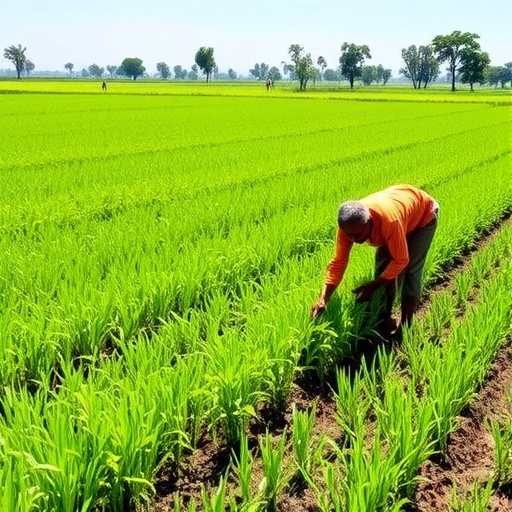
Green manure could be one of the most underused tools in the fight against soil degradation, according to a comprehensive new review that synthesizes decades of research on the practice in Bangladesh and around the world. The study, published in the journal Discover Agriculture, argues that incorporating fast-growing plants such as dhaincha, sunn hemp, and cowpea into cropping cycles can restore fertility on exhausted farmland, lift yields by as much as 45 percent, and sharply reduce the need for synthetic fertilizers, all while helping soils store carbon and withstand the mounting pressures of climate change.
The review arrives at a critical moment for Bangladesh, where the agricultural engine of the economy is running down its own foundation. The country’s rice-based farming systems are among the most intensively cultivated on Earth, with farmers routinely harvesting four to five crops per year from the same plots. Roughly 2.4 million hectares of modern rice varieties are grown in the high and medium-highland regions, mostly in rainfed lowlands. The result is a slow-motion crisis: soil fertility is declining at about 1 percent per year, and the nation’s soils are running short of nitrogen, phosphorus, potassium, sulfur, boron, and zinc. In a telling sign of the scale of dependence, urea fertilizer consumption on arable land rose by 3.36 percent in just a decade, even as the long-term use of chemical inputs has been linked to rising soil salinity, heavy metal accumulation, eutrophication, nitrate pollution, and greenhouse gas emissions.
The authors, led by Israt Jahan Irin of Khulna Agricultural University, along with colleagues at Bangladesh Agricultural University and Charles Sturt University in Australia, frame green manuring as a way out of this trap. The practice involves growing plants specifically to be plowed back into the soil while still green, rather than harvested. As the biomass decomposes, it feeds soil microbes, builds organic matter, and releases nutrients in a slow, steady stream that matches what crops actually need. Unlike conventional fertilization, the technique addresses soil biology, structure, and chemistry all at once, making it a fundamentally more holistic approach to land restoration.
The heart of the review’s technical argument rests on biological nitrogen fixation. Leguminous green manures, including Sesbania rostrata, Sesbania aculeata, Crotalaria juncea, Vigna unguiculata, and Vigna radiata, host symbiotic bacteria of the genus Rhizobium in their root nodules. These bacteria carry the enzyme nitrogenase, which converts atmospheric nitrogen gas (N₂) into ammonia (NH₃), a form plants can absorb. The review estimates that leguminous green manures can fix between 50 and 250 kilograms of nitrogen per hectare through this symbiosis, with some species contributing as much as 300 kilograms per hectare per year depending on climate and management. That is a substantial fraction of the nitrogen needs of a typical rice crop, supplied free of charge by biology rather than by fossil-fuel-intensive fertilizer factories.
Dhaincha, a legume in the genus Sesbania, emerges as the workhorse of Bangladeshi green manuring. It grows rapidly during the warm, humid pre-monsoon period, producing large quantities of biomass in just 45 to 60 days. When incorporated into the soil before transplanting aman rice, it can supply roughly 20 to 30 kilograms of nitrogen per hectare for the next crop. Sunn hemp (Crotalaria juncea), a fast-growing tropical legume, can produce more than 25 tonnes of biomass per hectare under ideal conditions, simultaneously suppressing weeds, reducing erosion, and improving soil aeration. Short-duration pulses such as cowpea, mung bean, and black gram offer a dual benefit: farmers harvest a food crop first, then incorporate the leftover residue, capturing both income and soil fertility from the same field.
The review also highlights non-leguminous green manures, a category that includes sorghum, millet, mustard, water hyacinth, and the aquatic fern Azolla pinnata. These species do not fix nitrogen but contribute 10 to 20 tonnes of green biomass per hectare when well managed, boosting soil organic carbon, improving phosphorus availability, and adding structural matter to soils. A global meta-analysis cited in the review found that non-leguminous green manures significantly improve labile phosphorus pools and crop yields, a reminder that soil health benefits extend well beyond nitrogen alone.
The mechanisms behind these gains are complex and interconnected. As green manure biomass decomposes, microbes break down organic compounds through mineralization, releasing nitrogen, phosphorus, and sulfur in plant-available forms. High-quality residues with low lignin and high nitrogen content break down fastest, providing quick nutrient release, while more fibrous materials feed soil organic matter over longer timescales. Root exudates, the sugars and organic acids that green manure plants leak into the rhizosphere, act as fuel for beneficial microbes, including nitrogen-fixing bacteria and phosphate-solubilizing organisms. Decomposition of residues can also temporarily lower soil pH, increasing the availability of phosphorus and micronutrients, while the addition of organic matter raises cation exchange capacity and buffers soil chemistry over time.
Perhaps most striking for Bangladesh’s coastal regions is the review’s analysis of salinity mitigation. Salt intrusion from tidal water and poor irrigation practices is degrading soils across the southern delta, threatening productivity on millions of hectares. The review explains that green manures combat salinity through several routes: incorporated biomass improves soil structure and water-holding capacity, promoting the leaching of excess salts beyond the root zone; increased organic carbon raises cation exchange capacity, displacing toxic sodium ions from exchange sites; and salt-tolerant species such as Sesbania rostrata with deep root systems physically break up compacted layers and help flush salts from the topsoil. Symbiotic interactions between rhizobia and salt-tolerant plant growth-promoting rhizobacteria further enhance nitrogen fixation, osmo-protectant production, and antioxidant enzyme activity in root cells, restoring ionic balance and improving plant tolerance under stress.
Field trials across Bangladesh back up the theory. In Brahmanbaria district, using Sesbania rostrata as a green manure boosted wheat yields by 25 percent compared with untreated plots, driven by improved soil nitrogen and organic matter. In Rajshahi, incorporating green gram during the Kharif season reduced chemical fertilizer requirements by 20 percent over two cropping seasons. In the southwestern coastal zone, sunn hemp trials improved soil structure and moisture retention, translating into higher rice yields and better crop resilience under saline conditions. Globally, the evidence is similarly consistent: a synthesis of cover crop studies found that green manures raise subsequent cash-crop yields by an average of 13 percent, while meta-regression work shows that green manuring alters nitrogen pools in arable soils, reducing leaching losses while maintaining productivity.
The review also positions green manuring as a climate-smart technology. Leguminous green manures capture atmospheric carbon dioxide through photosynthesis and store it as soil organic carbon, protected within soil aggregates. By replacing synthetic fertilizer nitrogen, which is manufactured through energy-intensive processes, the practice reduces the carbon footprint of farming systems. Meta-analyses show that substituting even a portion of synthetic nitrogen with organic amendments can reduce net greenhouse gas emissions and shrink the carbon footprint of agriculture. However, the authors caution that climate benefits are not automatic: rapid decomposition of high-nitrogen biomass can temporarily spike nitrous oxide emissions, a greenhouse gas roughly 273 times more potent than carbon dioxide over a century. Careful timing of incorporation, mixtures of legumes and non-legumes, and avoidance of excess fertilizer application are essential to minimize this risk.
Despite the impressive evidence base, adoption of green manuring in Bangladesh remains low, and the review is candid about why. Many smallholder farmers are simply unaware of the practice or its benefits, and agricultural extension systems tend to prioritize high-yield crop technologies over long-term soil investments. Quality seed of green manure species is difficult to obtain, with farmers relying on informal sources that produce low germination rates and inconsistent performance. Perhaps most fundamentally, the practice generates no immediate income: plowing a crop back into the soil rather than selling it is viewed as a loss by farmers on marginal lands who depend on each harvest for cash. Cultural resistance, short-term economic priorities, and the absence of supportive policies compound the problem.
The authors argue that overcoming these barriers requires coordinated intervention: strengthened extension services, reliable seed supply systems built on public-private partnerships, economic incentives such as subsidies or integration with crop-livestock systems where green manures double as fodder, and the formal incorporation of green manuring into national soil fertility policy. They also point to future opportunities in biofertilizers and microbial inoculants that could amplify the natural processes at work.
What the review ultimately delivers is a compelling case that a centuries-old practice, refined by modern science, could be central to the future of agriculture in Bangladesh and comparable agroecological regions. Green manuring is not a silver bullet, and it demands tailored approaches that fit local climates, soils, and cropping calendars. But with soil fertility collapsing under the weight of intensive cultivation, the biological machinery of nitrogen fixation, carbon sequestration, and microbial symbiosis offers something synthetic inputs cannot: a way to grow food while rebuilding the very foundation that makes growth possible.
Subject of Research: Green manuring practices for sustainable soil fertility management in Bangladesh’s rice-based cropping systems
Subject of Research: Agriculture
Article Title: Green manuring promotes sustainable soil management in bangladesh through agronomic benefits mechanisms and global perspectives
Article References: Irin, I. J., Roy, T. K., Zaman, S. B., Haque, K. M. S., Wadud, M. I., Rana, M. M., & Islam, A. K. M. M. (2026). Green manuring promotes sustainable soil management in bangladesh through agronomic benefits mechanisms and global perspectives. Discover Agriculture, 4(1), Article 232. https://doi.org/10.1007/s44279-026-00719-9
Image Credits: AI Generated
DOI: 10.1007/s44279-026-00719-9
Keywords: green manuring, soil fertility, Bangladesh, biological nitrogen fixation, sustainable agriculture, Sesbania rostrata, soil organic carbon, salinity mitigation, climate-smart agriculture, chemical fertilizer reduction, rice-based cropping systems, cover crops
Cite Scienmag News
APA MLA Chicago
Alan Morgan. (September 10, 2026). Green Manuring Boosts Sustainable Soil Management in Bangladesh. Scienmag. https://scienmag.com/green-manuring-boosts-sustainable-soil-management-in-bangladesh/
Alan Morgan. “Green Manuring Boosts Sustainable Soil Management in Bangladesh.” Scienmag, 10 September 2026, https://scienmag.com/green-manuring-boosts-sustainable-soil-management-in-bangladesh/. Accessed 10 September 2026.
Alan Morgan. “Green Manuring Boosts Sustainable Soil Management in Bangladesh.” Scienmag. September 10, 2026. https://scienmag.com/green-manuring-boosts-sustainable-soil-management-in-bangladesh/
Copy citation Download RIS
Tags: agroecological practices for soil healthcarbon sequestration in agricultural soilschallenges of intensive rice farming in Bangladeshclimate-resilient farming practicesclimate-smart agriculture practices in Bangladeshcombating soil degradation in Bangladeshcombating soil nutrient depletion in rainfed lowlandscowpeacrop yield improvement through green manuringenvironmental sustainability in Bangladesh agriculturefast-growing cover crops for soil healthgreen manure benefits for soil fertilitygreen manure crops like dhainchaimpact of green manuring on smallholder farmersintensive rice cultivation impactslong-term agricultural productivity enhancementorganic farming and soil nutrient replenishmentreducing synthetic fertilizer dependencyreducing synthetic fertilizer userice cropping system sustainabilitysoil carbon sequestrationsoil degradation and restorationsunn hempSustainable soil management in Bangladesh