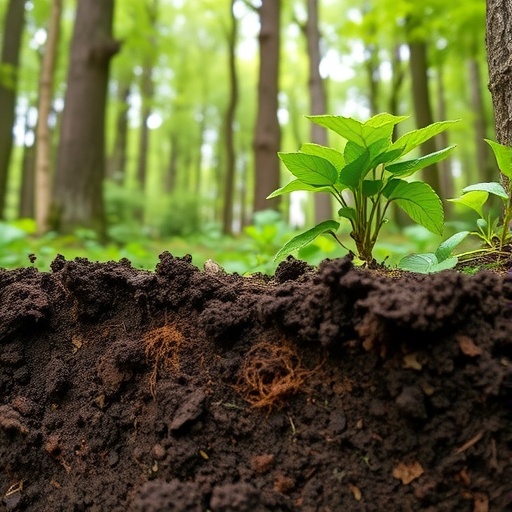
Beneath the quiet canopy of cold-temperate poplar-birch forests in northern China, an invisible metabolic drama is unfolding. As secondary forests recover from disturbance and mature over decades, the microbial communities in the soil beneath them are renegotiating their relationship with carbon, nitrogen, and phosphorus—and the outcome of that negotiation may shape how much carbon these ecosystems can lock away. A new study published in the journal Plant and Soil by researchers at Hebei Agricultural University and their collaborators has charted this hidden process in remarkable detail, revealing that soil microbes face persistent phosphorus scarcity even as their carbon constraints ease with forest succession, and that the intensity of microbial carbon metabolism steadily climbs as the forest ages.
The research team, led by Jiahe Zhou, with Yue Pang and Jing Tian serving as corresponding authors, set out to answer a deceptively simple question: how do microbial nutrient limitation and carbon metabolism change—and interact—during the progression of artificially promoted forest succession? Secondary forests that regrow after logging or other disturbances dominate landscapes worldwide, and understanding their below-ground biochemistry is critical for predicting their contribution to the global carbon cycle. Yet the coupling between what microbes find limiting in their diet and how fast they burn through soil organic carbon has remained poorly resolved, particularly in cold-temperate systems where decomposition is slow and growing seasons are short.
To untangle this, the researchers employed a space-for-time substitution approach, sampling soils across four distinct successional stages of poplar-birch secondary forests. This method assumes that sites of different ages represent a temporal sequence, allowing scientists to compress decades of ecological change into a single field campaign. At each stage, the team measured a comprehensive suite of soil physical and chemical properties, alongside the activities of extracellular enzymes—proteins secreted by microbes into the soil to break down complex organic molecules that are otherwise too large to cross cell membranes. Because microbes must invest resources to produce these enzymes, the relative balance of enzyme activities serves as a sensitive indicator of what the microbial community is most hungry for.
The analytical framework at the heart of the study is ecoenzymatic stoichiometry, a technique that compares the ratios of carbon-acquiring, nitrogen-acquiring, and phosphorus-acquiring enzymes against the presumed nutritional needs of microbial biomass. Deviations from theoretical optimum ratios reveal whether microbes are energy-starved, nitrogen-limited, or phosphorus-limited. The researchers complemented this with vector analysis, which uses the length and angle of a stoichiometric vector to quantify the degree of nutrient limitation, and with two key parameters of microbial carbon metabolism: carbon use efficiency, or CUE, which describes the fraction of metabolized carbon that microbes convert into their own biomass rather than releasing as carbon dioxide, and the microbial organic carbon decomposition rate, abbreviated MC, which measures how quickly soil organic carbon is being broken down.
The results paint a vivid picture of an ecosystem in transition. Activities of both carbon-acquiring and nitrogen-acquiring enzymes increased steadily with succession, signaling rising microbial demand for energy and nitrogen as the developing forest pumped more organic matter into the soil. Microbial carbon limitation followed a distinctive trajectory: it peaked at the middle stage of succession before declining, suggesting that early-to-mid successional soils offer abundant but nutritionally imbalanced carbon that forces microbes to work hard to acquire it, while later stages provide a more accessible carbon supply. Phosphorus limitation, by contrast, told a different story altogether—it persisted across all four successional stages, never relenting as the forest matured.
This persistent phosphorus hunger is ecologically significant. Phosphorus is derived ultimately from weathering rock, and as soils age, available forms of the element become increasingly locked in organic compounds or bound to minerals. The finding aligns with a growing body of global evidence that microbial phosphorus limitation is widespread in forest ecosystems, particularly in older, more weathered soils. For the poplar-birch forests of the study, it means that no matter how much carbon the maturing forest delivers to the soil, the microbial community remains constrained by a nutrient that cannot simply be manufactured from air.
Perhaps the most striking results concern the twin metrics of carbon metabolism. Carbon use efficiency reached its lowest point at the mid-successional stage, exactly when carbon limitation peaked—a logical pairing, since microbes struggling to acquire carbon have fewer resources to spare for growth and must dissipate more of what they metabolize as heat and carbon dioxide. Meanwhile, the microbial organic carbon decomposition rate increased continuously throughout succession, reaching 0.24 percent per day at the late stage. Intriguingly, CUE and the decomposition rate showed a positive relationship with each other, a coupling that challenges any simplistic assumption that faster decomposition necessarily means less efficient carbon use. Instead, the two processes appear to rise and fall together in a coordinated fashion across successional time.
The study’s correlation analysis deepens this picture. Carbon limitation was associated with reduced carbon use efficiency, meaning that when microbes faced energy scarcity, they converted less of their carbon intake into biomass. Persistent phosphorus limitation, on the other hand, was associated with increased decomposition rates—a counterintuitive link that the authors interpret as evidence that nutrient stress drives microbes to mine soil organic matter more aggressively, releasing enzymes to extract the scarce phosphorus they need and, in the process, decomposing carbon that might otherwise have remained stored. When microbes are phosphorus-starved, they essentially ramp up their digestive machinery, with carbon oxidation as an unavoidable by-product.
The environmental drivers behind these two facets of microbial physiology turned out to be distinct. Carbon use efficiency was significantly negatively related to dissolved organic carbon, suggesting that abundant labile carbon in solution does not translate into efficient microbial growth—possibly because it reflects an imbalance between carbon supply and nutrient availability. The decomposition rate, in contrast, was primarily governed by soil water content and nitrogen availability, two factors that control both the physical accessibility of organic matter and the capacity of microbes to build the enzymes needed to degrade it. In other words, what limits how efficiently microbes use carbon is not the same as what controls how fast they decompose it—a decoupling of regulation despite a coupling of patterns.
Taken together, these findings carry weighty implications for carbon sequestration management in cold-temperate forests. As secondary forests succeed, their soils host microbial communities that are metabolically intensifying—processing more carbon per unit time—while remaining shackled by phosphorus scarcity. If phosphorus availability moderates the pace of decomposition, then management strategies that alleviate microbial phosphorus stress might paradoxically accelerate carbon loss, whereas strategies that maintain nitrogen supply and soil moisture regimes could influence decomposition in the opposite direction. The authors suggest that their results advance mechanistic understanding of soil carbon dynamics and offer insights for managing soil carbon storage in these ecosystems, which cover vast areas of northeastern China and comparable cold-temperate zones globally.
The work also contributes to a lively scientific debate about the role of microbial physiology in Earth’s carbon cycle. Recent global modeling studies have argued that microbial carbon use efficiency is a dominant control on global soil carbon storage, potentially rivaling the influence of climate and carbon inputs. By demonstrating that CUE and decomposition rates are shaped by different environmental levers yet move in concert during succession, the new study adds nuance to these models: future predictions may need to represent nutrient limitation and carbon metabolism as linked but separately regulated processes rather than a single dial. For a forest regrowing after disturbance, the microbial underworld is not merely a passive decomposer community—it is an active, nutrient-starved, metabolically intensifying engine whose appetites will help determine whether the carbon that forests capture from the atmosphere ends up locked in soil or returned to the sky.
As forests worldwide continue to recover from centuries of logging and land-use change, studies like this one remind us that the fate of the carbon cycle is negotiated in the dark, by organisms too small to see, one enzyme at a time.
Subject of Research: Soil microbial nutrient limitation and carbon metabolism during succession stages of poplar-birch secondary forests
Subject of Research: Agriculture
Article Title: Driving mechanisms of soil microbial nutrient limitation and carbon metabolism during succession stages of poplar-birch secondary forests
Article References: Zhou, J., Li, G., Zhang, Z., Ma, D., Liu, Q., Sun, L., Pang, Y., Tian, J., & Wang, X. (2026). Driving mechanisms of soil microbial nutrient limitation and carbon metabolism during succession stages of poplar-birch secondary forests. Plant and Soil. https://doi.org/10.1007/s11104-026-09079-1
Image Credits: AI Generated
DOI: 10.1007/s11104-026-09079-1
Keywords: Enzyme stoichiometry, Microbial nutrient limitation, Secondary forest succession, Soil carbon metabolism, Carbon use efficiency, Ecoenzymatic stoichiometry, Phosphorus limitation, Soil organic carbon decomposition, Poplar-birch forests, Cold-temperate forest ecosystems, Soil microbial ecology, Carbon sequestration
Cite Scienmag News
APA MLA Chicago
Alan Morgan. (September 10, 2026). How soil microbes shift nutrient limits and carbon use as forests recover. Scienmag. https://scienmag.com/how-soil-microbes-shift-nutrient-limits-and-carbon-use-as-forests-recover/
Alan Morgan. “How soil microbes shift nutrient limits and carbon use as forests recover.” Scienmag, 10 September 2026, https://scienmag.com/how-soil-microbes-shift-nutrient-limits-and-carbon-use-as-forests-recover/. Accessed 10 September 2026.
Alan Morgan. “How soil microbes shift nutrient limits and carbon use as forests recover.” Scienmag. September 10, 2026. https://scienmag.com/how-soil-microbes-shift-nutrient-limits-and-carbon-use-as-forests-recover/
Copy citation Download RIS
Tags: carbon and nitrogen cyclingeffects of disturbance on soil microbesforest recovery and successionforest succession and microbial activityimpact of soil microbes on global carbon cycleimpact on global carbon sequestrationmicrobial carbon metabolism in forestsmicrobial community changes during forest regenerationmicrobial contribution to nutrient cyclingmicrobial nutrient dynamics during forest recoverymicrobial responses to forest disturbancenutrient constraints in recovering forestsnutrient limitationphosphorus limitation in soil microbesphosphorus scarcity in soilssecondary forest ecosystem dynamicssecondary forest recoverysoil biochemistry in temperate forestssoil microbes and carbon sequestrationsoil microbial communitiessoil microbial metabolismsoil microbial nutrient cycling