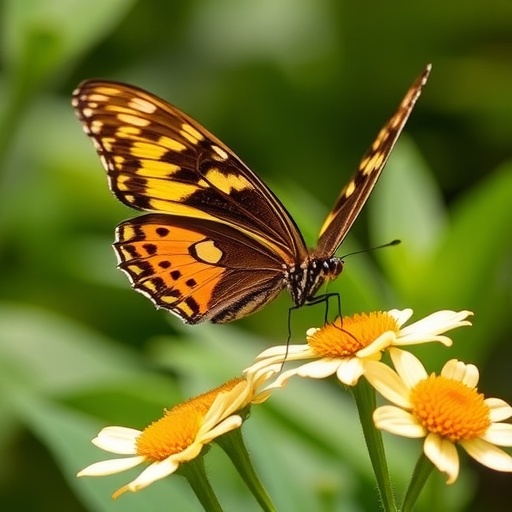
Butterflies may be among the most visible indicators of a rapidly changing planet. Their delicate wings suggest fragility, but their populations can reveal large-scale ecological transformations taking place across continents. A study listed for publication in Nature Ecology & Evolution under the title “Extensive climate-induced range shifts in butterflies across the globe” is drawing attention because it addresses one of the central questions in modern ecology: how far are species moving as temperatures and other climate conditions change?
The study is identified as an observational investigation involving animals, with butterflies as its focus. Its subject is particularly important because butterflies respond quickly to environmental changes. Their development depends on temperature, humidity, seasonal timing and the availability of specific larval food plants. Even modest shifts in climate can alter when eggs hatch, when caterpillars feed, when adults emerge and where suitable habitat can be found. These linked processes make butterflies sensitive biological indicators of climate disruption.
A climate-induced range shift occurs when the geographic distribution of a species changes as environmental conditions become more or less suitable. In many regions, warming allows species to survive farther toward the poles or at higher elevations than they could previously. At the warm edge of a distribution, however, populations may decline as temperatures exceed physiological limits, drought intensifies or host plants disappear. The result is not simply a uniform movement across a map. A species may expand in one direction while losing territory in another, producing a changing and sometimes fragmented range.
Butterfly distributions are shaped by several interacting mechanisms. Adult butterflies require appropriate temperatures for flight, mating and feeding, while caterpillars often depend on a narrow selection of plants. Climate change can also disrupt synchrony between butterflies and their food sources. If plants flower earlier because of warmer springs but butterflies emerge at their historical time, larvae may encounter poor-quality or unavailable food. Conversely, unusually warm conditions can trigger premature development, exposing immature stages to later cold events or drought.
Global analyses of this kind commonly draw on long-term observations, museum records, monitoring schemes and species-distribution data. Researchers can compare historical and contemporary records to determine whether a species has appeared in new areas, vanished from former locations or changed its elevation and latitude limits. Climate models are then used to test whether these movements correspond with changes in temperature and other environmental variables. Such approaches can reveal broad patterns that would be impossible to detect from a single reserve or country.
The technical challenge is separating climate effects from other forces that influence butterfly populations. Land-use change, pesticide exposure, habitat fragmentation, invasive plants, urban development and conservation activity can all alter distributions. Observational studies cannot always prove that climate alone caused a particular movement, but statistical models can estimate the relationship between climate variables and recorded occurrences while accounting for geographic and ecological differences. The strongest conclusions emerge when independent monitoring programs show similar trends over many years.
The global scale of the reported work is significant because butterfly responses are unlikely to be identical everywhere. Tropical species may face narrow thermal limits and have fewer opportunities to move when temperatures rise. Temperate species may benefit temporarily from warmer conditions, but those gains can be offset by drought, extreme heat or the loss of host plants. Mountain species may move uphill until they run out of suitable habitat. Island species face an even sharper constraint: when climate change pushes suitable conditions beyond the coastline, natural migration may be impossible.
These changes matter far beyond the insects themselves. Butterflies pollinate plants, provide food for birds and other animals, and participate in complex ecological networks. A shift in their seasonal activity can influence predators, parasites and flowering plants. Declines in butterfly diversity can also signal broader deterioration in habitat quality. Conservation strategies therefore increasingly combine climate projections with habitat protection, restoration of native vegetation and the creation of connected landscapes that allow species to move.
The listing for the study gives Nature Ecology & Evolution as the journal and identifies the article publication date as 5 August 2026. It also provides the DOI 10.1038/s41559-026-03117-y and names Monash University as the institutional affiliation associated with the media contact. However, the accompanying release states that it was removed at the request of the submitting institution, and the available material does not provide the study’s numerical results, species list or detailed methodology. Those details will be essential for evaluating the extent of the reported range shifts and determining which butterflies are most at risk.
What is already clear is why the subject has captured public interest. Butterflies translate an abstract global trend into a visible ecological story: species appearing in unexpected places, disappearing from familiar landscapes and changing their seasonal rhythms. As climate conditions continue to move, the future of butterfly conservation will depend not only on protecting existing habitats but also on anticipating where suitable environments may emerge. The reported research could help scientists and conservationists identify those future refuges, provided the full findings become available for independent examination.
Subject of Research: Animals
Article Title: Extensive climate-induced range shifts in butterflies across the globe
News Publication Date: 5 August 2026
Web References: https://doi.org/10.1038/s41559-026-03117-y
References: Nature Ecology & Evolution, DOI: 10.1038/s41559-026-03117-y
Image Credits: Dr Shawan Chowdhury
Keywords: butterflies, climate change, species distribution, range shifts, biodiversity, conservation biology, endangered species, ecological monitoring, global warming, habitat change
Tags: butterfly migration patterns due to climate changebutterfly responses to changing environmental conditionsclimate-driven biodiversity changesclimate-induced species range shiftsecological indicators of global warmingecological significance of butterfly range shiftseffects of climate change on insect distributionglobal patterns of butterfly habitat redistributionhabitat migration caused by climate changeimpact of temperature on butterfly life cyclepoleward and elevational range expansionseasonal timing alterations in butterflies