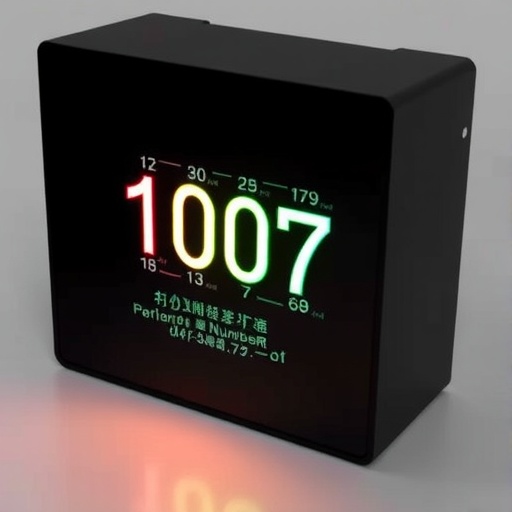
A groundbreaking advancement from Hanyang University in South Korea promises to revolutionize image security through hardware-level protection. Led by Associate Professor Hocheon Yoo, researchers have introduced a photospike-based true random number generator (PS-TRNG) that leverages light-induced entropy within semiconductor nanostructures to generate genuinely unpredictable numbers. This innovation stands to enhance the authentication and integrity of digital images, combating sophisticated forgeries including AI-generated deepfakes.
Traditional pseudo-random number generators (PRNGs), commonly used for encryption and security, produce algorithmic sequences which, although appearing random, are ultimately deterministic and susceptible to cyberattacks. To ensure unassailable security, technologies tapping into physical, inherently stochastic processes have become essential. The PS-TRNG developed by Yoo’s team is a prime example, embodying true randomness derived from the quantum behavior of electrons under pulsed light.
The device architecture consists of a heterostructure combining copper vanadate (CuV₂O₆) nanostructures with a layer of tin dioxide (SnO₂) quantum dots, sandwiched between a substrate and a transparent conducting polymer electrode. Upon exposure to pulsed red light, electrons are excited within the substrate, migrating toward the electrode. Crucially, some electrons become trapped at random defect sites within the quantum-dot layer. This stochastic trapping and subsequent unpredictable release of charges when the light pulses are switched off generate random photocurrents, or “photospikes.”
These photospikes are then digitized into ternary logic states (0, 1, and 2) based on current thresholds, producing true random numbers in real time. Comprehensive testing confirmed near-ideal statistical distributions and stability over two million operational cycles and more than 460 days, with the random sequences passing all 15 metrics in the National Institute of Standards and Technology (NIST) randomness test suite.
The application of this technology goes beyond secure number generation. By embedding these truly random numbers as covert security signatures within imagery during acquisition, the researchers demonstrate a method to authenticate images at the hardware level. Any alteration to the image content disturbs the embedded signature, allowing for pixel-level detection of tampering, including the identification of AI-manipulated deepfakes.
Prof. Yoo highlights the transformative potential of integrating entropy sources directly into cameras and sensors. This hardware-based fingerprinting ensures that every captured frame carries a verifiable and unique security imprint, providing unprecedented trustworthiness for digital visuals used in journalism, law enforcement, identity verification, and medical diagnostics.
This pioneering work not only addresses longstanding vulnerabilities in digital image security but also paves the way towards future-proof defenses against increasingly sophisticated digital forgeries. By anchoring security at the point of image creation rather than in post-processing algorithms, PS-TRNG technology embarks on a new era of trustworthy visual information.
Subject of Research:
Electrical engineering, Electronics, Image processing, Information processing
Article Title:
Light-Induced Entropy for Secure Vision
News Publication Date:
June 12, 2026
References:
DOI: 10.1002/adma.202516947
Image Credits:
Dr. Hocheon Yoo, Hanyang University, Republic of Korea
Keywords
True random number generator, photospike, quantum-dot heterostructure, image authentication, randomness entropy, light-induced charge trapping, digital image security, AI deepfake detection, hardware-level security
Tags: advanced image authentication methodsanti-forgery technology for digital imagescombating AI-generated deepfakeshardware-level image securitylight-induced entropy in semiconductor nanostructureslight-powered random number generatornanostructure-based encryption techniquesphotospike-based true random number generatorphysical entropy sources for cybersecurityquantum behavior of electrons under pulsed lightsemiconductor heterostructures for randomnessSouth Korea technological innovation