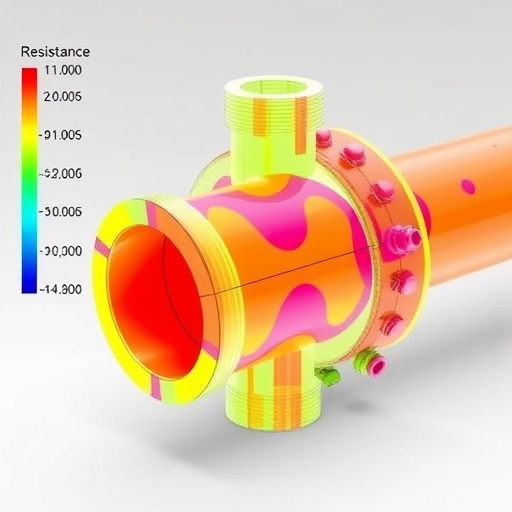
In the ever-evolving field of engineering, fluid dynamics remains a critical discipline with profound implications across industries, from water distribution to oil pipelines and industrial process systems. A recent breakthrough by Tian, Gao, Li, and their colleagues offers a transformative approach to minimizing flow resistance in local piping components, a challenge that has long impeded efficiency enhancements and operational excellence. Their novel shape optimization method, validated across multiple scales, promises not only energy savings but also advances in component design principles that could redefine piping standards globally.
Flow resistance in piping systems has traditionally been a persistent problem, leading to inefficiencies and increased operational costs. Local components such as bends, tees, valves, and joints inherently disrupt the smooth passage of fluid, introducing turbulence, pressure drops, and energy loss. Historically, attempts to mitigate these issues relied heavily on empirical data and incremental design tweaks, lacking a comprehensive scientific framework to optimally reshape components for resistance reduction. The work by these researchers introduces a paradigm shift, leveraging cutting-edge computational techniques combined with rigorous experimental validation.
At the heart of this research is an advanced shape optimization framework that integrates computational fluid dynamics (CFD) with multiscale validation strategies. Unlike conventional optimization methods that often focus only on either micro- or macro-scale effects, this study embraces a holistic approach. By considering flow behaviors across scales—from microscopic surface interactions up to the overall piping network—the method caters to the complex nature of fluid mechanics in real operational environments. This ensures that optimized designs not only perform well in simulations but also deliver robust performance in physical applications.
The researchers began by constructing detailed CFD models capable of capturing the intricate fluid behaviors around local piping geometries. These models incorporate turbulence models, intermittency factors, and transient flow phenomena to simulate real-world conditions accurately. Such comprehensive modeling allowed identification of critical resistance contributors, including flow separation zones, vortex formation sites, and pressure loss areas. Through iterative shape adjustments guided by optimization algorithms, they effectively reduced these adverse effects by reshaping local components into more streamlined forms.
One of the key innovations in this study is the integration of machine learning techniques to enhance optimization efficiency. By training algorithms on large datasets generated from initial CFD runs, the research team developed predictive models capable of expediting the convergence toward optimal shapes. This approach drastically reduced computational overhead, enabling more complex geometries to be analyzed and optimized within practical timeframes. The synergy between AI-driven insights and physics-based modeling sets a new standard for engineering design processes.
Validation of the optimization results presented a formidable challenge that the researchers tackled with a robust multiscale methodology. Experimental verification was carried out across various scales, including microfluidic testbeds simulating local flow characteristics, laboratory-scale piping sections, and full-scale pipeline prototypes. Advanced measurement techniques such as particle image velocimetry (PIV) and pressure sensing arrays ensured precise correlation between simulated and actual flow behaviors. The high degree of agreement across these scales reinforces the reliability and applicability of the proposed method.
The practical implications of reducing flow resistance in local piping components are vast. Energy consumption linked to pumping power constitutes a major operational cost in fluid transport networks. By reducing pressure drops, the optimized designs can significantly decrease the power needed to maintain desired flow rates, leading to substantial energy savings. Additionally, lower turbulence levels reduce wear and fatigue stress on pipes and fittings, potentially extending the service life of infrastructure and decreasing maintenance expenses.
Beyond economic and operational benefits, the proposed optimization strategy aligns strongly with sustainability goals. Energy efficiency improvements contribute directly to lowering carbon footprints associated with industrial and municipal piping systems. In an era where environmental impact is a significant concern, such innovations play a crucial role in enabling greener technologies and smarter resource management. The scalability and adaptability of this method ensure that it can be applied to diverse systems worldwide, fostering global sustainability efforts.
The study also opens new avenues for design customization in fluid transport systems. By tailoring component geometries to specific flow regimes and operational conditions, engineers can now move beyond one-size-fits-all approaches. This bespoke design capability allows for enhanced performance optimization that aligns with unique system requirements and constraints. Integrated within digital design workflows, the method supports rapid prototyping and iterative refinement, accelerating innovation cycles.
Collaboration across disciplines was vital to the breakthrough achieved in this research. Fluid mechanics experts, computational scientists, machine learning specialists, and experimentalists contributed their expertise to build a comprehensive and effective solution. Such multidisciplinary synergy exemplifies the future direction of engineering research, where complex challenges demand integrated approaches harnessing diverse knowledge domains and technologies.
Looking forward, the research team envisions further enhancements to the optimization framework. Incorporating real-time monitoring data from operational pipelines could enable adaptive shape modifications or retrofitting designs responsive to changing flow conditions. The integration of additive manufacturing technologies may facilitate the production of complex, optimized geometries previously impossible with conventional fabrication methods. Such future developments promise even more substantial advancements in efficiency and system resilience.
Moreover, extending the methodology to multi-phase flows involving gas-liquid mixtures, particulates, or reactive chemicals represents a promising research frontier. These complex flows exhibit more challenging behaviors that significantly affect resistance and require specialized modeling approaches. Adapting the shape optimization framework to these scenarios could revolutionize industrial processes involving chemical reactors, wastewater treatment, and energy production systems.
Industry response to this research has already indicated strong interest, with several pipeline operators and engineering firms exploring pilot projects leveraging the optimized designs. The method’s compatibility with existing design and simulation tools facilitates seamless integration into current workflows, lowering barriers to adoption. Early feedback underscores not only performance improvements but also the potential for cost reductions during the design and manufacturing phases.
The comprehensive documentation accompanying the research details the mathematical formulations, optimization algorithms, experimental setups, and validation protocols, providing a valuable resource for engineers and researchers globally. Open collaboration and data sharing initiatives are also planned to further disseminate knowledge and foster innovation inspired by this work. Such community engagement will accelerate progress and expand the method’s impact.
In a broader sense, this breakthrough exemplifies the transformative power of combining traditional engineering principles with modern computational intelligence and experimental rigor. As industries and societies grapple with growing demands for efficiency, sustainability, and innovation, such integrative approaches will increasingly define success. The research by Tian, Gao, Li, and their team stands as a beacon demonstrating how scientific creativity, technological advances, and interdisciplinary collaboration can coalesce to solve long-standing challenges.
The study not only advances academic knowledge but also provides a tangible pathway to practical improvements in fluid transport infrastructure. By addressing fundamental resistance issues through shape optimization backed by multiscale validation, it paves the way for smarter, cleaner, and more efficient fluid systems worldwide. As fluids continue to power modern life, such innovations will be paramount in shaping a sustainable and resilient future.
Subject of Research:
Resistance reduction in local piping components through advanced shape optimization and multiscale validation.
Article Title:
A shape optimization method for resistance reduction of local piping components with multiscale validation.
Article References:
Tian, A., Gao, R., Li, A. et al. A shape optimization method for resistance reduction of local piping components with multiscale validation. Commun Eng (2026). https://doi.org/10.1038/s44172-026-00705-5
Image Credits:
AI Generated
Tags: advanced CFD for piping designcomputational methods for pipe flowenergy savings in fluid transport systemsenergy-efficient pipeline componentsexperimental validation of piping designsfluid dynamics in industrial systemsinnovative pipeline design principlesmultiscale shape optimization in pipingoptimization of local piping elementspressure drop minimization techniquesreducing flow resistance in pipesturbulence reduction in fluid systems