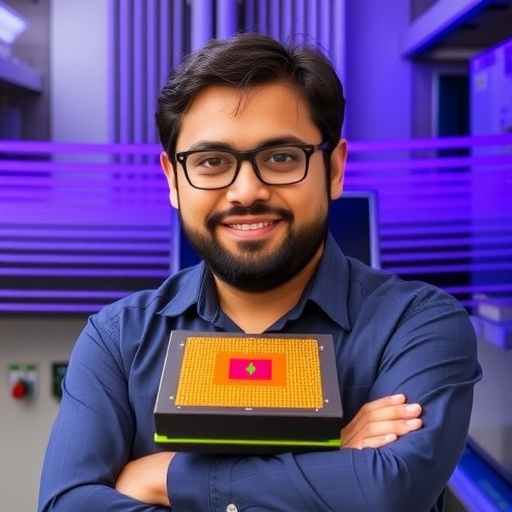
In a world increasingly dependent on renewable energy and advanced electronics, semiconductors play a pivotal role in shaping how devices function. From powering our smartphones and computers to harvesting solar energy and illuminating spaces with energy-efficient lighting, semiconductors control the critical flow of electrical charges essential for modern technologies. Traditionally anchored by silicon-based materials, the semiconductor landscape is experiencing a transformative shift with the advent of innovative materials such as halide perovskites and organic semiconductors. These new materials offer promising solutions that overcome many limitations inherent to conventional silicon, heralding a new era in electronic and optoelectronic applications.
At the heart of optimizing semiconductor performance lies the concept of electronic doping – a process that precisely manipulates the charge carrier concentration in semiconductor materials to enhance their electrical conductivity. Traditional doping techniques often rely on incorporating metal salts or organic additives, which, while effective to an extent, introduce complexities such as chemical residues and stability issues over time. Such methods are typically slow and largely based on iterative trial-and-error protocols, resulting in limited predictability and control over the final device properties. Recognizing these challenges, a research team led by Dr. Pabitra Nayak at the Tata Institute of Fundamental Research in Hyderabad has pioneered a novel doping technique termed in situ regenerative adduct-assisted (IRAA) doping, which promises to revolutionize the electronic tuning of organic semiconductors.
The IRAA doping strategy represents a paradigm shift. Unlike conventional methods that often necessitate external additives or prolonged incubation periods, IRAA facilitates a clean, rapid, and additive-free doping process. During the doping event, a self-regenerating active doping species is spontaneously generated in situ—meaning directly within the material system—ensuring continuous and efficient doping without residual impurities. This innovative approach not only accelerates the doping kinetics but also significantly enhances the uniformity and stability of the doped semiconductor material, addressing key hurdles that have long impeded organic semiconductor applications.
Beyond simply refining an existing process, IRAA fundamentally reengineers the doping framework. Historically, organic semiconductor doping has been constrained by the use of singular dopants which inherently balance between effectiveness, stability, and compatibility compromises. IRAA disrupts this outdated model by introducing a multi-component dopant system, wherein individual molecular constituents can be optimized independently for targeted functionalities. This flexibility transforms doping into a modular and design-driven science, allowing precise tailoring of electronic properties for diverse semiconductor types and device architectures. The implication is profound: doping methodologies can now be predictive and adaptable rather than empirical and rigid.
This breakthrough has profound significance for numerous emerging technologies, particularly flexible electronics and next-generation solar cells. Organic semiconductors and halide perovskite materials have been spotlighted for their exceptional optoelectronic properties, but their broader adoption has been hampered by doping inefficiencies and material instabilities. The IRAA method directly addresses these pain points, laying the groundwork for scalable manufacturing of highly efficient, stable, and flexible devices that leverage organic and perovskite materials.
In the realm of solar energy, where achieving high power conversion efficiency and prolonged operational lifetimes is crucial, IRAA offers a promising pathway. Silicon-based solar cells currently dominate the market with power conversion efficiencies reaching about 27.9%. However, halide perovskite solar cells—initially around 10% efficient a decade ago—have shown remarkable improvement owing to advances in material engineering and doping techniques. Leveraging the IRAA doping strategy, researchers have demonstrated halide perovskite solar cells with an impressive efficiency of 24.6%, bringing these materials tantalizingly close to commercial viability and opening avenues for further enhancement.
This doping methodology’s clean and regenerative nature also means devices can be engineered with greater precision, minimizing defects and enhancing charge transport stability—both critical for practical, long-term applications. Importantly, the IRAA strategy is universally applicable and scalable, making it highly attractive for industrial-scale production of organic semiconductor-based optoelectronics, including flexible displays, sensors, and photovoltaic cells.
The holistic benefits provided by IRAA touch on core technological challenges that have limited the functional potential of organic semiconductors for decades. By effectively eliminating the reliance on fixed dopant chemistries and their associated trade-offs, IRAA empowers researchers to fine-tune semiconductor electronic properties dynamically. This advancement elevates semiconductor doping from a somewhat artisanal craft to an engineering discipline rooted in molecular design and mechanistic understanding.
Additionally, the rapid, additive-free nature of IRAA doping simplifies device fabrication workflows, reducing time and material waste, which is a significant advantage for cost-effective manufacturing. This streamlined approach will likely accelerate the translation of laboratory experimentation into commercially feasible products—a critical step for industries ranging from renewable energy to consumer electronics.
The implications for renewable energy go beyond mere efficiency gains. The ability to engineer semiconductors with enhanced stability and tailor-made electrical properties via IRAA could facilitate the development of next-generation solar cells and energy conversion devices that endure harsh environmental conditions without degradation. Such robust devices are crucial for scaling solar technologies in global markets, especially in regions with limited maintenance infrastructure.
This innovation epitomizes the synergy between fundamental science and applied engineering. It underscores a future where electronic properties are not passively accepted but actively molded through a modular, design-first doping approach. The capacity to customize semiconductor behavior with such fine control will unlock new functionalities, improve device longevity, and catalyze sustainable energy transitions.
Through the pioneering work led by Dr. Nayak and his team, electronic doping has entered a new era—one characterized by regeneration, precision, and sustainable efficiency. The IRAA doping strategy not only challenges existing conventions but sets a new standard for how organic and perovskite semiconductors can be harnessed in the technologies of tomorrow. As research continues to explore and expand IRAA’s potential, the prospect of renewable and flexible electronics achieving widespread adoption becomes ever more tangible. Indeed, this approach may represent a key milestone on the global journey toward cleaner, smarter, and more adaptive semiconductor devices.
Subject of Research: Experimental study on a novel in situ regenerative adduct-assisted p-type doping technique for organic semiconductors
Article Title: In Situ Regenerative Adduct Assisted p-Type Doping of Organic Semiconductor
Web References:
https://advanced.onlinelibrary.wiley.com/doi/10.1002/adma.73351
http://dx.doi.org/10.1002/adma.73351
Image Credits: Photograph by Brijesh K. Patel
Keywords
Organic semiconductors, Electronic doping, IRAA doping, Halide perovskites, Renewable energy, Solar cells, Charge transport, Optoelectronics, Semiconductor stability, Modular doping, Design-driven doping, Photovoltaic efficiency
Tags: advanced optoelectronic materialschallenges in traditional semiconductor dopingelectronic doping optimization methodshalide perovskite semiconductorsimproving electrical conductivity in semiconductorsIRAA semiconductor doping techniquenext-generation semiconductor materialsorganic semiconductor advancementsrenewable energy semiconductor applicationssemiconductor device performance enhancementsustainable electronics innovationTIFRH semiconductor research breakthroughs