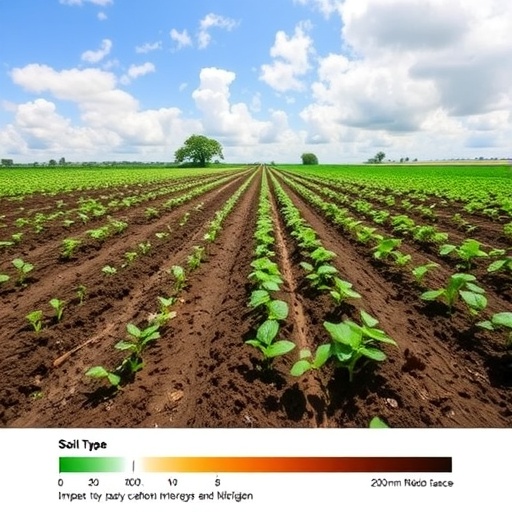
Agricultural soils are recognized as significant sources of nitrous oxide (N₂O), a potent greenhouse gas primarily produced through microbial nitrogen transformations. A groundbreaking study spanning five typical Chinese farmland soils has revealed that identical carbon and nitrogen inputs can generate markedly different N₂O emission profiles, a phenomenon influenced heavily by soil acidity, nutrient status, and microbial community function.
Researchers collected black soil, lime concretion black soil, yellow-cinnamon soil, red soil, and fluvo-aquic soil from diverse agricultural regions across China, each representing unique physicochemical properties and historic fertilizer regimes. Employing bacterial community sequencing, quantification of key denitrification genes, and dynamic laboratory incubations that tracked nitrogen gases in real time, the study pinpointed that soil pH and nitrate availability are the paramount drivers shaping bacterial community structure—pH alone accounting for almost half of the observed variation.
Denitrification—a microbial pathway reducing nitrate to gaseous nitrogen compounds—is central to this process, where incomplete conversion can emit environmentally harmful N₂O instead of inert nitrogen gas (N₂). Among the soils examined, fluvo-aquic soil consistently exhibited the lowest ratio of N₂O emissions, displaying a robust capacity to complete the denitrification process. This was mirrored by high abundances of denitrification genes, notably nosZ, which encodes nitrous oxide reductase critical for converting N₂O to N₂.
However, gene abundance was not a straightforward predictor of emission outcomes. Soils like black soil, lime concretion black soil, and yellow-cinnamon soil accumulated substantial N₂O despite having relatively high nosZ gene levels. This highlights that measuring gene presence alone is insufficient; the physiological activity, community composition, environmental responsiveness, and enzyme dynamics of the denitrifying microbes decisively influence emission patterns.
The red soil represents a contrasting case, where a strongly acidic environment combined with low organic carbon availability limited overall denitrification potential. Acidic conditions may inhibit microbial reduction of N₂O, amplifying greenhouse gas release risks.
Enhancing substrates by adding both nitrate and glucose generally promoted more complete denitrification and lowered the proportional share of N₂O in emitted gases. Notwithstanding, this dual amendment increased total gaseous nitrogen loss, underscoring a critical trade-off between mitigating greenhouse gas emissions and preserving nitrogen essential for crop productivity.
Further analysis identified a core bacterial microbiome common to all soils, involved in carbon and nitrogen cycling and organic matter decomposition. Yet, these taxa’s abundance did not correlate directly with soil-specific N₂O emission patterns, suggesting that nuanced microbial interactions dictate nitrogen gas fluxes.
The findings from this study unambiguously demonstrate that effective mitigation strategies for agricultural nitrous oxide emissions must be soil-specific. Future research combining gene expression analysis, enzymatic activity monitoring, and strain-level microbial ecology promises to refine predictive models of soil greenhouse gas emissions, a crucial step toward sustainable farming and climate change mitigation.
Subject of Research: Microbial communities and denitrification gas emissions in farmland soils
Article Title: Comparative study of microbial communities and denitrification gas emissions in typical Chinese farmland soils under varying C/N conditions
News Publication Date: 21-Apr-2026
References: Wu Q, Yu S, Xie Z, Qin X, Li J, et al. 2026. Comparative study of microbial communities and denitrification gas emissions in typical Chinese farmland soils under varying C/N conditions. Nitrogen Cycling 2: e019 doi: 10.48130/nc-0026-0006
Image Credits: Qiaoyu Wu, Siyu Yu, Zhen Xie, Xianchao Qin, Ji Li & Xiaojun Zhang
Keywords
Nitrous oxide, Denitrification, Microbial communities, Soil pH, Nitrate availability, Agricultural soils, Greenhouse gas emissions, Nitrogen cycling
Tags: agricultural soil greenhouse gasesdenitrification genesdenitrification processfarmland soil diversitymicrobial community structuremicrobial nitrogen transformationsnitrogen gas emissionsnitrous oxide emissionssoil nutrient statussoil pH influencesoil physicochemical propertiessoil type