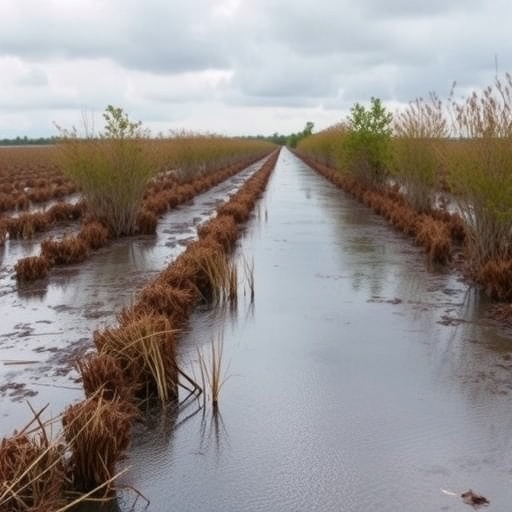
Tidal wetlands are among the most vital yet fragile ecosystems on the planet. These distinctive landscapes, which include tidal marshes, mangrove forests, and tidal flats, perform invaluable ecological functions. They serve as sanctuaries for diverse species, shield coastlines from flooding and storm surges, act as significant carbon sinks, and aid in purifying water. The intricacy of their intertidal existence, ebbing and flowing with daily tides, uniquely positions them as buffers between land and sea, but also renders them highly sensitive to environmental changes.
Despite their importance, tidal wetlands are disappearing worldwide at an alarming rate. Human development, including urban expansion, agriculture, and infrastructure projects, has fragmented and destroyed large portions of these habitats. Compounding this are the effects of climate change, as sea levels rise and extreme weather events become more frequent and severe. Recent research has highlighted not just the ongoing loss but the increasing acceleration of this decline in the United States, painting a sobering picture about the future of these ecosystems.
A pivotal study, conducted over four decades using satellite remote sensing data, has uncovered a crucial insight: the escalating loss of tidal wetlands in the U.S. is increasingly driven by extreme weather events rather than just the steady rise in sea level. This work, spearheaded by Xiucheng Yang, previously a postdoctoral researcher at the University of Connecticut and now a senior research fellow at the University of Victoria, alongside Zhe Zhu, an associate professor directing the Global Environmental Remote Sensing Laboratory at UConn, breaks new ground. It provides a quantitative framework to disentangle the relative impacts of abrupt disturbances like hurricanes from chronic stressors such as sea level rise.
Historically, the prevailing assumption has been that sea level rise is the principal driver behind wetland loss. While this remains true in terms of total area lost, the study’s nuanced approach reveals that the accelerating rate of decline is actually dominated by episodic storm events. By employing a novel analytical technique known as DECODE—the Detection and Characterization of cOastal tiDal wEtlands model—the researchers harnessed high-resolution, time-series satellite imagery. This allowed for continuous and consistent monitoring of wetland changes, overcoming previous challenges posed by the highly dynamic tidal environment which complicates traditional mapping efforts.
Unlike past studies which primarily cataloged wetland shrinkage, the DECODE model enabled the team to link specific wetland losses to distinct storm events that struck U.S. coastlines over the past 40 years. This capability is groundbreaking. It provides actionable insights into how extreme weather, increasingly amplified by global warming, intensifies the degradation of these critical habitats. The research suggests the acceleration of wetland loss is nearly 1.4 times greater due to these extreme events compared to chronic stressors, highlighting the disproportionate impact of episodic forces on ecosystem stability.
Since 1985, the United States has lost approximately 7.5% of its tidal wetlands—equivalent to about 1,600 square kilometers—at an accelerating rate of roughly 0.73 square kilometers per year. Such rapid loss has dire implications not only for biodiversity but also for coastal communities depending on wetlands for natural defense mechanisms. Furthermore, the uneven geographic patterns of decline revealed by the study underscore that the effects of climate and development pressures manifest differently across regions.
The Gulf Coast, for example, experiences the most severe loss, suffering from both high relative sea level rise and growing frequency of intense hurricanes and storms. These combined pressures exacerbate wetland degradation, jeopardizing the ecological and protective services these habitats provide. Contrastingly, San Francisco Bay has seen an increase in tidal wetland area, largely credited to successful restoration initiatives and a natural lack of major storm events such as hurricanes. This regional variability offers hope and guidance, underscoring the efficacy of targeted conservation and proactive restoration strategies.
One particularly noteworthy ecological trend uncovered involves mangrove forests expanding geographically into areas traditionally dominated by tidal marshes, such as parts of Florida, Louisiana, and Texas. Mangroves are inherently more resilient to rising sea levels and extreme weather, providing a measure of natural adaptability. However, their encroachment also signals significant shifts in coastal ecosystem dynamics. Understanding these transitions is critical for managing future wetland conservation in a warming world.
The study’s authors stress the necessity for adaptive management strategies that accommodate the newfound reality of accelerating, storm-driven wetland loss. They caution that tidal wetlands’ natural capacity for recovery after storms is diminishing due to the increasing frequency and intensity of events, meaning that recovery intervals are becoming too short to allow effective regeneration. Consequently, post-storm intervention and active restoration are required to ensure wetlands can rebound and continue delivering essential ecological functions.
This research offers a sophisticated and timely perspective on the nuanced drivers behind tidal wetland decline in the face of global change. It presents a compelling scientific case for prioritizing resources toward forecasting and mitigating storm impacts while reinforcing the importance of longer-term strategies addressing sea level rise. The integration of remote sensing technologies with ecological modeling exemplifies the innovative approaches needed to safeguard these vulnerable coastal habitats for future generations.
As coastal populations grow and climate challenges mount, the insights derived from this study are indispensable. They not only inform conservation science but also direct policymaking aimed at protecting the natural infrastructure that underpins ecosystem resilience and human well-being. The accelerating loss of tidal wetlands is not merely an environmental issue but a socio-economic concern with global ramifications, necessitating urgent, coordinated response informed by cutting-edge research.
In sum, tidal wetlands are at a critical crossroads; their fate is intertwined with the trajectories of climate change and human intervention. The pioneering work by Yang, Zhu, and colleagues reshapes our understanding of wetland dynamics by revealing the outsized role of extreme weather events in accelerating ecosystem loss, elevating the urgency for innovative adaptation and restoration efforts to protect these vital coastal sentinels.
Subject of Research: Not applicable
Article Title: The accelerating loss and shifting dynamics of US tidal wetlands
News Publication Date: 19-May-2026
Web References: http://dx.doi.org/10.1038/s41467-026-71464-2
References: Yang, X., Zhu, Z. et al. (2026). The accelerating loss and shifting dynamics of US tidal wetlands. Nature Communications.
Image Credits: Zhiliang Zhu/USGS
Keywords: Wetlands, Tidal Marshes, Mangrove Forests, Coastal Ecosystems, Sea Level Rise, Extreme Weather, Climate Change, Remote Sensing, Tidal Wetland Loss, Coastal Resilience, DECODE Model
Tags: accelerating tidal marsh declineclimate-driven coastal habitat degradationcoastal flooding and storm surge protectionconservation of mangrove forestsecological importance of tidal flatseffects of sea level rise on tidal wetlandshabitat fragmentation from urban developmentimpact of climate change on coastal ecosystemslong-term monitoring of wetland ecosystemssatellite remote sensing of wetlandstidal wetland loss due to extreme weathertidal wetlands as carbon sinks