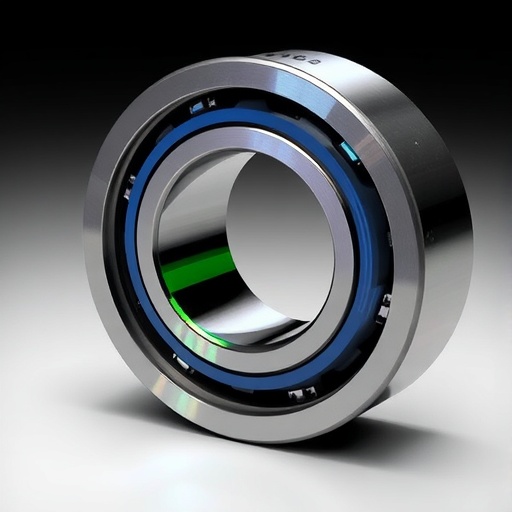
In a significant breakthrough poised to transform the diagnostics and monitoring of rolling bearings in heavy machinery, a team of scientists from Xi’an Jiaotong University in collaboration with Imperial College London has unveiled a sophisticated coupled elastohydrodynamic–acoustic model. This pioneering framework facilitates ultrahigh-resolution ultrasonic measurement of dynamic lubricant film thickness—a parameter paramount to the durability and performance of bearings in industrial applications. Published recently in the journal Engineering, this study addresses longstanding challenges hindering precise, real-time, noninvasive measurement techniques for oil films under operating conditions.
Lubricant films serve as protective layers in rolling bearings, mitigating friction and wear between moving parts. The thickness of these films governs bearing efficiency and lifespan; however, accurately measuring their dynamic thickness during operation has been notoriously difficult. Conventional methodologies relied heavily on optical or electrical sensors demanding transparent components or shielding to isolate measurement zones, a scenario impractical for many industrial environments. Ultrasonic testing offered promise due to its non-destructive nature, yet until now, spatial resolution was insufficient and complex reflections from interfaces within the layered bearing structure complicated signal interpretation.
To overcome these hurdles, the research team engineered an integrated approach combining detailed elastohydrodynamic lubrication (EHL) simulations and high-fidelity acoustic wave modeling. By incorporating algorithms such as Elrod–Adams to capture cavitation phenomena and employing JFO boundary conditions to more realistically simulate lubricant behavior under pressure, their EHL model yielded comprehensive surface deformation and pressure distribution profiles along with cavitation zone characterization. This hydrodynamic data became the foundation to understand how physical changes in the contact zone affect ultrasonic wave propagation.
Subsequently, leveraging COMSOL Multiphysics, the researchers developed an acoustics model finely tuned to the elastohydrodynamic contact geometry. The model simulated how variables including inlet and outlet zone lengths of the film, bearing rotational speed, and mechanical load influence ultrasonic reflections. Remarkably, the reflection coefficient distribution exhibited a characteristic symmetric double-peak pattern marked by a central valley—features directly linked to evolving film thickness and underlying contact mechanics. Furthermore, cavitation effects manifested as positional shifts in this valley and dictated amplitude changes in reflection signals, indicating a dynamic interplay between microbubble regions and acoustic wave behavior.
Building upon these insights, the investigators established a robust six-step algorithm to derive central film thickness from ultrasonic signals. A critical innovation involved introducing a correction coefficient bridging the holistic sensor reflection data with localized values at the film center, ensuring accurate thickness quantification under practical conditions. Polynomial fitting correlated this correction factor with the range of operating parameters, while a spring-based mechanical model transformed the refined reflection coefficients into physical thickness values. This multifaceted processing pipeline enhanced resolution and reliability beyond traditional ray-based or spring-based signal interpretation models.
The framework underwent rigorous experimental validation in two standout setups: a glass–oil–steel system enabling visualization-assisted fluorescence measurements, and an all-steel bearing representative of realistic industrial conditions. Fluorescence data substantiated the ultrasonic reflection patterns predicted by the simulations, while testing on steel bearings revealed film thickness measurements aligning closely with theoretical EHL predictions. Impressively, maximum errors were constrained to under 13%, marking a considerable improvement relative to existing ultrasonic measurement techniques. These successes affirm the method’s capability for practical, noninvasive in-situ monitoring, unlocking new pathways for proactive maintenance and condition assessment.
Unlike previous approaches that neglected complex contact geometry or cavitation’s acoustic impact, this elastohydrodynamic–acoustic framework accounts comprehensively for elastic deformation, lubricant phase changes, and interface reflection intricacies. Such realism in modeling ensures heightened accuracy and applicability to a broad spectrum of bearing designs and operational regimes. Importantly, the deployment leverages piezoelectric ceramic sensors, which are compact and easily affixed directly onto bearing surfaces without performance trade-offs, making industrial integration feasible.
Looking forward, the research envisions extending this methodology to encompass diverse bearing architectures beyond rolling contacts, exploring dimensionless analytical relations to generalize across scale and speed domains. Such expansions promise enhanced versatility, potentially accommodating oil, grease, or solid lubricant films and unraveling complex tribological phenomena in rotating machinery. The platform also lays groundwork for intelligent predictive maintenance solutions, where continuous film thickness monitoring informs timely intervention and optimizes equipment life cycles.
This breakthrough reflects a deft synthesis of tribology, acoustics modeling, numerical simulation, and experimental validation—an interdisciplinary feat heralding a new era of precision diagnostics in mechanical systems. As industries increasingly demand reliability and efficiency from their rotating equipment, methods enabling granular insight into lubricant behavior will prove indispensable. The coupled elastohydrodynamic–acoustic framework not only overcomes prior technological barriers but sets a new standard for ultrasonic lubricant film thickness measurement under realistic operational stresses.
The authors of this impactful study, including Pan Dou, Yayu Li, Suhaib Ardah, Tonghai Wu, Min Yu, Thomas Reddyhoff, Yaguo Lei, and Daniele Dini, propel the field toward practical solutions aligning with contemporary industrial needs. Their open access article is available in Engineering and promises to stimulate further innovation by bridging theoretical modeling with direct application. This advancement represents a cornerstone in bearing condition assessment, promoting enhanced machine reliability and energy efficiency through superior lubrication monitoring.
Subject of Research: Elastohydrodynamic lubrication and ultrasonic measurement techniques for dynamic lubricant film thickness in rolling bearings.
Article Title: A Coupled Elastohydrodynamic–Acoustic Framework for High-Resolution Ultrasonic Measurement of Dynamic Film Thickness in Lubricated Contacts
News Publication Date: April 4, 2026
Web References:
https://doi.org/10.1016/j.eng.2026.01.014
https://www.sciencedirect.com/journal/engineering
Image Credits: Pan Dou, Yayu Li et al.
Keywords
Lubricated Bearings, Elastohydrodynamic Lubrication, Ultrasonic Measurement, Acoustic Modeling, Cavitation, Film Thickness, Rolling Machinery, COMSOL Multiphysics, Noninvasive Diagnostics, Mechanical Engineering, Tribology, Condition Monitoring
Tags: acoustic wave analysis in bearingsadvanced bearing wear detection techniquescoupled elastohydrodynamic-acoustic frameworkdynamic lubricant film measurementelastohydrodynamic lubrication modelinghigh-resolution ultrasonic testingindustrial machinery bearing monitoringnoninvasive bearing diagnosticsoil film thickness in heavy machineryreal-time lubricant film monitoringrolling bearing performance optimizationultrasonic measurement of oil film thickness