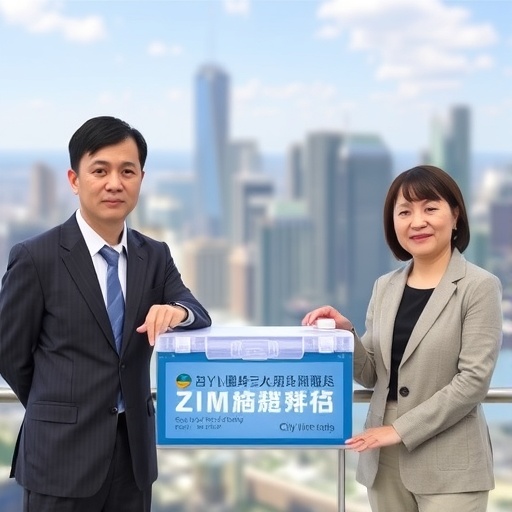
In the relentless pursuit of safer, more efficient, and environmentally sustainable energy storage solutions, a pioneering research team from City University of Hong Kong (CityUHK) is making significant waves. Supported by the government’s RAISe+ Scheme, this team is spearheading the development of next-generation aqueous zinc-based batteries poised to transform large-scale energy storage, particularly for critical backup power in data centers and AI infrastructure. Their visionary work promises to overcome the fire hazards of lithium-ion batteries while bypassing the limitations of conventional lead-acid alternatives.
The contemporary energy storage landscape is dominated by lithium-ion technology because of its commendable energy density and performance metrics. However, this dominance comes with risks: lithium batteries are notoriously prone to thermal runaway, short-circuiting, and catastrophic fires, issues exacerbated in dense, high-demand environments such as data centers. Meanwhile, lead-acid batteries, which make up a staggering 90% of uninterruptible power supply (UPS) systems, suffer from poor power density. Their bulkiness and need for over-provisioning inflate costs and complicate maintenance, restricting operational flexibility. It’s against this backdrop that the CityUHK team’s aqueous zinc battery innovation stakes a compelling claim.
Aqueous zinc batteries operate fundamentally differently from lithium-ion counterparts. Instead of flammable organic electrolytes, these batteries utilize water-based electrolytes, exploiting zinc metal as the primary anode material. This simple yet profound shift eradicates the risk of fire or explosion associated with high-voltage lithium systems. Zinc’s natural abundance, recyclability, and non-toxic profile further elevate this chemistry’s appeal, promising a battery that’s not only safer but also greener and more cost-effective to manufacture and recycle.
The researchers are advancing multiple cutting-edge material engineering strategies to refine battery performance. One notable focus is on mitigating zinc dendrite formation—a notorious phenomenon where needle-like zinc deposits grow during charging, risking internal short circuits and capacity loss. By optimizing the zinc anode’s structural properties and applying advanced surface treatments, the team aims to extend battery lifespan and reliability significantly.
Complementing anode improvements, the cathode materials undergo stabilization efforts via novel protective surface coatings. These coatings enhance resistance to dissolution and boost cycling stability during repetitive charge-discharge cycles, two critical factors in battery longevity and consistent power delivery. Moreover, the introduction of a custom-designed two-layer composite separator enhances ionic conductivity while maintaining electrical insulation, contributing both to safer operation and improved electrochemical performance.
Beyond material innovations, the manufacturing process receives meticulous attention. Precise control during slurry coating, roll pressing, electrode cutting, tab welding, electrode winding, and vacuum electrolyte filling is crucial to maximize battery uniformity, mechanical integrity, and energy density. Mastery of these production techniques is expected to yield aqueous zinc batteries with predictable, scalable performance suited for commercial deployment.
System-level integration also forms an essential piece of the puzzle. CityUHK’s team is developing three sophisticated control systems tailored to zinc battery technology: a battery management system (BMS), a power control system (PCS), and an advanced thermal management system. Together, these ensure real-time monitoring, safety protocols, and efficient heat dissipation, underpinning the stable operation required for demanding applications such as data centers and medical facilities.
Commercialization initiatives for this breakthrough battery technology are well underway. Amazinc Energy Limited, co-founded by Professor Zhi Chunyi and Dr. Tang Zijie from CityUHK, is bridging lab results to market-ready solutions. With support from CityUHK’s HK Tech 300 entrepreneurship program and funding from the RAISe+ Scheme, Amazinc Energy is developing automated production lines targeting an annual capacity of 1 GWh within three years, positioning itself as a serious contender in the energy storage sector.
Amazinc Energy’s collaboration with Huasu Technology, a key domestic supplier of battery management systems and data center infrastructure, strategically aligns expertise to accelerate market penetration. This partnership targets sectors such as UPS systems for data centers, grid energy storage, and renewable integration, domains desperately needing safer, more scalable energy storage options.
The implications of this aqueous zinc battery innovation go beyond mere technical progress. By providing a fire-safe, cost-competitive, and environmentally benign solution, the technology stands to revolutionize energy storage frameworks globally. It provides a resilient backbone for Hong Kong’s ambitions as an international financial and digital hub, offering critical infrastructure players reliable power backup solutions essential in today’s data-driven economy.
According to Dr. Tang Zijie, the elimination of fire risk combined with cost-effectiveness and operational safety marks a paradigm shift in energy storage, particularly for large-scale applications. By leveraging Hong Kong’s global connectivity, the team envisions technology demonstration platforms, standardized benchmarks, and streamlined entry into international markets, accelerating the diffusion of research breakthroughs.
This aqueous zinc battery project exemplifies multidisciplinary innovation wherein materials science, electrochemistry, manufacturing engineering, and system controls converge. The holistic approach adopted by CityUHK taps the full innovation ecosystem, from laboratory breakthroughs to industrial production, toward delivering sustainable, next-generation energy storage technologies suitable for a low-carbon future.
In conclusion, as the global community marches toward carbon neutrality amid escalating energy demands, the aqueous zinc-based battery technology from City University of Hong Kong emerges as a beacon of safe, scalable, and sustainable innovation. With rigorous research, advanced material design, precision manufacturing, and integrated system control, this novel battery chemistry offers an indispensable asset to the energy landscape of tomorrow, promising to power critical infrastructure with unmatched reliability and environmental stewardship.
Subject of Research: Development of aqueous zinc-based batteries for safe, efficient, and sustainable large-scale energy storage
Article Title: CityUHK Pioneers Aqueous Zinc Battery Technology for Safer, Greener Power Storage
News Publication Date: Information not provided
Web References: Information not provided
References: Information not provided
Image Credits: City University of Hong Kong
Keywords
Batteries, Lithium ion batteries, Zinc, Energy storage, Electrical power, Sustainable energy, Energy resources conservation, Electrolytes, Materials science, Electrodes
Tags: aqueous zinc batteries for AI infrastructureCity University of Hong Kong battery researchenvironmentally sustainable battery alternativesfire hazard reduction in energy storageinnovative backup power technologieslarge-scale energy storage for data centerslimitations of lead-acid UPS systemsnext-generation energy storage solutionssafer aqueous zinc battery technologythermal runaway prevention in batterieswater-based electrolyte batterieszinc-based battery advantages over lithium-ion