


In the evolving landscape of oncology, the surge of immune checkpoint inhibitors (ICIs) has marked a paradigm shift, especially among elderly cancer patients. As the global population ages, lung and gastrointestinal (GI) cancers have emerged as predominant malignancies within this demographic, reflecting daunting incidence figures that demand refined therapeutic strategies. Recent data from China forecast a chilling estimate of 681,124 new elderly lung cancer cases and 333,821 GI cancer cases for the year 2024 alone, underpinning the urgent clinical need for optimized immunotherapy protocols tailored to the elderly.
Immune checkpoint inhibitors revolutionize cancer treatment by harnessing the immune system’s ability to target tumor cells more effectively than conventional chemotherapy. Notably, ICIs exhibit superior tolerability profiles in elderly patients, a cohort traditionally vulnerable to the toxicities of cytotoxic agents. Nonetheless, the clinical application in the elderly is hampered by their underrepresentation in pivotal clinical trials, creating critical gaps in understanding the spectrum and severity of immune-related adverse events (irAEs) linked to ICIs, particularly as they may vary between different tumor types.
Addressing this knowledge void, a pioneering retrospective observational study spearheaded by Peking University Cancer Hospital analyzed real-world data from 407 elderly patients aged 70 years and above, all having undergone at least two cycles of ICI therapy. This cohort included 261 patients with gastrointestinal tumors and 146 with lung cancer, enrolled between January 2016 and February 2022. By applying a sophisticated 2:1 propensity score matching approach, the investigators meticulously balanced covariates such as sex, smoking history, Eastern Cooperative Oncology Group (ECOG) performance status, and concomitant treatment modalities, culminating in two well-matched groups: 197 elderly patients with GI tumors and 133 with lung cancer.
The study’s primary endpoint focused on the incidence of any-grade irAEs, which were systematically classified according to the Common Terminology Criteria for Adverse Events (CTCAE) version 4.03, while a secondary analysis explored organ-specific toxicity profiles. These rigorous methodologies represent a significant advancement in carefully delineating the nuanced safety landscape of ICIs in elderly populations afflicted with distinct tumor types, an area previously obscured by heterogeneous clinical trial data.
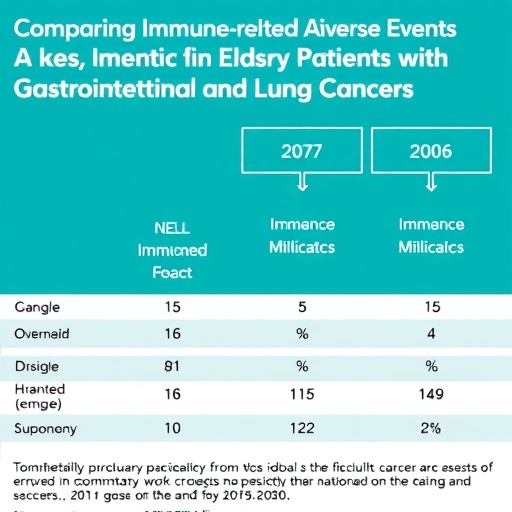
Intriguingly, the results revealed a tangible disparity in the incidence of immune-related toxicities between the two cohorts. The overall irAE occurrence was 52.6% across the study population, yet lung cancer patients exhibited a notably higher incidence at 61.0%, compared to 47.9% in GI tumor patients—a statistically significant difference underscored by a p-value of 0.013. This trend persisted post-propensity score matching, with lung cancer group irAEs slightly higher (61.7% vs. 50.8%, though just shy of statistical significance at p=0.056), and a pronounced difference in mild-to-moderate (grade 1-2) irAEs favoring lung cancer patients (52.6% vs. 37.1%, p=0.006).
Diving deeper into the organ-specific irAEs, the study uncovered distinctive patterns reflective of tumor biology and host immune interaction. Cutaneous toxicities emerged as the most prevalent irAE, affecting 23.8% of the entire cohort, but displayed a significant predilection for GI tumor patients, with a 28.7% incidence relative to 15.1% among lung cancer patients (p=0.002). Conversely, thyroid dysfunction—characterized by autoimmune thyroiditis or hypothyroidism—surfaced as a prominent adverse event within the lung cancer group, occurring in 28.1% of patients versus 11.9% in those with GI tumors (p < 0.001). Other organ systems, including hepatobiliary toxicity, cytopenias, and pneumonitis, showed no statistically significant differences between the groups, suggesting a degree of tumor-specific immune modulation confined to particular organ toxicities.
These findings illuminate a complex interplay between tumor microenvironment heterogeneity and systemic immune responses modulated by ICIs, which may be further influenced by gut microbiota compositions, especially relevant in GI cancers. The gut microbiome’s modulatory role in immune homeostasis and response to checkpoint blockade introduces a mechanistic hypothesis for the observed differential patterns of irAEs. Understanding such interactions could pave the way for novel predictive biomarkers and tailored prophylactic approaches to manage toxicity profiles across diverse oncologic populations.
Importantly, this research stands as the inaugural large-scale real-world investigation to dissect tumor-specific immune toxicities in an elderly cohort, filling a crucial evidence gap left by randomized controlled trials. The clinical implications are profound: practitioners should adopt vigilant monitoring protocols for thyroid dysfunction in elderly lung cancer patients receiving ICIs and simultaneously be alert for cutaneous irAEs in those battling GI tumors. Tailoring surveillance and management strategies according to tumor type could mitigate adverse effects, enhance patient quality of life, and potentially improve treatment adherence.
While these insights herald a new frontier in geriatric oncology, the study’s limitations must be acknowledged. Being a single-center retrospective analysis confines the generalizability of the findings, and the absence of longitudinal data correlating irAEs with therapeutic efficacy leaves critical questions unanswered. Future multicenter prospective studies integrating robust biomarker analyses and longitudinal follow-up are indispensable to validate and expand upon these foundational observations.
Led by Dr. Yuyan Wang, a distinguished thoracic oncologist at Peking University Cancer Hospital, this study underscores an era where clinical research is increasingly responsive to the nuances of elderly cancer care. Dr. Wang’s expertise in thoracic oncology and her research into tumor microenvironment dynamics and molecular resistance mechanisms have been instrumental in shaping this pioneering investigation. Supported by multiple institutional and national grants, the collaborative endeavor reflects a commitment to addressing the unmet needs of an aging oncologic population.
Collectively, these findings advance our understanding of immunotherapy’s safety profile among elderly patients with lung and GI cancers, reinforcing the necessity for tumor-specific and patient-centered approaches. They evoke critical questions about the immunobiology underpinning differential irAE manifestations and herald an opportunity for precision medicine to extend beyond efficacy into toxicity management. As the medical community grapples with rising cancer burdens in the elderly, such research offers hope for improved outcomes through personalized, immune-guided treatment strategies.
In summary, this landmark real-world study elucidates the heterogeneous landscape of immune-related adverse events in elderly patients treated with ICIs for gastrointestinal and lung cancers. The discernible variation in both incidence and organ-specific toxicity emphasizes the importance of tumor biology in shaping immune responses and adverse event profiles. Enhanced surveillance tailored to tumor site—especially for thyroid dysfunction in lung cancer and skin toxicities in GI cancers—may optimize immunotherapy’s risk-benefit balance and usher in refined standards of care for an increasingly vulnerable patient population.
Subject of Research: People
Article Title: Immune-related adverse events between elderly patients with gastrointestinal and lung cancers: A real-world study
News Publication Date: 3-Apr-2026
Web References: DOI link
References: DOI: 10.1097/CM9.0000000000004069
Image Credits: Chinese Medical Journal
Keywords: Immune checkpoint inhibitors, elderly cancer patients, gastrointestinal cancer, lung cancer, immune-related adverse events, toxicity profiles, tumor microenvironment, propensity score matching, thyroid dysfunction, skin toxicity, real-world study, immunotherapy
Tags: challenges in elderly cancer treatmentcomparative study of irAEs in lung vs GI cancerelderly cancer patient immunotherapygastrointestinal cancer immunotherapy adverse eventsimmune checkpoint inhibitor clinical trials and elderlyimmune checkpoint inhibitor toxicity in elderlyimmune checkpoint inhibitors in gastrointestinal cancerimmune checkpoint inhibitors in lung cancerimmune-related adverse events in elderly cancer patientsimmunotherapy safety in elderlylung cancer immunotherapy adverse eventsreal-world data on immune-related adverse events

