• HOME
  • NEWS
  • EXPLORE
    • CAREER
      • Companies
      • Jobs
    • EVENTS
    • iGEM
      • News
      • Team
    • PHOTOS
    • VIDEO
    • WIKI
  • BLOG
  • COMMUNITY
    • FACEBOOK
    • INSTAGRAM
    • TWITTER
Thursday, February 5, 2026
BIOENGINEER.ORG
No Result
View All Result
  • Login
  • HOME
  • NEWS
  • EXPLORE
    • CAREER
      • Companies
      • Jobs
        • Lecturer
        • PhD Studentship
        • Postdoc
        • Research Assistant
    • EVENTS
    • iGEM
      • News
      • Team
    • PHOTOS
    • VIDEO
    • WIKI
  • BLOG
  • COMMUNITY
    • FACEBOOK
    • INSTAGRAM
    • TWITTER
  • HOME
  • NEWS
  • EXPLORE
    • CAREER
      • Companies
      • Jobs
        • Lecturer
        • PhD Studentship
        • Postdoc
        • Research Assistant
    • EVENTS
    • iGEM
      • News
      • Team
    • PHOTOS
    • VIDEO
    • WIKI
  • BLOG
  • COMMUNITY
    • FACEBOOK
    • INSTAGRAM
    • TWITTER
No Result
View All Result
Bioengineer.org
No Result
View All Result
Home NEWS Bioengineering

Computing with Silicon Neurons

Bioengineer by Bioengineer
January 29, 2014
in Bioengineering, Neuroscience
Reading Time: 2 mins read
0
Share on FacebookShare on TwitterShare on LinkedinShare on RedditShare on Telegram

Scientists from Berlin and Heidelberg use artificial nerve cells to classify different types of data Thus, they may recognize handwritten numbers, or distinguish plant species based on their flowers. A bakery assistant who takes the bread from the shelf just to give it to his boss who then hands it over to the customer? Rather unlikely. Instead, both work at the same time to sell the baked goods. Similarly, computer programs are more efficient if they process data in parallel rather than to calculate them one after the other.
Computing with Silicon Neurons

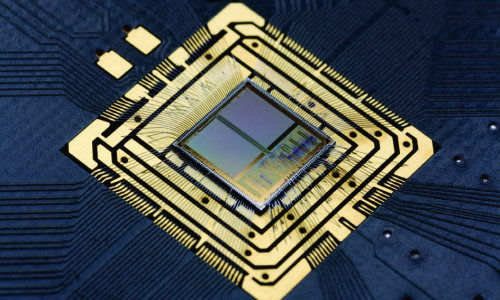
However, most programs that are applied still work in a serial manner. Scientists from Freie Universität Berlin, the Bernstein Center Berlin, and Heidelberg University have now refined a new technology that is based on parallel data processing. In the so-called neuromophic computing, neurons made of silicon take over the computational work on special computer chips. The neurons are linked together in a similar fashion to the nerve cells in our brain. If the assembly is fed with data, all silicon neurons work in parallel to solve the problem. The precise nature of their connections determines how the network processes the data. Once properly linked, the neuromorphic network operates almost by itself. The researchers have now designed a network–a neuromorphic “program”– for this chip that solves a fundamental computing problem: It can classify data with different features. It is able to recognize handwritten numbers, or may distinguish certain plant species based on flowering characteristics.

“The design of the network architecture has been inspired by the odor-processing nervous system of insects,” explains Michael Schmuker, lead author of the study. “This system is optimized by nature for a highly parallel processing of the complex chemical world.” Together with work group leader Martin Nawrot and Thomas Pfeil, Schmuker provided the proof of principle that a neuromorphic chip can solve such a complex task. For their study, the researchers used a chip with silicon neurons, which was developed at the Kirchhoff Institute for Physics of Heidelberg University.

Computer programs that can classify data are employed in various technical devices, such as smart phones. The neuromorphic network chip could also be applied in super-computers that are built on the model of the human brain to solve very complex tasks. Using their prototype, the Berlin scientists are now able to explore how networks must be designed to meet the specific requirements of these brain-like computer. A major challenge will be that not even two neurons are identical – neither in silicon nor in the brain.

Story Source:

The above story is based on materials provided by Freie Universitaet Berlin

Share12Tweet8Share2ShareShareShare2

Related Posts

Why is the first Turkish bioengineering promotion website, Biyomuhendislik.com, so important?

February 4, 2023

Redox biomarker could predict progression of epilepsy

October 5, 2016

Neural membrane’s structural instability may trigger multiple sclerosis

October 5, 2016

Scientists find new path in brain to ease depression

October 5, 2016
Please login to join discussion

POPULAR NEWS

  • Robotic Ureteral Reconstruction: A Novel Approach

    Robotic Ureteral Reconstruction: A Novel Approach

    81 shares
    Share 32 Tweet 20
  • Digital Privacy: Health Data Control in Incarceration

    63 shares
    Share 25 Tweet 16
  • Study Reveals Lipid Accumulation in ME/CFS Cells

    57 shares
    Share 23 Tweet 14
  • Breakthrough in RNA Research Accelerates Medical Innovations Timeline

    53 shares
    Share 21 Tweet 13

About

We bring you the latest biotechnology news from best research centers and universities around the world. Check our website.

Follow us

Recent News

Mitophagy’s Role in Pancreatic Cancer Therapy

AI-Enabled Stethoscope Proves Twice as Effective at Detecting Valvular Heart Disease in Clinical Settings

Study Finds No Link Between COVID-19 Vaccination and Decline in Birth Rates

Subscribe to Blog via Email

Enter your email address to subscribe to this blog and receive notifications of new posts by email.

Join 73 other subscribers
  • Contact Us

Bioengineer.org © Copyright 2023 All Rights Reserved.

Welcome Back!

Login to your account below

Forgotten Password?

Retrieve your password

Please enter your username or email address to reset your password.

Log In
No Result
View All Result
  • Homepages
    • Home Page 1
    • Home Page 2
  • News
  • National
  • Business
  • Health
  • Lifestyle
  • Science

Bioengineer.org © Copyright 2023 All Rights Reserved.