In a groundbreaking development poised to reshape our understanding of nuclear physics, an international team of scientists has for the first time successfully produced the elusive hydrogen-6 isotope through an electron scattering experiment. This pioneering work, spearheaded by the A1 Collaboration at the Institute of Nuclear Physics, Johannes Gutenberg University Mainz (JGU), in partnership with researchers from China and Japan, employed state-of-the-art techniques at the Mainz Microtron (MAMI) particle accelerator. Their novel approach not only opens new avenues for investigating light neutron-rich nuclei but also challenges existing theoretical models of nuclear interactions in extreme neutron-to-proton ratios.
Hydrogen isotopes have long captivated nuclear physicists, particularly those with extreme neutron richness such as hydrogen-6 (⁶H) and hydrogen-7 (⁷H). While ordinary hydrogen consists of a single proton without neutrons, isotopes like ⁶H stretch the limits of nuclear stability, containing one proton bound with five neutrons. These isotopes occupy an uncharted territory where the conventional nuclear forces and nucleon interactions are put to the test. The ability to experimentally produce and measure such nuclei provides crucial insight into the fundamental question of how many neutrons an atomic nucleus can accommodate alongside a given number of protons.
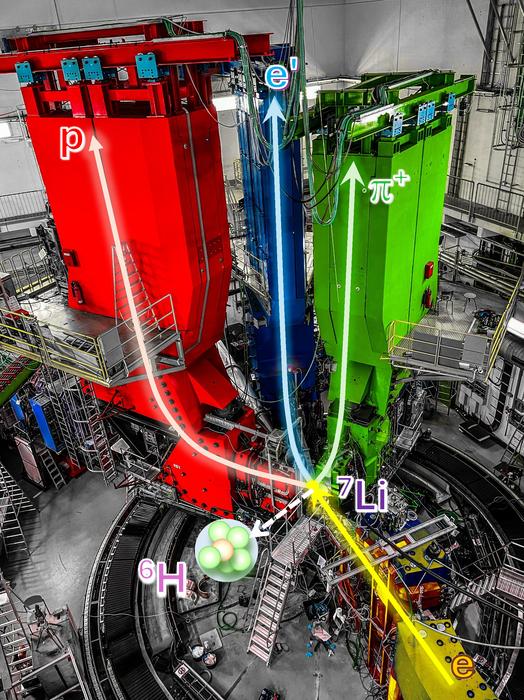
One formidable challenge in studying ⁶H arises from its fleeting existence and the scarcity of empirical data. Conflicting experimental results have left the scientific community divided over its ground-state energy, a critical parameter that reveals the strength of the binding forces within the nucleus. Addressing this, the A1 Collaboration developed an innovative experimental methodology, leveraging MAMI’s exceptional electron beam and the precision detection capabilities of three high-resolution magnetic spectrometers positioned in the A1 experimental hall.
The experiment utilized a target made from lithium-7 (⁷Li), upon which a highly focused, 855 MeV electron beam was directed. Unlike traditional electron scattering experiments that rely on ultra-thin targets intersecting a broad electron beam, this setup involved the electron beam traversing a narrow yet long lithium plate. This unconventional configuration was necessitated to maximize the probability of the rare two-step reaction essential for ⁶H formation. In the first step, the electron beam’s interaction resonantly excites a proton within the lithium nucleus, which promptly decays into a neutron and a positive pion. Subsequently, if this neutron transfers its energy to another proton in the nucleus, the reaction culminates in the creation of hydrogen-6 alongside the residual nucleus. Both the emitted pion and the proton escape the nucleus, where their detection in tandem with the scattered electron provides unmistakable experimental signatures.
A key aspect facilitating this complex experiment was MAMI’s exceptional beam quality. The electron beam’s stability and precise focus permitted the prolonged traversal of the lithium target without compromising its integrity or experimental conditions. Handling the lithium target posed additional hurdles due to its chemical reactivity, fragility, and sensitivity to temperature fluctuations. Overcoming these technical challenges was vital for sustaining a continuous measurement campaign that extended over four weeks, affirming the experiment’s meticulous design and execution.
Remarkably, the rate of ⁶H production was estimated and observed to be about one event per day, reflecting the intricate nature and rarity of the nuclear reactions involved. The simultaneous operation of all three spectrometers in coincidence mode—a rare configuration at MAMI—enabled the detection of three particles produced during the reaction, greatly enhancing the experiment’s resolution and background suppression. This precision allowed the researchers to discern a clean and robust signal corresponding to ⁶H.
The resulting data revealed a ground-state energy for hydrogen-6 that was significantly lower than many theoretical predictions. Such a low binding energy suggests unexpectedly strong interactions between neutrons in these extreme neutron-rich conditions. This finding poses a formidable challenge to prevailing nuclear models that typically underestimate the strength of multinucleon forces in such isotopes. As a result, the study not only advances experimental nuclear physics but also calls for refined theoretical frameworks capable of accommodating these nuanced interaction dynamics.
Beyond its fundamental scientific implications, this experiment highlights the importance of international collaboration and cutting-edge technology. Scientists from Fudan University in Shanghai, Tohoku University in Sendai, and the University of Tokyo contributed critical expertise, showcasing the global nature of contemporary nuclear research. The multidisciplinary efforts underscore how the synthesis of advanced accelerator facilities, innovative detector technologies, and international scientific cooperation can push the boundaries of observable nuclear phenomena.
Funding from the German Research Foundation (DFG), the European Union’s Horizon 2020 program, the National Key Research and Development Program of China, the National Natural Science Foundation of China, and the Japan Society for the Promotion of Science (JSPS) played an essential role in enabling this ambitious research. The success of the experiment underlines the vital necessity of sustained investment in scientific infrastructure and international partnerships to unravel the complexities of the atomic nucleus.
Looking forward, the ability to produce hydrogen-6 with precise control heralds new experimental possibilities. Further investigations can probe the structure and decay properties of other neutron-rich isotopes, shedding light on the neutron drip line—the boundary beyond which nuclei cannot bind additional neutrons. The refined methodologies developed here could also be adapted to explore other isotopic chains, thereby enriching our comprehension of the nuclear landscape under extreme isospin asymmetries.
In addition to expanding fundamental nuclear physics knowledge, insights derived from such studies may resonate in astrophysical contexts, particularly in understanding neutron stars and nucleosynthesis processes. The strong neutron correlations revealed in hydrogen-6 could inform models of matter under extreme densities and enrich simulations of stellar environments where such exotic nuclei transiently form.
This landmark experiment, published in the prestigious journal Physical Review Letters, represents a milestone in the quest to delineate the limits of nuclear existence and the forces that govern atomic nuclei. The collaboration’s innovative approach, meticulous execution, and consequential findings epitomize the synergy between experimental prowess and theoretical challenge—propelling the frontier of nuclear science into new and exciting realms.
Subject of Research: Hydrogen-6 isotope production and ground-state energy measurement in an electron scattering experiment.
Article Title: Measurement of 6H Ground State Energy in an Electron Scattering Experiment at MAMI-A1
News Publication Date: 22-Apr-2025
Web References: http://dx.doi.org/10.1103/PhysRevLett.134.162501
Image Credits: Ryoko Kino, Josef Pochodzalla; Tianhao Shao
Keywords
Hydrogen-6, neutron-rich isotopes, electron scattering, Mainz Microtron, MAMI, nuclear structure, multinucleon interactions, high-resolution spectrometers, lithium-7 target, nuclear physics, neutron drip line, isotope production
Tags: A1 Collaboration achievementselectron scattering experimentsexperimental nuclear physicsextreme neutron-to-proton ratioshydrogen-6 isotope productionInternational Scientific Collaborationisotopes of hydrogenMainz Microtron acceleratorneutron-rich nuclei researchnuclear physics breakthroughsnuclear stability limitstheoretical models of nuclear interactions