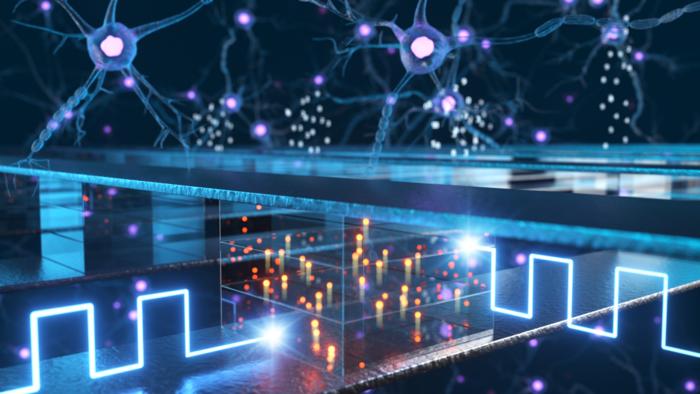
As artificial intelligence (AI) evolves at an unprecedented rate, researchers from POSTECH (Pohang University of Science and Technology) have made a groundbreaking discovery that promises to accelerate AI technologies significantly. Led by Professor Seyoung Kim and Dr. Hyunjeong Kwak, alongside Dr. Oki Gunawan from the IBM T.J. Watson Research Center, the team has unveiled the foundational operating mechanisms of Electrochemical Random-Access Memory (ECRAM). This breakthrough might revolutionize the efficiency of data processing in AI applications, addressing one of the most critical challenges in modern computing.
Traditional computing architectures often compartmentalize memory and processing. This design leads to significant delays and energy consumption due to the myriad data transfers required between memory units and processors. This separation is increasingly inadequate as the demand for data processing continues to scale up, particularly in AI contexts where swift calculations are necessary. The innovative concept of ‘In-Memory Computing’ emerges as a solution. This paradigm shifts the calculation process into the memory space itself, allowing for more efficient operations while bypassing the energy-intensive data movements to and from separate components.
ECRAM plays a pivotal role in realizing in-memory computing, as it functions by employing ionic movements to store and process information, enabling a continuous mode of analog data storage. However, previous understandings of ECRAM’s mechanisms were limited, hampering its commercialization and practical implementation. The intricate structures and behaviors of high-resistive oxide materials used in these devices posed significant hurdles that the science community struggled to overcome. This work, conducted by the POSTECH-led team, addresses these challenges directly and comprehensively.
By engineering a multi-terminal structured ECRAM device utilizing tungsten oxide, the researchers have significantly advanced the understanding of how the device operates under varying temperature conditions. They utilized a technique called the Parallel Dipole Line Hall System, which allowed them to observe internal electron dynamics across an expansive temperature range—from ultra-low temperatures of -223°C (50K) right up to room temperature (300K). This temperature variance is crucial because it impacts the performance and reliability of semiconductor devices in real-world applications.
In a remarkable first, the research team discovered that the internal oxygen vacancies in the ECRAM device fashioned shallow donor states, approximating 0.1 eV. This phenomenon created ‘shortcuts’ that facilitate the movement of electrons through the material, vastly improving electron transport efficiency. Rather than merely increasing the electron count, the findings reveal that ECRAM inherently fosters an environment conducive to freer electron movement, which enhances operational reliability and sustainability even under extreme conditions.
This foundational understanding is a giant leap in the race to commercialize ECRAM technology, as noted by Professor Seyoung Kim of POSTECH. The implications of this research extend beyond just theoretical advancements. It holds the potential for substantial real-world applications, especially in accelerating AI performance and prolonging battery lives in a multitude of devices such as smartphones, tablets, and laptops. The convergence of AI demands and advances in semiconductor technology could usher in a new era of computational speed and efficiency.
The application of this groundbreaking research is timely, considering the rising production demands and the growing necessity for devices that can manage larger datasets seamlessly and effectively. By collapsing the traditional barriers between memory and processing, ECRAM technology may redefine the performance benchmarks for numerous smart devices. Technologies that once seemed disconnected could integrate more cohesively, ultimately improving user experiences across the board.
Moreover, this innovative approach aligns with the global pursuit of sustainable computing solutions. The energy efficiencies gained from in-memory computing signify a vital step towards reducing the ecological footprint of technology, highlighting the intertwined paths of technological advancement and environmental responsibility. The groundbreaking findings from POSTECH contribute significantly to this endeavor, making ECRAM both a practical and a forward-thinking choice in the future landscape of technology.
The research has garnered support from K-CHIPS (Korea Collaborative & High-tech Initiative for Prospective Semiconductor Research), funded by Korea’s Ministry of Trade, Industry & Energy (MOTIE), showcasing the collaborative efforts and strategic initiatives underpinning this important work. As the world leans more heavily into the digital domain, the implications of this research resonate beyond academic circles, reaching into policy, industry, and everyday life.
Peer-reviewed and published in the esteemed journal, Nature Communications, this study addresses one of the critical bottlenecks in achieving the full potential of AI technologies. It provides a pathway toward more integrated, higher-performing computing systems. The combination of robust experimental evidence and theoretical insights lays the foundation for future research aimed at refining and deploying ECRAM technology effectively.
In conclusion, the unveiled mechanisms of ECRAM mark a significant milestone in semiconductor research and pave the way for next-generation AI technologies. As researchers continue to explore these advancements, the future looks promising. Innovations stemming from this research may soon lead to a reality where in-memory computing is no longer a theoretical ideal but a practical standard, transforming how information is processed and stored.
Subject of Research:
Electrochemical Random-Access Memory (ECRAM) and In-Memory Computing
Article Title:
Unveiling ECRAM switching mechanisms using variable temperature Hall measurements for accelerated AI computation
News Publication Date:
19-Mar-2025
Web References:
http://dx.doi.org/10.1038/s41467-025-58004-0
References:
Not applicable
Image Credits:
Credit: POSTECH
Keywords
Artificial intelligence, Electrochemical Random-Access Memory, In-Memory Computing, semiconductor technology, data processing, ionic movements, device efficiency, AI applications, computational speed, sustainable computing, temperature dynamics, commercial applications.
Tags: AI computation breakthroughsAI technology accelerationdata processing efficiency in AIElectrochemical Random-Access Memoryenergy-efficient computing architecturesin-memory computing technologyionic movement in data storagemodern computing challengesPOSTECH research advancementsProfessor Seyoung Kim innovationsreducing data transfer delaysrevolutionary memory processing techniques