Leuven (Belgium) 26 March 2024 – Belgian scientists have developed AI models that can predict how a particular beer will be rated by consumers, and what aroma compounds brewers can add to improve it. The research was published today in the renowned scientific journal Nature Communications and may revolutionize how the food and beverage industry develops new products.
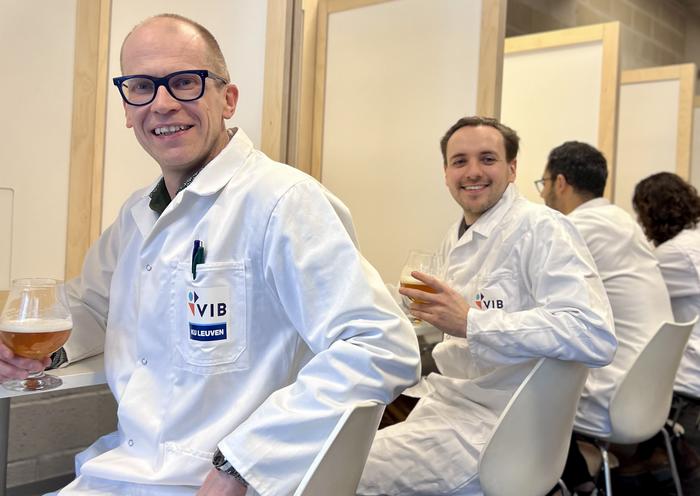
Credit: Copyright: VIB
Leuven (Belgium) 26 March 2024 – Belgian scientists have developed AI models that can predict how a particular beer will be rated by consumers, and what aroma compounds brewers can add to improve it. The research was published today in the renowned scientific journal Nature Communications and may revolutionize how the food and beverage industry develops new products.
Tricky to compare
Comparing and ranking flavor profiles of different beers is a challenge. There are a multitude of guides on the market describing beverages with generic terms like ‘fruity’ and rating them based solely on one person’s taste. “This makes beer comparisons highly biased and makes it difficult to predict how a beer actually tastes,” says Kevin Verstrepen, professor at KU Leuven and director of the VIB-KU Leuven Center for Microbiology and the Leuven Institute for Beer Research.
I wanted to have a more neutral and scientific description for the different beers in the world. – Kevin Verstrepen
The team started chemically analyzing beers, carefully measuring the concentrations of hundreds of aroma compounds. Each beer was also evaluated on a set of 50 criteria by a trained panel of 15 people. “It was a truly Herculean effort. We began the project with less than 100 beers, and quickly realized this would not be enough to capture Belgium’s incredible beer diversity, so we ended up analyzing 250 beers,” remembers Dr. Miguel Roncoroni, who led the chemical analyses and tasting panel.
New insights with AI
It took the team 5 years, but once they had the chemical concentrations and detailed tasting reports for hundreds of different beers, they knew it would be possible to use AI to connect the two. One model could predict key aromas and the final appreciation score of a beer, without the need for human tasting. These outcomes, in turn, were used to further improve the taste of an existing commercial Belgian ale, by adding certain aromas predicted by the model to boost the beer’s quality. Sure enough, the modified beer indeed scored quite a bit better in blind tastings.
The flavor of beer is a complex mix of aroma compounds. It is impossible to predict how good a beer is by just measuring one or a few compounds. We really need the power of computers. – Michiel Schreurs
The study can be expanded to other food products, which may revolutionize how new foods are made.
Our biggest goal now is to make better alcohol-free beer. Using our model, we have already succeeded in creating a cocktail of natural aroma compounds that mimic the taste and smell of alcohol without the risk of a hangover. – Kevin Verstrepen
“However,” Michiel Scheurs adds jokingly, “we did celebrate the paper with the alcohol-containing variants!”.
Journal
Nature Communications
DOI
10.1038/s41467-024-46346-0
Subject of Research
Not applicable
Article Title
Scheurs M. (et al.) Predicting and improving complex beer flavor through machine learning.
Article Publication Date
26-Mar-2024
COI Statement
K.J.V. is affiliated with bar.on. The other authors declare no competing interests.