In a groundbreaking study published in Nature, researchers have unveiled the molecular intricacies by which LASER, a newly identified lysosomal damage sensor, triggers ESCRT polymerization to initiate lysosome repair. This discovery sheds light on a critical pathway for maintaining cellular homeostasis and offers profound implications for understanding diseases characterized by lysosomal dysfunction.
Central to this study is the ubiquitin E2 variant (UEV) domain of the ESCRT-I component TSG101. Prior evidence suggested the UEV domain’s capacity to recognize ubiquitin and specific protein motifs known as Pro-Ser/Thr-Ala-Pro (PS/TAP). Building on these insights, the researchers hypothesized that TSG101 might interact with TFG, a protein implicated in diverse cellular functions, through its UEV domain to regulate lysosomal repair mechanisms.
The team began by generating recombinant glutathione S-transferase (GST)-tagged UEV domains of TSG101, including wild-type and mutants defective in ubiquitin or PSAP motif binding. Upon incubation with cellular lysates, only the wild-type and ubiquitin-binding mutant UEV domains demonstrated binding affinity to endogenous TFG, whereas the PSAP-binding mutant failed to interact. This pattern mirrored interactions with the ESCRT-0 protein HRS and highlighted that the UEV domain’s interaction with TFG depends specifically on the PSAP motif.
Detailed sequence analysis of TFG revealed a highly conserved PSAP sequence located immediately downstream of its coiled-coil region. This finding was pivotal, as it pinpointed the likely site for UEV domain engagement. The researchers confirmed this by incubating mCherry-tagged TFG fragments representing different regions with UEV-coated beads. Binding assays demonstrated that only the PSAP-containing TFG fragments associated with TSG101’s UEV domain, reinforcing the motif’s central role in mediating this interaction.
To investigate the functional implications, the authors generated a mutant TFG protein in which the PSAP motif was substituted with AAAA. Unlike the wild-type protein, this mutant failed to bind the UEV domain in vitro. Furthermore, when expressed in cells lacking endogenous TFG, the PSAP>AAAA mutant was unable to promote clustering of CHMP4B, an ESCRT-III component tagged with mNeonGreen, at damaged lysosomes. This defective clustering occurred despite the mutant’s intact recruitment to lysosomes, likely mediated by other lysosomal binding sequences such as LIR motifs.
The failure of the PSAP mutant to rescue ESCRT assembly translated into impaired lysosomal repair. In U2OS cells depleted of TFG, reintroduction of wild-type TFG restored the ability to reseal lysosomal membranes following damage. In contrast, the PSAP mutant was ineffective, as evidenced by increased dextran-FITC unquenching assays measuring lysosomal leakage. This defective repair demonstrates that the PSAP-mediated interaction between TFG and TSG101 is essential for efficient lysosomal recovery after damage.
These findings collectively propose a molecular model in which LASER, upon sensing lysosomal membrane disruption, recruits ESCRT-I via the specific engagement between the PSAP motif in TFG and the UEV domain of TSG101. This recruitment acts as a critical nexus for initiating downstream ESCRT complex assembly necessary for membrane resealing. It highlights how adaptor proteins with defined peptide motifs orchestrate dynamic protein complex formation in response to cellular stress.
The elucidation of this mechanism provides new perspectives on lysosomal biology and its regulation. Given that lysosomal membrane integrity is vital for cellular health, understanding how the cell detects and repairs lysosomal rupture opens avenues to target lysosomal storage diseases and other pathologies involving compromised organelle integrity.
Moreover, the work underscores the broader principle that short linear motifs, such as PSAP, function as modular recruitment signals facilitating precise protein-protein interactions. This expands the catalog of known recognition events governing the vital ESCRT pathway, which has roles beyond lysosomal repair, including viral budding, cytokinesis, and membrane trafficking.
The study also raises intriguing questions about the regulation of LASER and TFG interactions in different cellular contexts and whether additional layers of control exist upstream or downstream of ESCRT-I recruitment. Future investigations might explore how post-translational modifications or competing binding partners modulate this critical interface during lysosomal stress responses.
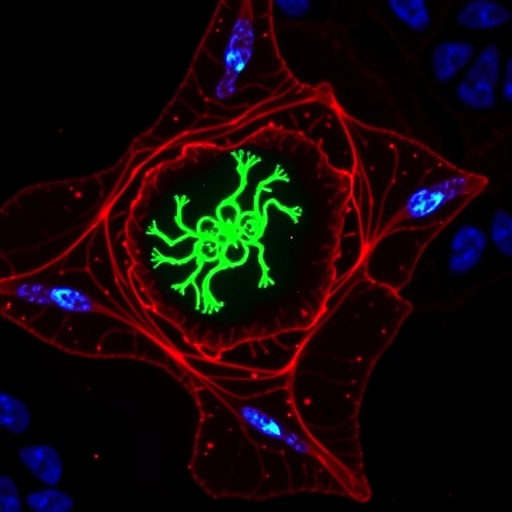
Advanced in vitro binding assays and high-resolution microscopy techniques provided compelling visual and quantitative data supporting this interaction paradigm. Notably, the use of fluorescently tagged CHMP4B allowed live-cell tracking of ESCRT recruitment dynamics, linking molecular binding events to functional membrane repair outcomes in real time.
In summary, this research demystifies a fundamental step in lysosome biology by identifying the PSAP motif of TFG as the linchpin for ESCRT-I engagement through the TSG101 UEV domain. The selective and high-affinity interaction therein triggers the assembly of ESCRT complexes essential for lysosomal membrane resealing, preserving cellular integrity amidst damage.
The implications of these findings are far-reaching, potentially informing therapeutic strategies aimed at enhancing lysosomal repair capacity or manipulating ESCRT pathway function in diseases such as neurodegenerative disorders, cancer, and infections. As the full biological significance of LASER-TFG-ESCRT interplay unfolds, this molecular insight marks a milestone in cell biology’s ongoing quest to elucidate intracellular repair pathways.
Subject of Research:
Mechanistic investigation of LASER-mediated ESCRT recruitment via TFG-TSG101 interaction in lysosomal membrane repair.
Article Title:
LASER couples damage sensing to ESCRT assembly for lysosome repair.
Article References:
Goul, C.S., Jain, A., Yitiz, S. et al. LASER couples damage sensing to ESCRT assembly for lysosome repair. Nature (2026). https://doi.org/10.1038/s41586-026-10604-6
Image Credits:
AI Generated
DOI:
https://doi.org/10.1038/s41586-026-10604-6
Tags: cellular homeostasis maintenanceESCRT polymerization mechanismLASER protein functionlysosomal damage sensorlysosomal dysfunction diseaseslysosome repair pathwaymolecular mechanisms of lysosome repairPSAP motif protein interactionrecombinant GST-tagged UEV domainsTFG protein lysosomal regulationTSG101 role in lysosome repairubiquitin E2 variant domain