In recent years, the surge in at-home fitness routines, especially during the global Covid-19 pandemic, has spotlighted a critical issue: improper exercise form leading to a significant rise in injuries. The U.S. Consumer Product Safety Commission reported a 48% increase in injuries related to at-home exercise during this period, underscoring the challenge many face without direct access to professional coaching. Addressing this gap, a pioneering team of researchers from Drexel University and Michigan State University has developed a cutting-edge prototype integrating artificial intelligence (AI), computer vision, and biomechanical modeling to offer real-time, precise exercise form coaching from streaming video footage.
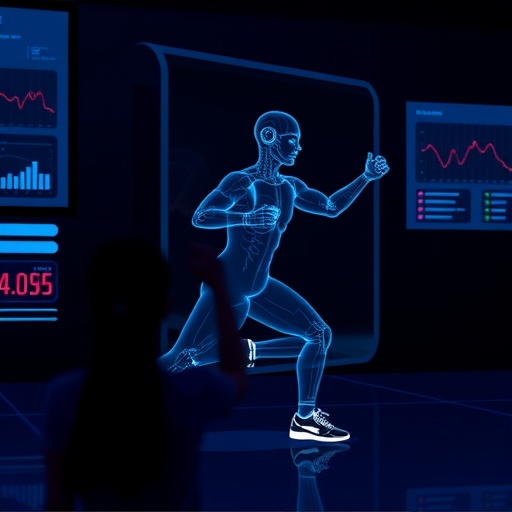
This innovative program, dubbed BioCoach, marries advanced computer vision techniques with a vision-language model, allowing it not only to analyze human movement but also to generate live, anatomical feedback during various exercises. While numerous fitness coaching apps exist, few provide the specificity and immediacy of biomechanical correction delivered by a seasoned human trainer. BioCoach aims to bridge this divide by delivering targeted, timely cues rooted in the biomechanics of body motion, effectively emulating the nuanced guidance a knowledgeable coach would provide in person.
At the heart of BioCoach lies an intricate fusion of data processing algorithms. The system employs a dual-stream analysis approach: one stream utilizes a three-dimensional convolutional neural network (3D CNN) to capture visual appearance and motion dynamics, expertly recognizing distinct objects and movements within video sequences. Concurrently, a complementary stream estimates 3D skeletal posture and body morphology, extracting quantitative joint angles, ranges of motion, and exercise-phase data. This robust combination grants BioCoach an unprecedented depth of insight into the biomechanics underlying each repetition and posture captured on video.
The development team significantly enhanced the model’s training dataset by augmenting the Qualcomm Exercise Video Dataset (QEVD), a publicly available repository containing extensive exercise footage annotated with basic coaching feedback. Recognizing the sparse nature of original annotations, which often consisted of brief comments like “lower your body more,” the researchers re-annotated over 200 videos with detailed biomechanical targets and rationales. This enriched dataset included over 2,400 meticulously crafted notes specifying precise joint angles and motion thresholds, thus grounding the language model in authentic biomechanical context and timing.
This careful re-annotation process was integral not only in elevating the model’s linguistic precision but also in enabling rigorous evaluation of its feedback timing and relevance. By preserving the temporal alignment of coaching cues with specific exercise phases, the researchers ensured BioCoach’s ability to respond not just accurately but precisely when corrections are most beneficial—mirroring the instantaneous interventions of expert trainers.
BioCoach’s capacity to provide feedback is rooted in its ability to identify key joints relevant to individual exercises. For example, during squats, the system prioritizes analysis of the hips, knees, and ankles, while for push-ups, it focuses on the shoulders, elbows, and wrists. This targeted approach ensures that feedback remains specific and actionable, avoiding generic or irrelevant comments common in many current fitness apps. Additionally, by integrating detailed body shape and movement quality metrics, BioCoach can parse subtle deviations that might indicate compensatory patterns or strain risks.
The linguistic component of BioCoach translates intricate biomechanical data into natural language coaching cues with unparalleled clarity and relevance. Unlike more superficial feedback models, BioCoach articulates the significance behind each correction, explaining why a certain adjustment matters for distributing load or preventing injury. For instance, a suggestion might not only encourage “increasing elbow flexion to 90 degrees at the bottom of a push-up” but also clarify that “this adjustment helps distribute load evenly across joint structures,” thereby fostering user understanding and compliance.
In rigorous head-to-head testing, BioCoach was benchmarked against top-tier video-language AI models developed by prestigious institutions and corporations including MIT, NVIDIA, ByteDance, Alibaba, Salesforce, OpenAI, and leading Chinese universities. The evaluation involved feeding each program a combination of original QEVD videos and the newly annotated footage, assessing the response quality based on accuracy, anatomical correctness, detailed specificity, and timeliness.
The results were compelling. BioCoach outperformed its closest competitor, Stream-VLM (a collaboration between MIT and NVIDIA researchers) in text quality and relevance when evaluated on the original dataset. More strikingly, on the enriched dataset with biomechanics-based annotations, BioCoach demonstrated substantial gains across all metrics. Its feedback was notably more biomechanically accurate and rich with anatomy-specific details, establishing new standards for AI-driven exercise coaching.
The success of BioCoach highlights the profound benefit of integrating explicit 3D kinematic data and biomechanical constraints into AI coaching frameworks. By moving beyond mere pixel-level image analysis to structured, domain-specific knowledge, the system not only generates more accurate and insightful guidance but also becomes more interpretable and dependable, critical factors for user trust and safety in fitness applications.
Looking forward, the research team envisions expanding BioCoach’s capabilities to estimate joint reaction forces and muscle activation patterns from video input. Such enhancements would empower the system to detect even subtle compensatory movements or loading imbalances that can precipitate injury over time. These improvements could revolutionize both exercise and physical therapy by supporting users in receiving continuous, expert-level feedback remotely, effectively extending the reach of human trainers into digital spaces.
Dr. Feng Liu, assistant professor at Drexel’s College of Engineering and Computing and lead for the Visual Intelligence Lab, emphasized the transformative potential of BioCoach. “Our aspirations extend beyond simple encouragement,” he explained, “to actual biomechanically grounded coaching that helps individuals exercise safely and effectively. This integration of computer vision, 3D modeling, and language understanding is poised to redefine how AI supports human movement education.”
The development of BioCoach epitomizes a new wave of AI applications that intertwine deep learning and biomechanics, heralding an era where personalized, scientific exercise coaching is accessible anytime and anywhere. With ongoing refinement, such systems could democratize expert-level fitness guidance, mitigate injury risks, and ultimately promote healthier lifestyles across diverse populations worldwide.
Subject of Research: Not applicable
Article Title: From 3D Pose to Prose: Biomechanics-Grounded Vision–Language Coaching
News Publication Date: 27-Mar-2026
Web References: http://dx.doi.org/10.48550/arXiv.2603.26938
References: Feng Liu et al., arXiv preprint, 2026
Image Credits: Drexel University
Keywords: Artificial intelligence, Computer vision, Machine perception, Image processing, Natural language processing, Three dimensional modeling, Physical exercise
Tags: AI fitness trainer appAI in sports scienceAI-powered exercise coachingat-home workout injury preventionbiomechanical modeling for exercisecomputer vision in fitnessCovid-19 fitness trendspersonalized workout guidance technologyprecise exercise form correctionreal-time biomechanical feedbackstreaming video exercise analysisvision-language models for coaching