In an experiment on how turbulent boundary layers respond to acceleration in the flow around them, aerospace engineers at the University of Illinois Urbana-Champaign observed an unexpected internal boundary layer.
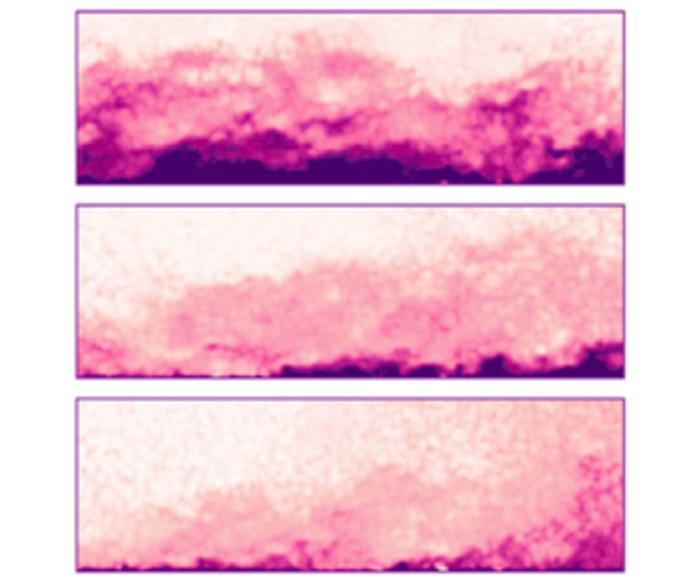
Credit: The Grainger College of Engineering at the University of Illinois Urbana-Champaign
In an experiment on how turbulent boundary layers respond to acceleration in the flow around them, aerospace engineers at the University of Illinois Urbana-Champaign observed an unexpected internal boundary layer.
“Not only were we able to identify a new internal boundary layer, but we were able to systematically track its height so we can understand its growth rate. We also noticed that it only formed if our pressure grading, our acceleration, was sufficiently strong. There was a threshold under which we didn’t see this phenomenon occurring, something that wasn’t known before,” said AE Professor Theresa Saxton-Fox.
She explained a boundary layer is a thin region of fluid where the flow is slowed down because of friction with a surface, and an internal layer is a boundary layer inside of a boundary layer, like a nesting doll.
“The internal boundary layer fundamentally changed the behavior of the flow from what would have been expected without it,” she said.
When designing a new vehicle, it is crucial to know how boundary layers will respond to the vehicle’s shape, as the response changes the forces on the vehicle. But current computer models of how boundary layers respond to curvature don’t get it right, making the design process challenging, expensive, and risky. It is important to improve turbulence models to make better predictions for novel designs.
“We can’t predict ahead of time how the flow will behave with complex geometries. That’s why we wanted to look at a number of different acceleration profiles to get a sense for not just one configuration, but 22 different shapes to get a better understanding,” she said.
According to Saxton-Fox, the basic setup of the wind tunnel experiment has been done; what’s new is that this one is easily re-configurable. This allowed them to test many geometries, in the hopes of providing data to make robust models that are accurate across a range of vehicle shapes.
Saxton-Fox and her Ph.D. student Aadhy Parthasarathy subjected a flat plate in a wind tunnel to a family of 22 pressure gradients by allowing the curvature of a small panel in the ceiling of the tunnel to buckle. This shape change creates a change in pressure which affects the acceleration of the flow, much like putting your thumb over a water hose makes the flow around the edge move faster.
She said when she first saw the internal boundary layer, she thought something was wrong. Since then, she learned others in the field had seen something similar and had the same reaction.
“They saw these internal layers forming and thought they were caused by something wrong in their experiment, and so they weren’t trusting their data. I became convinced that the layer was real because it only showed up if our ceiling was sufficiently deflected,” she said. “We hadn’t changed anything about our surface. The plate was identical. We went back to the literature. Researchers, even my adviser’s adviser, had seen it in the ‘80s but it had never been fully characterized.”
Identifying this new boundary layer is important because it will help in understanding complicated aerodynamics physics. The type of acceleration profiles generated in the study were analogous to those found in flow over airfoils and in converging /diverging nozzles.
“When the flow doesn’t follow a geometry and ignores what we asked it to do, it causes a lot of big problems such as stall. Now that we’ve seen the presence of an internal layer and how the flow separates, it can help in modeling flows and in vehicle designs.”
The research is funded by an Office of Naval Research Young Investigator Program award.
The study, “A family of adverse pressure gradient turbulent boundary layers with upstream favourable pressure gradients,” by Aadhy Parthasarathy and Theresa Saxton-Fox, is published by Cambridge University Press. DOI: 10.1017/jfm.2023.429
Journal
Journal of Fluid Mechanics
DOI
10.1017/jfm.2023.429
Article Title
A family of adverse pressure gradient turbulent boundary layers with upstream favourable pressure gradients
Article Publication Date
29-Jun-2023